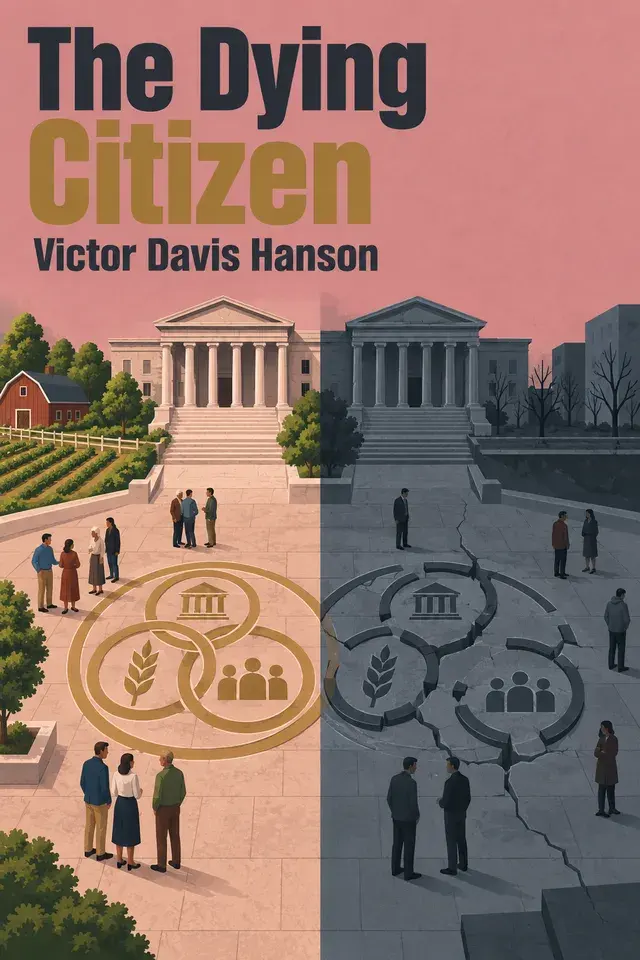
What you'll learn
Key ideas from The Dying Citizen
These ideas compress the book's argument without treating the author's view as settled fact. Use them as an orientation before reading the full work or listening in Wiseley.
Citizenship joins consent, equal standing under law, protected rights, and reciprocal duties.
Hanson links costly housing and education, stagnant wages, and debt to weaker economic autonomy and mobility.
Hanson links weak enforcement to employer demand for low-cost labor and political incentives that differed across coalitions.
Tribal loyalty organizes belonging through kinship, ancestry, religion, or community; civic membership binds people through common political rights.
Hanson describes administrative power as a loose network, not a secret cabal, and argues that its scale can outstrip elected oversight.
Global trade and technology widen consumer access and reduce poverty, while offshoring and unequal competition can concentrate job losses in particular workers and regions.
National citizenship links defined rights and duties to leaders accountable to voters; global citizenship leaves shared values and democratic authority uncertain.
Inside The Dying Citizen
Read the first chapter in full here. The other 14 continue in the Wiseley app.
Chapter 1 of 15 · 6 min · Audio & text
Citizenship As A Shared Compact
The Dying Citizen, by Victor Davis Hanson.
Citizenship, in Hanson’s opening account, is more than a passive legal status. It is a political compact linking protected rights to consent and shared responsibilities. Drawing on a framework associated with Immanuel Kant, Hanson describes three linked conditions: lawful freedom, civil equality, and independence. Citizens should live under laws they can authorize, stand equally before those laws, and rely on rights rather than a ruler’s favor. Consent does not mean that each person writes every law; in a representative republic, citizens choose officials who govern within constitutional limits. Government protects freedoms that belong to citizens; it does not grant them as personal favors.
Rights and duties complete this compact. Citizens obey statutes, honor shared customs, and contribute time and resources to their commonwealth. Hanson says they may even need to risk their safety or lives to preserve it. These obligations are not incidental burdens added to citizenship. They are part of what makes a republic a shared undertaking, rather than a set of benefits citizens receive without responsibility for their survival.
Hanson sets this ideal against much of political history, where rulers imposed order without popular consent. In his account, people under authoritarian rule often lacked inalienable rights or independent courts, and ordinary people and ruling classes could face different laws. The Greek city-states offered an early alternative: political membership could bring a voice in public decisions and protection under law. Yet access was restricted. Early oligarchies excluded the landless poor. Some later democracies broadened participation to free male residents, while continuing to exclude women and enslaved people.
For those recognized as citizens, participation had practical meaning. Men could speak in assemblies, serve on juries, pass property on to chosen heirs, and vote on war and peace. They also served in their city-state’s army, and expected the state to allow them to protect their families and farms. Rights and obligations thus met in public life: citizens helped make decisions and accepted duties in defending the political community. The example shows the promise of citizenship, even as its limited membership shows how far practice fell short of equal standing for everyone.
Hanson also points to Greek self-criticism. Drama could place women at the center of political conflicts and portray their judgment as consequential. The writer Alkidamas condemned slavery. Such arguments did not make Greek societies equal by modern standards, and Plato feared that democracy might become chaotic and tyrannical. But public debate gave citizens and observers grounds to challenge exclusions in the name of freedom and equality.
Rome carried the civic ideal into a more systematic legal order. Roman citizenship joined codified rights and responsibilities, while republican arrangements sought to check the volatility and abuses Hanson associated with radical democracy. The larger history was neither smooth nor final: citizenship’s ideals were inconsistently realized, and political development could reverse. Hanson traces a long struggle toward wider recognition, including the emancipation of the poor, women, and minority populations.
He presents the American Constitution as another experiment in consensual government and legal protection. Its framework gave later generations tools to criticize and amend the political order. But the founding was incomplete. Slavery persisted, statutory discrimination remained, and voting rights were unequal. Hanson treats public criticism, political action, and constitutional reform as opportunities to bring practice closer to the founding’s stated ideals, not as proof that those ideals had already been fully realized.
For Hanson, preserving such a compact also requires civic competence: citizens need some knowledge of the rights and institutions they share. He cites a 2017 Annenberg survey in which 37 percent of respondents could not name a First Amendment right. Only about one quarter could name all three branches of government, while one third could name none. A 2018 Woodrow Wilson survey found that nearly three quarters could not identify the original thirteen colonies; more than half did not know whom the United States fought in World War Two, and fewer than one quarter knew why colonists fought the Revolutionary War. Hanson presents these findings as signs of weak civic and historical knowledge, not as trivia. Citizens who cannot identify basic rights or institutions may find it harder to judge how well self-government is working.
The standard Hanson establishes is therefore active citizenship: people share rights and legal obligations, authorize government, and take responsibility for preserving the conditions of self-rule. The ancient examples show that participation can create civic belonging, while exclusions expose the limits of an ideal not yet applied equally. The American experiment carries that ideal forward with means for reform, but its survival still depends on citizens who understand and maintain the compact.
Chapter 2 of 15 · 7 min · Audio & textIn the app
Property And Political Independence
Hanson’s economic account of citizenship begins with a practical question: how much control does a person have over a livelihood and future? Political rights matter, but he argues that self-government also depends on citizens who are not routinely dependent on a patron or the state for their means.
Chapter 3 of 15 · 6 min · Audio & textIn the app
Debt, Work, And Family
The preceding argument linked material independence with citizenship. Here, Hanson asks what happens when ordinary routes to independence become harder to reach.
Chapter 4 of 15 · 6 min · Audio & textIn the app
California's Two-Tier Warning
California gives Hanson a regional test of the economic diagnosis developed earlier in the book. His question is what happens when a wealthy, attractive state becomes harder for ordinary households to afford, while public services and infrastructure fail to meet expectations.
Chapter 5 of 15 · 7 min · Audio & textIn the app
Residence, Borders, And Assimilation
Someone can live in a country without holding its citizenship, and a citizen can be away from home without losing membership. Hanson argues that residence describes physical location, while citizenship names a political status with rights and responsibilities.
Chapter 6 of 15 · 8 min · Audio & textIn the app
Enforcement And Civic Equality
The previous chapter draws a line between living in a country and being its citizen. Here Hanson asks how political choices, he argues, have weakened that distinction in practice.
Chapter 7 of 15 · 7 min · Audio & textIn the app
Tribalism Against Common Citizenship
Citizenship asks people who may differ in ancestry, religion, or family history to meet one another as members of a shared political community. Hanson calls tribalism a rival form of belonging: loyalty organized around kinship, blood ties, religion, and community.
Chapter 8 of 15 · 8 min · Audio & textIn the app
Race, Merit, And Shared Memory
The argument now turns from group identity in public life to the decisions institutions make about individuals. Hanson contends that equal citizenship depends on common standards, but race-conscious policies can make it harder to judge status, opportunity, and merit consistently.
Chapter 9 of 15 · 7 min · Audio & textIn the app
The Administrative State's Reach
Administrative power is a way government can shape citizens’ lives after elections are over. Career officials can write consequential rules, enforce them, and decide whether people have violated them.
Chapter 10 of 15 · 8 min · Audio & textIn the app
Resistance, Media, And Security
The preceding chapter described a permanent bureaucracy with authority beyond direct elections. Here Hanson applies that concern to the Trump years, focusing on intelligence agencies, military figures, and media allies.
Chapter 11 of 15 · 8 min · Audio & textIn the app
Constitutional Checks And Political Design
Hanson turns from threats to citizenship toward a question of design: how can citizens govern without leaving every decision to an immediate majority? He argues that the Constitution does not abolish political conflict.
Chapter 12 of 15 · 6 min · Audio & textIn the app
Rights And The Nullification Trap
Hanson treats the rights disputes in this chapter as a test of consistency. People should be able to rely on law without guessing which city they are in or which cause an official favors.
Chapter 13 of 15 · 9 min · Audio & textIn the app
Global Integration And Its Uneven Costs
Global integration can make lives materially richer and daily life more alike, yet it does not reliably create shared political commitments. Hanson treats globalism as a recurring, unstable project: people and rulers seek wider connections, but societies do not move in a straight line toward one universal order.
Chapter 14 of 15 · 8 min · Audio & textIn the app
Sovereignty, Global Citizenship, And Local Consent
Hanson’s concern turns on what makes political membership real. Citizenship joins defined rights to obligations within a community whose laws and leaders citizens can influence.
Chapter 15 of 15 · 8 min · Audio & textIn the app
Crisis, Reversal, And Renewal
The epilogue tests the book’s arguments against a short, turbulent period. Hanson says he wrote most of the book between 2018 and early 2020, then updated a few events through March 6, 2021.
Chapter 1 of 15 · 6 min · Audio & text: Citizenship As A Shared Compact
Wiseley supports reading and listening to summaries in the app.
Continue in WiseleyAbout Victor Davis Hanson
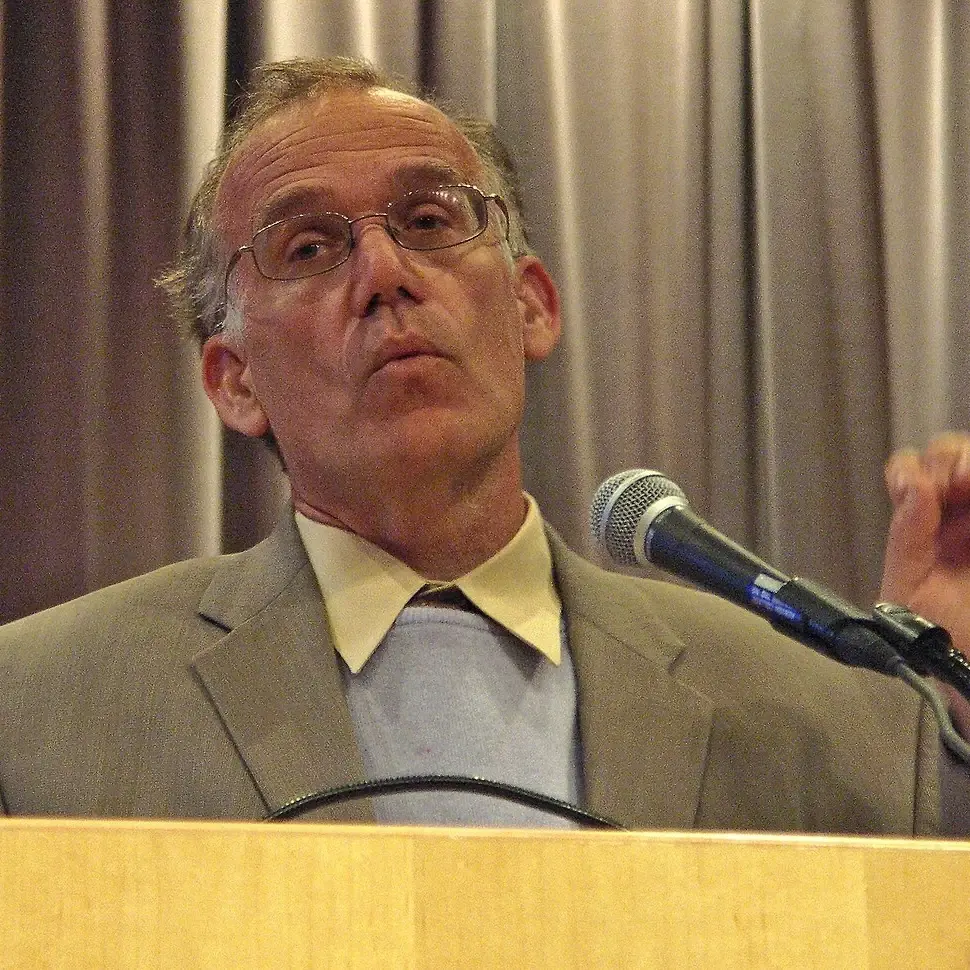
Victor Davis Hanson is an American classicist, military historian, and political commentator. “The Dying Citizen” explores what sustains citizenship when economic independence, shared identity, and national self-government come under strain.
Explore more books by Victor Davis Hanson