What you'll learn
Key ideas from The Diet Compass
These ideas compress the book's argument without treating the author's view as settled fact. Use them as an orientation before reading the full work or listening in Wiseley.
Diet claims depend on study design, what the comparison changed, who was studied, and whether the pattern fits a person’s life.
Protein can make appetite management easier without making calories irrelevant or explaining all obesity.
Large, rapidly consumed liquid sugar loads can create a different exposure from the slower, more filling delivery of intact whole fruit.
Carbohydrate quality is judged through physical form, processing, fibre, and glycaemic response rather than carbohydrate percentage alone.
Fat’s health effects depend on fatty-acid structure, the whole food, and its replacement rather than fat content alone.
Food-first reasoning treats supplements as answers to specific gaps, not universal replacements for complex nutrient packages in ordinary foods.
A sustainable rhythm can move late eating earlier while letting food quality, appetite, carbohydrate tolerance, preferences, and schedule shape meals.
Inside The Diet Compass
Read the first chapter in full here. The other 10 continue in the Wiseley app.
Chapter 1 of 11 · 9 min · Audio & text
A Compass for Dietary Evidence
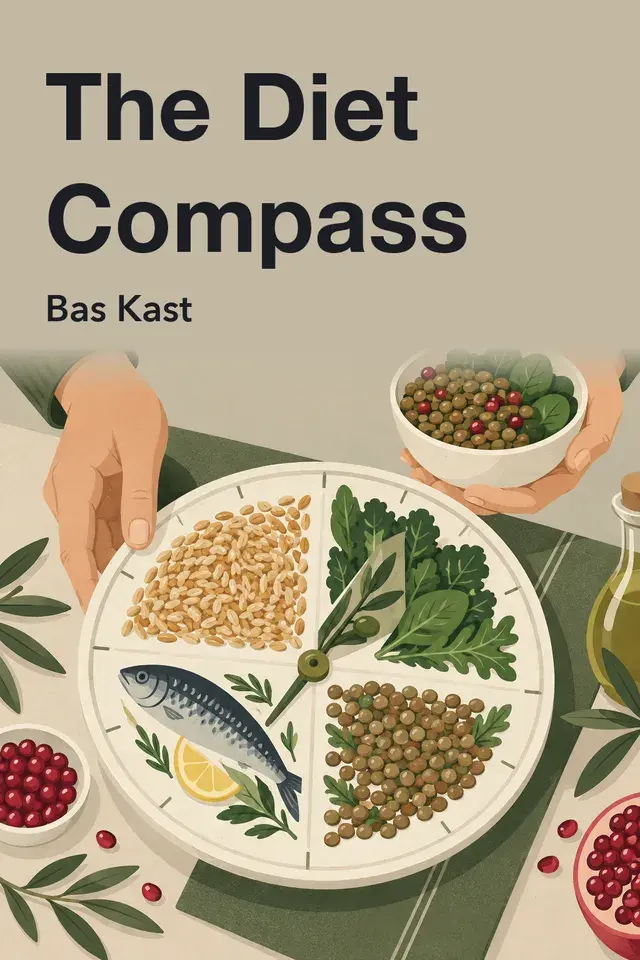
The Diet Compass, by Bas Kast.
Bas Kast begins with a practical question: how can eating support everyday wellbeing while also helping us live a longer, healthier life? Here, diet means a person’s habitual food pattern, not just a temporary weight-loss program. The book examines weight control, disease prevention, nutrition myths, and the possibility of influencing ageing.
The question became personal after Kast, an obsessive runner, began experiencing recurring chest sensations while running. Before then, he paid little attention to food and could live on coffee, chocolate, potato chips, beer, and other junk food. He stayed lean without much effort until his mid-thirties, then developed persistent abdominal weight despite running almost daily. A severe episode stopped him after less than a kilometre, and later attacks occurred during sleep. He initially resisted changing his habits or seeing a doctor. The physical breakdown eventually forced him to change how he thought about his life and diet. By then he had recently become a father, and he wondered whether he had brought on his heart problems and what would become of him if he carried on that way. That crisis sent him into years of research on nutrition, medicine, metabolism, and ageing. The account is a motivation for investigation, not a diagnosis or proof that one diet works for everyone.
Kast’s goal is broader than living longer. Lifespan is the number of years lived; healthspan is the period lived in good physical and mental health. A successful diet would ideally delay decline and compress morbidity, so illness and frailty occupy a shorter final phase instead of filling many added years. The book presents extending both lifespan and healthspan as plausible, though not guaranteed, outcomes of healthy eating. That framing changes the question from which diet makes someone thinner to which pattern may help someone function well for longer.
The competing diet camps make that question difficult. The conventional low-fat position treats fat as a problem because it is energy-dense, and it especially targets saturated fat through its proposed effects on cholesterol and cardiovascular risk. Low-fat advice often encourages bread, pasta, rice, and potatoes. Low-carbohydrate, high-fat, or LCHF, advocates reverse the emphasis. They welcome natural fats such as butter, cream, cheese, full-fat milk, olive oil, and coconut oil, while restricting sugar, bread, pasta, rice, and other starchy foods. Their case focuses on the possible problems of rapidly digested carbohydrates. Kast presents both positions as arguments with evidence behind them, not as caricatures. Each can cite mechanisms, population observations, case reports, or controlled experiments, yet they can point toward opposite plates.
His answer is to stop treating low-fat and low-carb as measures of food quality. A low-fat product may replace removed fat with refined starch or sugar. A low-carbohydrate label may also hide important differences in processing and food quality. The useful question is what replaced what. Then ask whether the whole pattern contains mostly real, nourishing foods, whether calories and appetite changed, and whether the result is sustainable. For most people, Kast argues, the proportion of carbohydrate and fat is more flexible than the quality of the foods supplying them. Some people may respond poorly to large amounts of bread, pasta, rice, or potatoes, but that possibility is not a universal verdict on carbohydrates.
Traditional Okinawa challenges the idea that a low-carbohydrate ratio is required for health. Earlier accounts describe a diet providing about eighty-five percent of calories from carbohydrates and only about six percent from fat; more recent traditional intake was still close to sixty percent carbohydrate. Older Okinawans are described as unusually long-lived and as having lower rates of several major diseases. Yet their experience cannot be reduced to carbohydrates. The comparison also includes cultural habits, possible calorie restraint, a different environment, genetics, and unknown factors. Even if the food mattered, the evidence does not isolate one macronutrient.
The Tsimané offer another carbohydrate-rich example. Their predominantly vegetarian diet is described as roughly seventy-two percent carbohydrate, fourteen percent fat, and fourteen percent protein, alongside very low apparent atherosclerosis. But Tsimané life also involves long periods of hunting and walking. They spend much of the day on their feet and less than a tenth of it sitting. Their example therefore combines food with activity, calorie use, culture, and material conditions. It cannot be transferred to a sedentary modern reader as a simple prescription to eat more carbohydrates.
The Mediterranean pattern looks different. It can provide more than forty percent of calories from fat and less than forty percent from carbohydrates, yet it is one of the book’s strongest examples of a healthy eating pattern. In research terms, it means vegetables, pulses, fruit, whole grains, nuts, olive oil, fish, modest fermented dairy, poultry more often than red meat, few sweets, herbs, and limited salt. It does not mean any large pasta meal, pizza, or fast food eaten in a Mediterranean country. Questionnaire studies associate higher adherence with lower risks of several heart and metabolic problems, but they cannot establish that specific foods caused those outcomes. Other differences may contribute.
The evidence becomes more experimental in a large Spanish intervention involving almost seven thousand five hundred people at elevated cardiovascular risk. Participants were assigned to a Mediterranean pattern or a lower-fat control. The Mediterranean groups received either olive oil or mixed nuts; the control group received no free food. The reported stroke risk was thirty-three percent lower in the olive-oil group and forty-six percent lower in the extra-nuts group than in the control group. The groups did not differ dramatically in total fat: the Mediterranean group was reported at about forty-one percent of calories, compared with thirty-seven percent in the control. Kast uses that contrast to argue that the overall food pattern mattered more than a simple high-fat label. The trial offers stronger evidence for the tested pattern and population than an observational questionnaire does, but it does not make Mediterranean eating the only healthy option.
These examples suggest a method for reading nutrition claims. First, examine the whole eating pattern rather than a single nutrient. Second, ask what the intervention replaced, because removing fat or carbohydrates says little without knowing what took their place. Third, distinguish observation from experiment: an association can be confounded, while an assigned intervention gives a clearer test of that intervention. Finally, ask how closely the participants resemble you. Okinawans and Tsimané differ from modern readers in activity, calorie intake, culture, and environment. The Spanish trial enrolled people at elevated cardiovascular risk. Each study answers a narrower question than a diet book’s headline suggests.
Evidence still has to meet a human life. A pattern that looks excellent on paper must be enjoyable and workable enough to maintain. Kast therefore favors experimentation within broadly recommendable options, followed by attention to hunger, digestion, and overall wellbeing. He gives the example of a friend who felt worse whenever she consumed too much olive oil and nuts at his house, showing why a successful population pattern may not suit every person in the same form. The compass is neither a low-fat nor a low-carb flag. It combines whole-pattern evidence with personal fit, while keeping the question, the comparison, and the limits of the evidence in view.
Chapter 2 of 11 · 9 min · Audio & textIn the app
Why Protein Changes Your Appetite
Protein can change appetite because the body needs it as building material, not only as fuel. If food supplies too little protein for its calories, eating may continue until enough protein has been obtained.
Chapter 3 of 11 · 9 min · Audio & textIn the app
Balancing Growth and Cellular Maintenance
Protein can reduce hunger and help explain the rapid initial weight loss seen with high-protein diets. But protein is more than fuel and building material.
Chapter 4 of 11 · 9 min · Audio & textIn the app
Sugar, Delivery Speed, and Liver Fat
Kast begins by separating everyday sugar from the wider carbohydrate family. In this chapter, sugar usually means household granulated sugar, whose scientific name is sucrose.
Chapter 5 of 11 · 9 min · Audio & textIn the app
Matching Carbohydrates to Your Metabolism
Carbohydrate tolerance can differ between people and can change within one person’s life. The chapter’s central point is not that low-carbohydrate eating is always best.
Chapter 6 of 11 · 12 min · Audio & textIn the app
Choosing Carbohydrates by Their Structure
The question is not simply whether a food contains carbohydrate. Kast asks what form that carbohydrate takes, how much its structure has been altered, what travels with it, and how quickly it becomes available.
Chapter 7 of 11 · 10 min · Audio & textIn the app
Fats Depend on Their Food Context
Fat is often reduced to a single verdict: good or bad, fattening or protective. Kast makes the question more precise.
Chapter 8 of 11 · 7 min · Audio & textIn the app
Omega Three as Biological Information
Food can be more than fuel. The book’s omega-three discussion makes that idea concrete: some dietary fats are burned for energy, while others become parts of cell membranes or act as signals that change what cells do.
Chapter 9 of 11 · 9 min · Audio & textIn the app
Reassessing What We Drink
Drinks invite simple labels: milk is wholesome, coffee is suspect, tea is purer, and alcohol is either medicinal or dangerous. Kast’s compass asks harder questions.
Chapter 10 of 11 · 6 min · Audio & textIn the app
When Supplements Fill a Gap
Kast begins with a presumption: people eating a varied, food-based diet generally should not need a shelf of vitamin pills. Food delivers nutrients in combinations rather than as isolated chemicals, and, as Kast puts it, our bodies get nutrients in packets.
Chapter 11 of 11 · 10 min · Audio & textIn the app
Build a Sustainable Eating Rhythm
Food quality is only part of a sustainable eating pattern. The other part is when eating happens.
Chapter 1 of 11 · 9 min · Audio & text: A Compass for Dietary Evidence
Wiseley supports reading and listening to summaries in the app.
Continue in WiseleyWhat The Diet Compass is about
What makes a diet healthy, satisfying, and sustainable for a particular person? Bas Kast examines how protein, carbohydrates, fats, and meal timing affect appetite, metabolism, and ageing. His framework connects food quality with individual responses, offering practical ways to choose foods while distinguishing promising mechanisms from established findings.
About Bas Kast

Bas Kast is a German science writer. “The Diet Compass” explores what makes a diet healthy, satisfying, and sustainable, and how food affects metabolism and aging.
Explore more books by Bas Kast