What you'll learn
Key ideas from The Dharma in DNA
These ideas compress the book's argument without treating the author's view as settled fact. Use them as an orientation before reading the full work or listening in Wiseley.
Craving and clinging can turn changing experience into distress; impermanence and non-self reveal the instability of what people try to possess.
Emptiness denies inherent existence, not conventional functioning; Madhyamaka rejects eternalism and nihilism.
Systems biology and developmental examples show reciprocal influences among genes, organisms, tissues, and bacteria.
Falsifiability makes a claim vulnerable to testing; surviving criticism gives corroboration, not proof, and no single rule cleanly separates science from pseudoscience.
DNA can move between double- and single-stranded forms, so its familiar helix depends on molecular and environmental conditions.
Sex development and racial categories resist fixed genetic rules, while specific ancestry patterns can still inform particular medical questions.
Detachment loosens commitment to hypotheses and categories, helping researchers remain open to conflicting evidence and unexpected observations.
Dependent origination and bodhicitta frame family love as arising from many conditions and extending beyond genetic kinship.
Inside The Dharma in DNA
Read the first chapter in full here. The other 9 continue in the Wiseley app.
Chapter 1 of 10 · 5 min · Audio & text
A Scientist Meets Buddhism
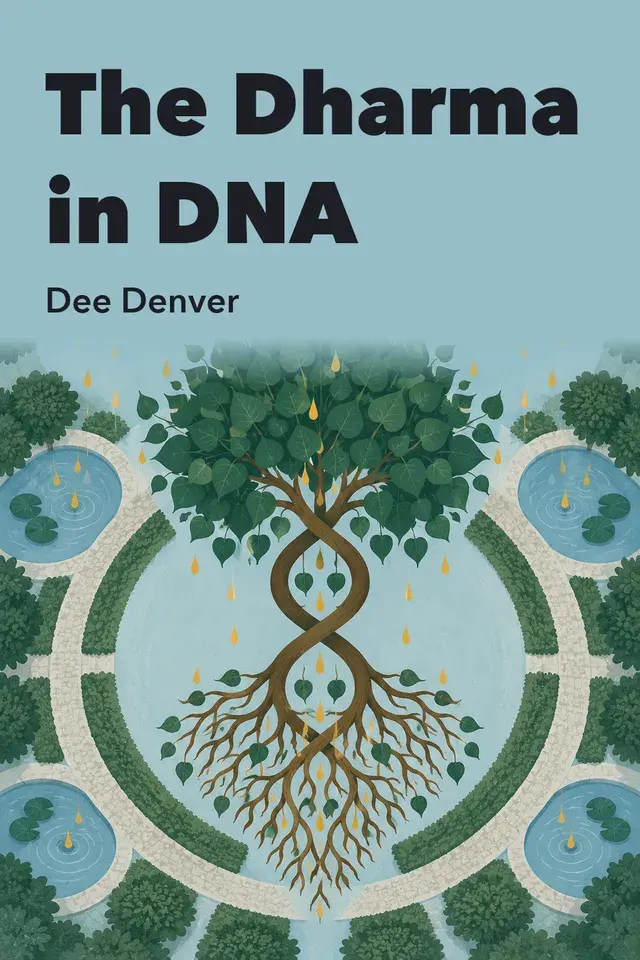
The Dharma in DNA, by Dee Denver.
The book begins with rain moving through a tree. Water gathers in clouds, falls onto the tree, enters through its roots and vessels, reaches its leaves, and returns to the air. In the story of Siddhartha, meditation beneath that tree brings a recognition: rain is tree, tree is rain, and he is both. He wakes as the Buddha. Denver uses this image to introduce interdependence before presenting an argument. It gives the reader a picture of relation and a question about what can be known by attending to it.
That question enters a book written by someone whose professional habits had pointed elsewhere. As an early-career evolutionary geneticist, Denver studied mutation through laboratory evolution experiments and DNA sequencing. He reports that his work found a mutation rate more than ten times faster than estimates in textbooks at the time. He describes professional success, but also remembers research as competitive: he wanted credit, enjoyed being right, and took satisfaction in proving others wrong. Science was not an abstract topic for him. It was his work and identity, and the source of confidence in methods that could test claims against evidence.
In 2003, while working in that environment, Denver attended an event with the Dalai Lama in Bloomington. He was an atheist, influenced in part by Richard Dawkins, and had not gone looking for a Buddhist experience. At first he was bored and dismissive. Then the Dalai Lama spoke about common ground among religions, the impermanent nature of things, their interconnection, and the need to test beliefs for truth and see truths directly. Denver heard an unexpected echo of scientific skepticism. The resemblance was not that Buddhism was simply doing science, or that shared language settled anything. What caught his attention was the possibility that both could ask a person to examine a claim instead of accepting it on authority. He began to wonder whether Buddhism offered a serious way to investigate reality, and whether science was the only legitimate route to truth. That parallel was his interpretation of what he heard, not a result established by the encounter.
He left unsettled rather than converted. Later he read a book by the Dalai Lama and other Buddhist works, then spent years privately trying to reconcile this interest with his scientific commitments. He worried that openly pursuing Buddhism could harm him professionally, and he did not know what it would mean to call himself a Buddhist. The book’s opening question comes from a tension he lived with, not from a single conversation that resolved it.
That tension also had a personal form. Denver and his wife prioritized adoption, and he recalls a deep desire to raise children who were not biologically related to him. He was studying how DNA passes between generations, yet felt little concern about passing on his own DNA. His professional focus on inheritance sat alongside a family choice that did not depend on genetic kinship. Denver says Buddhist teachings eventually helped him understand this tension. The story makes clear why questions about genes, identity, and relationship mattered to him personally.
Denver writes from several positions at once: as a student of Buddhism, an evolutionary genetics professor, and a white father raising two children adopted from Ethiopia. He wants to share what he learned at those intersections, especially with science-minded readers who may know little about Buddhism or its possible connections with science. One part of that project is to turn selected Buddhist ideas into scientific hypotheses and examine them using DNA. The opening presents this as a plan. It does not report the investigation’s results, and it does not ask the reader to treat the proposal as evidence that the ideas are true.
Denver also cautions against treating Buddhism as a single settled system. Its traditions have developed in different settings, and people approach it variously as religion or philosophy. His own encounters span different Buddhist settings, and he acknowledges that later learning sometimes showed his earlier interpretations to be incomplete or inaccurate. The ideas and terms, then, call for care rather than one uniform definition. The book begins from that uncertainty: scientific skepticism and Buddhist inquiry may challenge and inform each other, but the author has to examine what each claim means before judging how they meet.
Chapter 2 of 10 · 10 min · Audio & textIn the app
The Path Out of Suffering
In the traditional life story, Siddhartha Gautama’s path begins when a sheltered prince meets the ordinary facts of human vulnerability. On a trip beyond the palace, he sees an old person, someone ill, and a corpse.
Chapter 3 of 10 · 8 min · Audio & textIn the app
Emptiness, Names, and Compassion
An early parenting moment brought Denver to a question about names. At a meal with other adoptive parents, conversation turned to what they would call their children.
Chapter 4 of 10 · 10 min · Audio & textIn the app
A History of Scientific Crossings
An aspen grove offers a biological image of interdependence. Above ground, its trunks appear to be separate trees.
Chapter 5 of 10 · 10 min · Audio & textIn the app
Interdependence in Living Systems
This chapter asks what biology might look like when life is understood through relationships among organisms and levels of organization. The Buddhist idea of dependent arising gives that question a starting point: causes may intersect and condition one another, rather than forming a simple chain.
Chapter 6 of 10 · 9 min · Audio & textIn the app
What Counts as Scientific Evidence
Science is often taught as a neat sequence: observe something, ask a question, form a hypothesis, test it, and draw a conclusion. That outline can help organize an investigation, but it is not a universal recipe.
Chapter 7 of 10 · 9 min · Audio & textIn the app
DNA in Motion
DNA is often pictured as a stable double helix: two strands joined in a structure that seems to hold its information securely. This chapter tests that picture against three propositions: DNA changes over time, has no nature independent of its conditions and interactions, and functions through interdependent causes.
Chapter 8 of 10 · 12 min · Audio & textIn the app
Inheritance and Social Identity
DNA has become shorthand for what is inherited and for what makes a person who they are. It can help establish biological relationships, support forensic identification, and reveal how organisms are related.
Chapter 9 of 10 · 11 min · Audio & textIn the app
The Practice of Bodhi Science
A sound method can test a claim, but it cannot settle what research is for or help researchers notice every influence shaping their choices. The author calls Bodhi science a Buddhist ethical practice for inquiry, guided by selflessness, detachment, awareness, and compassion.
Chapter 10 of 10 · 7 min · Audio & textIn the app
Compassion Beyond Kinship
Near the end of the book, Denver returns to a question he has carried for years: why did he want to adopt? He describes his family of four as having coevolved over thirteen years.
Chapter 1 of 10 · 5 min · Audio & text: A Scientist Meets Buddhism
Wiseley supports reading and listening to summaries in the app.
Continue in Wiseley