What you'll learn
Key ideas from The Danish Way of Parenting
These ideas compress the book's argument without treating the author's view as settled fact. Use them as an orientation before reading the full work or listening in Wiseley.
Stress can bring inherited parental reactions to the surface as automatic defaults, even when those responses do not reflect a parent's considered intentions.
Child-directed play gives children practice coping with manageable stress and regulating emotions.
Useful feedback names meaningful effort, strategy, or improvement and can pair a setback with a practical next step.
Separating a person from a problem makes room to notice exceptions, strengths, and change.
Empathy includes understanding another person’s feelings, while acting on that understanding develops through repeated relationships and examples.
Authoritative guidance combines clear expectations with responsiveness, leaving room for questions while keeping important boundaries in place.
Hygge is an adaptable practice of present, meaningful time that people create together through ordinary routines.
Inside The Danish Way of Parenting
Read the first chapter in full here. The other 6 continue in the Wiseley app.
Chapter 1 of 7 · 5 min · Audio & text
From Stress to Deliberate Parenting
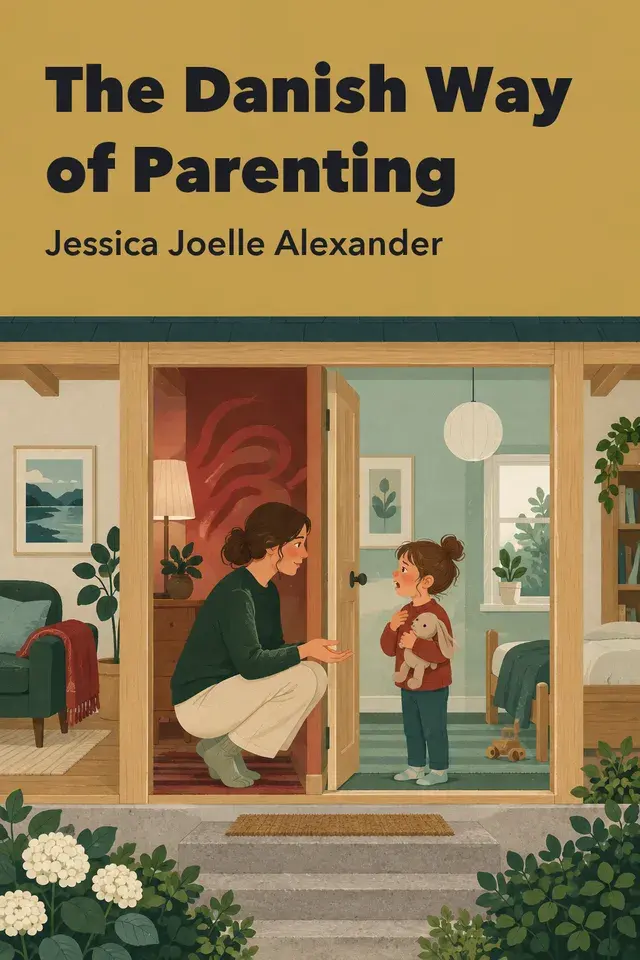
The Danish Way of Parenting, by Jessica Joelle Alexander.
The Danish Way of Parenting begins with a question: why does Denmark so often appear near the top of happiness rankings, while the United States places lower in the comparisons the authors discuss? They suggest that the way children are raised may be one part of the answer. Their theory is that children who grow up emotionally secure and resilient may become happier adults, then carry some of those habits into the next generation. Parenting is a possible contributor, not a complete explanation for a country’s happiness.
Jessica’s path into the question was personal. She turned to Danish friends and family for advice about everyday matters, from breastfeeding and discipline to education. Their answers led her to see that ways of parenting she had taken for granted were not universal. The authors describe the Danish approach as woven into ordinary culture rather than formally named. They developed their account through years of experience, research, interviews, and cultural observation.
They also set limits on the comparison. Denmark is not a utopia: it has unhappy people and problems of its own. The book offers a parenting theory, not a political argument or a guide to life in Denmark. Its observations about the United States are generalizations, not descriptions of every family or a disparagement of the country.
The contrast helps frame the pressure the authors see around parenting. They describe many US parents as feeling pushed to help children perform, excel, and look successful. In this competitive culture, parents can feel pressure, high stress, and judgment, while they may also pressure children to perform. Under pressure, parents may fall back on familiar ways of reacting, even when those reactions are not what they would choose after reflection.
The authors call these reactions default settings. They are often learned in our own upbringing and can surface when we are exhausted, stressed, or at our limit. A familiar response may feel like common sense simply because we have seen it before. But a parent can notice the pattern and decide which habits to keep and which to change. That awareness is the first step toward choosing how a child experiences the moment.
Jessica illustrates this with a street crossing. Her son moved toward the crossing, and she repeatedly called for him to stop. When he did not, she chased him, grabbed him, and shook him. Then she noticed her own reaction. She paused and explained the danger calmly, in terms her son could understand. Later, at another crossing, she saw him stop. The story shows both the force of an automatic reaction under stress and the possibility of interrupting it. It does not make one calm explanation a guarantee; it shows a different response and a later moment when her son acted safely.
This self-awareness opens the book’s larger framework, summarized by PARENT: play, authenticity, reframing, empathy, no ultimatums, and togetherness. Togetherness includes hygge, or coziness. The mnemonic previews the six practices; each has its own explanation and examples later in the book. Here the starting point is the parent’s attention to their own habits.
A reader can begin with three questions in a tense moment: What triggered me? What am I about to do automatically? What deliberate response fits the situation and the kind of example I want to set? The answer may be to keep a familiar habit or to practice another one. The authors present this as active work that takes awareness, patience, and practice, not an instant change in personality. The point is not to respond perfectly every time, but to create a pause in which a choice becomes possible. From there, the book moves from noticing defaults toward the six practices that may shape children’s everyday experience.
Chapter 2 of 7 · 10 min · Audio & textIn the app
Play Builds Room for Resilience
Free play is time when children choose what to do and how long to do it, alone or with other children. It differs from lessons, organized sports, and activities directed by adults.
Chapter 3 of 7 · 7 min · Audio & textIn the app
Honesty, Effort, and Growth
Authenticity, in Alexander’s account, begins with allowing feelings to be real. Children need room for pleasant emotions such as joy and contentment, and for anger, frustration, sadness, and fear.
Chapter 4 of 7 · 8 min · Audio & textIn the app
Reframing Without Denial
A setback can feel like a complete story when we see only its worst detail. A child has one bad game, a friend acts unkindly, or a difficult task goes wrong, and the first thought may be, “I always fail,” or “That person is mean.”
Chapter 5 of 7 · 9 min · Audio & textIn the app
Empathy Grows Through Relationship
Empathy is the capacity to recognize and understand another person’s feelings, feel what that person feels, and imagine an experience from that person’s point of view. But understanding what someone feels and choosing how to respond are different skills.
Chapter 6 of 7 · 8 min · Audio & textIn the app
Firm Boundaries Without Ultimatums
Respecting a child does not mean removing adult guidance. Children need limits, and adults remain responsible for safety and family expectations.
Chapter 7 of 7 · 7 min · Audio & textIn the app
Belonging Through Everyday Hygge
Hygge is often described as a cozy feeling, but the authors also present it as something people make together. It means choosing simple, meaningful time with others, creating a pleasant atmosphere, and being present enough to contribute to it.
Chapter 1 of 7 · 5 min · Audio & text: From Stress to Deliberate Parenting
Wiseley supports reading and listening to summaries in the app.
Continue in WiseleyAbout Jessica Joelle Alexander

Jessica Joelle Alexander is the author of “The Danish Way of Parenting”. The book explores how everyday parenting can help children grow more resilient, empathetic, and self-reliant.
Explore more books by Jessica Joelle Alexander