What you'll learn
Key ideas from The Daily Dad
These ideas compress the book's argument without treating the author's view as settled fact. Use them as an orientation before reading the full work or listening in Wiseley.
Children absorb everyday conduct, including the behavior parents show in private and under pressure.
A child’s belonging does not depend on good behavior, agreement, or achievement.
Children experience parental care through ordinary attention and dependable time; possessions cannot take a parent’s place.
A pause lets parents consider a child’s limited experience and look for the need beneath the behavior.
Questions about effort, honesty, kindness, and helping others show what parents count as success.
Everyday choices give children practice deciding, while experienced adults continue to advise and protect them.
Resilience grows through manageable difficulty when children have room to try and a parent remains available to guide them.
Childhood changes in ways parents cannot reverse, giving ordinary shared time value while it is happening.
Inside The Daily Dad
Read the first chapter in full here. The other 11 continue in the Wiseley app.
Chapter 1 of 12 · 6 min · Audio & text
Children Learn What We Live
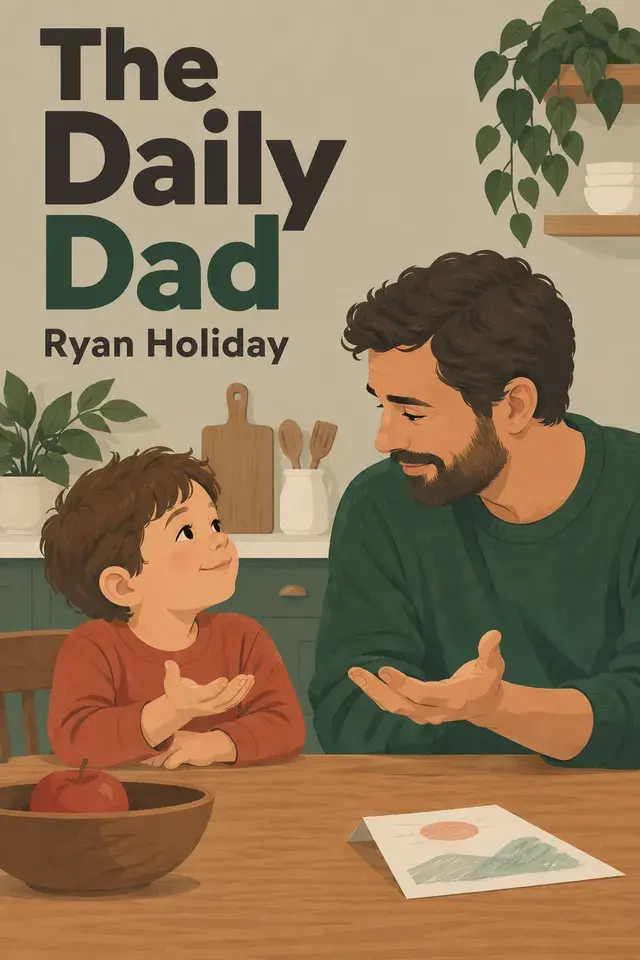
The Daily Dad, by Ryan Holiday.
Children learn a great deal by watching what their parents do. A rule can be explained in words, but a child also sees how an adult behaves when tired, frustrated, embarrassed, or under pressure. The small, repeated scenes of family life become lessons about what is normal. A parent’s example may last longer than any single lecture because children encounter it again and again, often without anyone naming it as a lesson.
That is why private conduct matters. A boy who had gone to study in Plato’s house heard his father yell when he returned home to visit his parents. Surprised, he said he had never seen anyone act that way at Plato’s house. The story captures how a child may take a parent’s usual behavior as the standard, then notice when the parent breaks it. Children can absorb how adults treat a spouse, speak about other people, respond to the world, or handle anger. Remarks and jokes matter too. Even when adults say they did not mean what they said, children may still take in the judgment behind it.
The same principle applies to everyday rules. A parent who tells a child to be honest but lies to avoid a ticket teaches two standards: one spoken, another practiced. Speeding through a stop sign while telling a child to be careful sends a similar mixed message. Children see whether care, respect, and honesty guide the adult’s own choices. When actions and advice agree, the value becomes something a child can observe in use.
The book illustrates this with Margaret Thatcher’s father. After losing office, he responded with composure. His example showed that a person need not be defined by a change in circumstances or answer disappointment with retaliation. A personal code can guide a response even when circumstances hurt. For a child watching, restraint is not an abstract virtue to memorize; it is a way of meeting a difficult moment. The example leaves a question for any parent: what does my response teach when events do not go my way?
Parents pass on more than deliberate lessons. Children may pick up virtues and flaws, along with patterns of fear, anger, or hurt that adults have not examined. The point is not to blame parents for every difficulty a child faces. It is to recognize that an unresolved pattern can become familiar in the next generation. Honest self-examination gives a parent a chance to understand what they are displaying and to work on what they do not want to pass along. That work can include seeking help, reading, or having honest conversations. The goal is not to erase the past by force, but to avoid handing its burdens forward unchanged.
A parent can make this idea practical by asking what a child sees in ordinary situations. Volodymyr Zelenskyy suggested placing photos of one’s children where consequential decisions are made. The reminder brings a child’s future, safety, and freedom into view at the moment an adult chooses. The gesture points beyond high-stakes decisions, too: a parent can pause over a daily choice and consider whether it reflects the future they hope to help create.
A useful daily audit is simple. What did my behavior teach today? Did I act by the standards I ask of my child? Did the way I drove, spoke about someone, or handled a disappointment show the care and honesty I claim to value? This is not a demand to scrutinize every gesture or to turn family life into a performance. It is a way to notice the gap between belief and habit, then bring the two closer through action. Dietrich Bonhoeffer’s grandmother, for instance, acted on her convictions by continuing to shop at Jewish businesses despite a boycott. The example made a value visible in a concrete choice.
If a child repeats something hurtful or irresponsible, a parent can ask whether the child has seen that behavior at home. That question does not excuse the child’s choice. It can reveal that the parent has modeled or tacitly accepted the same conduct. The response then begins with taking responsibility for one’s part and showing a different way forward. Children are more likely to understand a standard when they see an adult trying to live by it, including when that effort requires admitting a mistake.
No parent will model well in every moment. People lose their temper, lose sight of their priorities, or fall short of their own advice. One failure does not have to become the final lesson. A parent can acknowledge what happened, consider what it showed, and recommit to doing better. The book’s daily approach rests on that return: not perfect performance, but repeated attention and effort.
Parents influence children, but they do not control who children become. Children do much of their own growing, and they deserve credit for the work and choices that shape their lives. A parent’s example may not be understood right away; it may matter much later. The responsibility is to keep practicing the values one hopes to pass on, while leaving room for a child’s own path. In this view, teaching begins less with demanding a particular character than with living the example a child can carry forward.
Chapter 2 of 12 · 5 min · Audio & textIn the app
Love Without Conditions
Children need to know that affection is not a prize for behaving well. They may make choices their parents fear, disappoint them, or fail at something important.
Chapter 3 of 12 · 5 min · Audio & textIn the app
Make Presence the Priority
A parent can provide a comfortable life and still leave a child feeling that work gets the parent’s attention first. Money can make some things easier and pay for useful help, such as childcare or tutoring.
Chapter 4 of 12 · 6 min · Audio & textIn the app
Pause Before You React
A parent can bring the strain of work, a difficult conversation, or a bad day through the front door. A brief pause between outside pressures and family life can help.
Chapter 5 of 12 · 6 min · Audio & textIn the app
Teach Character Through Conduct
Grades, victories, talent, and recognition can all matter, but they do not tell the whole story of a life. The deeper question is what kind of person a child is becoming.
Chapter 6 of 12 · 6 min · Audio & textIn the app
Care for the Caregiver
Parenting asks for attention and patience day after day, but those qualities draw on a parent’s health, energy, and support. Children may not understand the pressures adults carry.
Chapter 7 of 12 · 7 min · Audio & textIn the app
Guide Without Taking Over
Parents inevitably shape a child’s life, but they do not own it. A parent’s hopes can quietly become a plan for who the child should be: a continuation of the parent, a source of pride, or someone who chooses the paths the parent approves.
Chapter 8 of 12 · 7 min · Audio & textIn the app
Encourage Without Owning Their Dreams
Children encounter ambitions and opportunities before they can know how they will turn out. A parent cannot choose a child’s direction or promise success.
Chapter 9 of 12 · 6 min · Audio & textIn the app
Curiosity Opens the Wider World
Believing in a child’s potential matters, but that belief needs a world of ideas to meet. Parents cannot choose a child’s innate abilities or guarantee genius.
Chapter 10 of 12 · 7 min · Audio & textIn the app
Let Struggle Build Capability
A parent cannot remove every difficulty from a child’s life. Trying to do so can also keep a child from discovering what they can manage.
Chapter 11 of 12 · 6 min · Audio & textIn the app
Gratitude and the Family Bond
Family closeness can be mistaken for something guaranteed by kinship: people belong to a family, so connection is assumed. Holiday treats it as a relationship people build through ordinary exchanges.
Chapter 12 of 12 · 6 min · Audio & textIn the app
Spend the Time You Have
Time passing rarely announces itself. It leaves small evidence: clothes that no longer fit, shoes that need replacing, another haircut, a child moving into a new season of life.
Chapter 1 of 12 · 6 min · Audio & text: Children Learn What We Live
Wiseley supports reading and listening to summaries in the app.
Continue in WiseleyAbout Ryan Holiday

Ryan Holiday is an American author who connects Stoic philosophy with contemporary life. His books, including The Obstacle Is the Way and Ego Is the Enemy, explore resilience, self-discipline, and our responses to adversity.
Explore more books by Ryan Holiday