What you'll learn
Key ideas from The Culture Code
These ideas compress the book's argument without treating the author's view as settled fact. Use them as an orientation before reading the full work or listening in Wiseley.
Group performance emerges from interaction patterns, so individual credentials alone cannot explain collective results.
Belonging grows through repeated cues that answer whether people are connected, share a future, and feel safe.
A vulnerability loop grows through signaling, recognition, reciprocal response, and recognition of that response.
Immediate, enlisted-led After-Action Reviews built a shared account of decisions and lessons without reducing discussion to credit or blame.
Shared purpose stays active when leaders revisit their values and connect them to visible signals and stories.
Creative work advances through successive drafts when teams keep ownership and have candid ways to examine unfinished ideas.
Inside The Culture Code
Read the first chapter in full here. The other 9 continue in the Wiseley app.
Chapter 1 of 10 · 6 min · Audio & text
The Group Is Built in Interaction
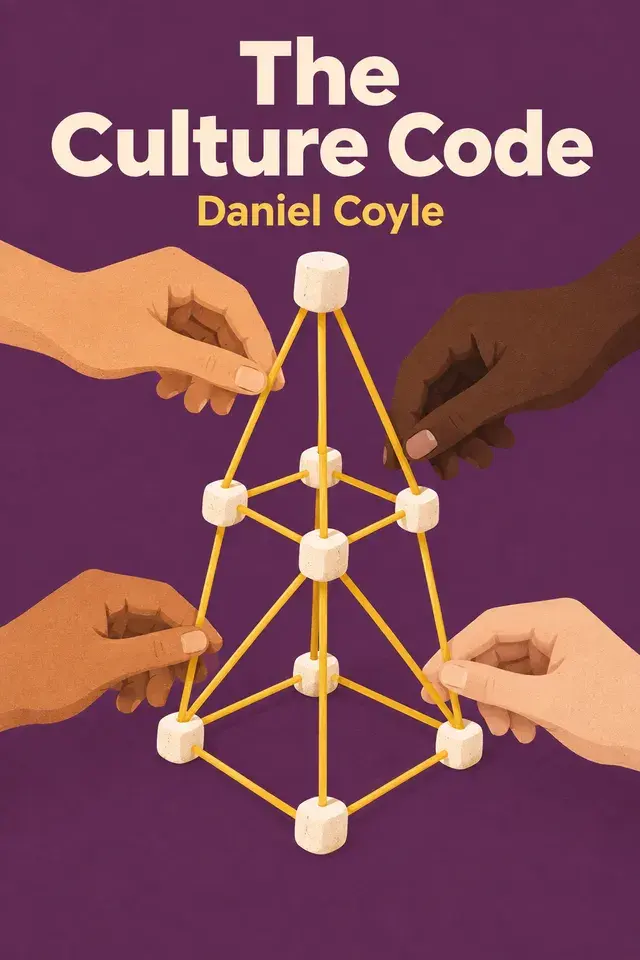
The Culture Code, by Daniel Coyle.
Why can one group produce more than the sum of its members, while another struggles to combine capable people? Daniel Coyle begins with a challenge that makes the difference visible: build the tallest tower you can from spaghetti, with a marshmallow at the top. The task seems simple, but success depends on how people work together while figuring it out.
In dozens of trials, kindergartners outbuilt business students. Their approach could look disorderly: they started quickly, tried ideas, watched what happened, and adjusted. They stayed close and helped one another. If a tower sagged, they could try another arrangement without first settling who had authority or whose idea deserved credit. Coyle also reports that the children outperformed teams of lawyers and chief executives in a comparison.
The business students often looked more polished. They discussed the task and managed the group’s process, but their attention drifted toward status: who would lead, what the rules should be, and whether it was acceptable to criticize an idea. That hesitation left less time for learning from the materials. A plan that ignored the marshmallow’s weight or the spaghetti’s instability could sound reasonable and still fail.
The contrast raises the book’s central question. Individual intelligence, skill, or experience does not automatically turn into strong group performance. What matters is also the pattern of interaction: whether people can offer an idea, test it, notice a problem, and build on someone else’s contribution. Coyle describes culture in these observable terms—as something people repeatedly do together, not a fixed trait a group simply possesses.
His starting point is a set of deliberately successful groups. Coyle says he studied eight groups across different fields and also looked at unsuccessful cultures to reduce the risk of drawing conclusions only from winners. The aim is to understand what members do that helps a group perform, rather than treating its reputation or members’ credentials as the explanation.
A more unsettling demonstration comes from researcher Will Felps. He placed an actor named Nick into forty four-person startup-marketing groups. In each group, Nick played one of three roles: a Jerk, who was hostile; a Slacker, who withheld effort; or a Downer, who dampened the group’s energy. The roles differed, but their effect was similar. In almost every group, performance fell by thirty to forty percent.
The damage spread through ordinary responses. A Downer could make energetic members tired and withdrawn. When Nick acted like a Slacker, groups sometimes finished quickly with poor work, then found reasons to accept the result. Most members did not confront him. Instead, they began acting as though the project did not matter, too. One person’s behavior had changed what the rest of the group expected from one another.
One group responded differently. A member named Jonathan met Nick’s negativity with attention rather than escalation. He asked inclusive questions, listened to people’s answers, and steered attention back toward the shared work. He did not take command, lay out a strategy, or deliver a motivational speech. His small responses helped other members stay engaged and contribute. The group remained productive despite Nick’s behavior.
For Coyle, this contrast shows that group culture is made in interaction. Members’ behavior can either spread withdrawal or help restore connection. Jonathan’s group was not presented as succeeding because its members were smarter. Its members had a safer setting in which to work: their contributions were noticed, and they could keep responding to one another.
Coyle calls the small, recurring signs of connection belonging cues. Attention, eye contact, listening, turn-taking, and inclusive questions can signal that people are safe and included. The point is not that a single gesture guarantees trust. Rather, group life is shaped by repeated signals that members are engaged with one another. Later chapters examine how those signals accumulate and how leaders can shape them.
Research discussed in the book also suggests that social signals influence how people evaluate a group’s work. In a business-pitch study, sociometers tracking cues exchanged by presenters and executives predicted the executives’ rankings with nearly perfect accuracy. In a separate step, angel investors who viewed the plans on paper ranked them very differently. This suggests that social signals can shape live evaluations without making the plans’ informational content irrelevant.
The book develops this starting point through three capacities: building safety, sharing vulnerability, and establishing purpose. Together, they describe how connection can make contribution and coordination possible. The first step is to notice the group itself: not only who its members are, but what their repeated interactions make possible.
Chapter 2 of 10 · 9 min · Audio & textIn the app
Belonging Through Repeated Signals
Belonging grows through signals that accumulate over time. Coyle frames those signals around three questions: Are we connected?
Chapter 3 of 10 · 6 min · Audio & textIn the app
Care Makes Candor Possible
Gregg Popovich’s San Antonio Spurs present a puzzle. On the court, they were known for extra passes, alert defense, movement, and hustle that put the team ahead of individual display.
Chapter 4 of 10 · 8 min · Audio & textIn the app
Design the Social Greenhouse
Leaders can make belonging easier before anyone says a word. Tony Hsieh approached culture as a set of conditions people could shape.
Chapter 5 of 10 · 8 min · Audio & textIn the app
Vulnerability Creates Cooperation
Trust is often treated as something people need before they can work together. But cooperation can also begin the other way around: someone signals a limit or need, another person recognizes it and responds, and trust grows from that exchange.
Chapter 6 of 10 · 6 min · Audio & textIn the app
Practice a Shared Team Brain
The previous chapter described how vulnerability can invite cooperation. This one asks what happens when people practice that exchange repeatedly.
Chapter 7 of 10 · 8 min · Audio & textIn the app
Listening and Candor Under Pressure
Dave Cooper’s strength, as Daniel Coyle presents it, was building teams that could think and work together when conditions deteriorated. In Team Six, he was neither the smartest nor the strongest team member, and he was not the best marksman or swimmer, nor the best at close-quarters combat.
Chapter 8 of 10 · 9 min · Audio & textIn the app
Purpose That Directs Action
A group cannot send every uncertain choice up a chain of command. Its members may face different problems, spread across many places, and need to act before anyone can supervise them.
Chapter 9 of 10 · 8 min · Audio & textIn the app
Rules for Reliable Excellence
A team’s starting reputation tells you less than how quickly it learns. For work that depends on reliable performance, culture shows up in the signals people exchange as they prepare, act, and improve.
Chapter 10 of 10 · 8 min · Audio & textIn the app
Build Systems for Creative Work
Some work asks a team to reach a known standard reliably. That kind of proficiency benefits from clear routines and repeated practice.
Chapter 1 of 10 · 6 min · Audio & text: The Group Is Built in Interaction
Wiseley supports reading and listening to summaries in the app.
Continue in WiseleyAbout Daniel Coyle

Daniel Coyle is an American author. “The Culture Code” explores how groups turn individual talent into collective performance through safety, shared vulnerability, and purpose.
Explore more books by Daniel Coyle