What you'll learn
Key ideas from The Cold War
These ideas compress the book's argument without treating the author's view as settled fact. Use them as an orientation before reading the full work or listening in Wiseley.
Wartime upheaval made US–Soviet tension possible; their choices and conflicting aims made it endure.
The Berlin blockade and airlift, divided German states, and NATO turned growing mistrust into a territorial and institutional split.
China’s Communist victory arose chiefly from Chinese political and military conditions, though US aid, Soviet interests, and global interpretations shaped its consequences.
Korea’s failed reunification efforts became a wider war after US intervention and China’s entry, ending in an armistice that restored much of the original division.
Postcolonial leaders used alignment and nonalignment to pursue security, aid, autonomy, and domestic political goals.
Détente managed some risks without ending the arms race or rivalry in the Third World.
Gorbachev’s rejection of force enabled the 1989 revolutions, while McMahon identifies acceptance of a united Germany in NATO in 1990 as the Cold War’s end.
Inside The Cold War
Read the first chapter in full here. The other 11 continue in the Wiseley app.
Chapter 1 of 12 · 8 min · Audio & text
A World Shattered, Visions Diverge
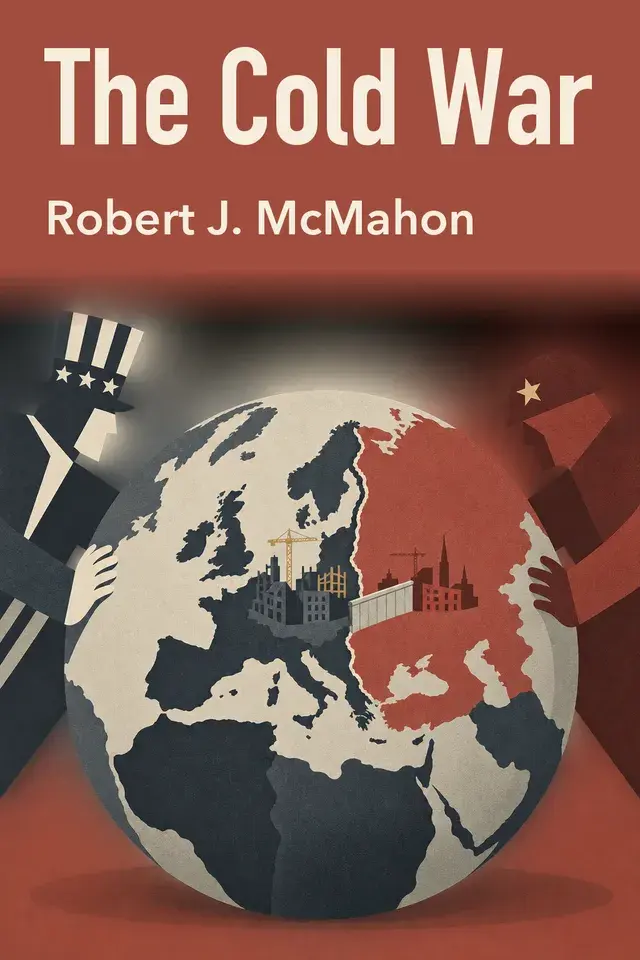
The Cold War, by Robert J. McMahon.
Robert J. McMahon approaches the Cold War as an international confrontation that ran from 1945 to its final denouement in 1990. He presents a compact interpretation, not a comprehensive account or definitive last word. He also gives military matters less attention, in part because separate volumes address the Korean and Vietnam wars. The starting problem is how a world shattered by war became a setting for prolonged rivalry between two powers with different ideas of security and order.
The human cost is staggering, though no exact total can be established. McMahon gives an approximate toll of 60 million deaths, about two-thirds of them noncombatants, and stresses that the number cannot be statistically precise. Destruction reached cities, industry, farmland, and communities across Europe and Asia. The Soviet Union alone suffered at least 25 million deaths, while millions more people were left homeless or uprooted. These figures convey the scale of the upheaval, not a precision the evidence cannot support.
The war also overturned the international order that had centered on Europe for roughly five centuries. The United States and Soviet Union emerged with most of the world’s military, economic, and diplomatic power. Both recognized the need to restore authority and stability amid economic distress and political unrest. In that sense, suspicion and tension were unsurprising: an established balance had collapsed, and the two strongest states had to shape what followed. But upheaval explains why conflict became possible, not why it acquired such reach or lasted so long. Other great powers have sometimes compromised to create an order that serves their basic interests. The failure of such cooperation is part of the explanation here.
The American starting point combined confidence with insecurity. The United States had suffered relatively moderate losses, and many American civilians experienced wartime prosperity. Yet Pearl Harbor had weakened the belief that oceans alone could protect the country. Planners concluded that air power and technology made distant threats harder to keep at bay. They wanted overseas bases and transit rights that would let the United States project power and deter danger before it reached American shores. A 1946 list of sites considered essential stretched across regions, naming Burma, Greenland, Cuba, and the Azores among many others. This far-reaching network reflected a conception of security that extended well beyond the homeland.
American leaders also linked military security to economic order. They feared that a hostile power controlling Europe and East Asia could command territory, resources, industry, and strategic positions that would shift the global balance. In their view, security therefore depended on preventing such dominance and sustaining a strong American role. They also argued that freer trade, equal investment opportunities, stable exchange rates, and currency convertibility could support peace. The 1944 Bretton Woods program, including the International Monetary Fund and World Bank, gave institutional form to that vision. The United States stood to benefit as the leading capitalist economy, so national interests and ideals were intertwined. Many Americans believed their country had a special duty to build a peaceful, prosperous order. They did not always recognize how that universal ambition might conflict with other states’ interests.
Soviet leaders approached security from a far more traumatic recent experience. The German invasion of 1941 had devastated Soviet families, cities, industry, and agriculture; earlier incursions reinforced the determination to prevent another breach of Soviet territory. Geography made the concern concrete. European Russia was vulnerable through the Polish corridor, and Stalin regarded Poland as essential to Soviet safety. He pointed out that German armies had invaded through Poland twice within twenty-five years. A strong, friendly Poland, in his view, could help block that route. The demand for a buffer was therefore connected to a specific memory of invasion and a particular geography, not simply to an abstract desire for territory.
That security logic nevertheless carried demands that alarmed others. Soviet leaders wanted friendly governments in strategically important neighboring states and sought influence over territory around their borders. Stalin was convinced that Germany would recover quickly and again threaten the Soviet Union. Yet the Kremlin’s choices were constrained by the war’s damage to Soviet manpower, resources, and industry. Soviet leaders wanted time and Western assistance for reconstruction, recognition as a great power, and continued cooperation with the United States and Britain. Those needs limited how far they could press their advantages without risking the support they still wanted. McMahon cautions against explaining Soviet policy as either Stalin’s personality alone or a simple drive to spread communism: state interests usually came first, and Stalin could act cautiously when the balance of power required it.
Ideology formed another part of the divide. Soviet leaders drew confidence from Marxist-Leninist beliefs that history favored socialism and that conflict between capitalist and socialist systems was inevitable. That conviction could encourage patience when the Soviet Union was weaker, but it could also distort how leaders interpreted other societies. American leaders, meanwhile, saw an open economic order and their own country’s power as instruments for advancing peace and freedom. Both societies could understand their national project as serving universal purposes. The practical comparison is therefore not security versus ideology, or economics versus power: the three dimensions overlapped. American openness could appear to Moscow as a plan for an order shaped by US strength, while Soviet demands for a protective buffer could appear to Washington as an expansion of control.
The war created the conditions for tension: immense destruction, a broken old order, and two powerful states with different security needs and visions of the future. Those conditions did not make a prolonged Cold War inevitable. The rivalry endured because each side pursued an order it considered legitimate and necessary, while its choices threatened the other’s assumptions and interests. That distinction—between circumstances that made conflict possible and political aims that made cooperation fail—sets up the story that follows.
Chapter 2 of 12 · 10 min · Audio & textIn the app
The Grand Alliance Frays
The wartime alliance had been held together by the need to defeat Nazi Germany, not by agreement about the peace that would follow. At Yalta, the leaders still found room for compromise, but the bargains were conditional and left their central disputes unresolved.
Chapter 3 of 12 · 7 min · Audio & textIn the app
Japan and China’s New Order
As rivalry hardened in Europe, it also entered East Asia, where the old order was already breaking apart. Japan’s wartime conquests had temporarily toppled Western colonial rule and weakened its claims to authority.
Chapter 4 of 12 · 8 min · Audio & textIn the app
Asian Hot War, European Stalemate
The Cold War did not spread into Asia simply because Washington and Moscow carried their rivalry overseas. In Southeast Asia, independence struggles began in conflicts over who would govern after colonial rule.
Chapter 5 of 12 · 10 min · Audio & textIn the app
Influence, Interventions, Nuclear Risk
By the mid-1950s, Europe’s division had become comparatively stable. Both sides had reason to avoid a major conflict there because it could become nuclear.
Chapter 6 of 12 · 11 min · Audio & textIn the app
Brinkmanship at the Edge
Between 1958 and 1962, disputes over small territories repeatedly became tests of superpower resolve. Leaders worried that retreat would weaken alliances or expose them to domestic criticism.
Chapter 7 of 12 · 7 min · Audio & textIn the app
Vietnam’s Costly Commitment
By 1963, Washington and Moscow had begun a partial rapprochement after the Cuban crisis. Vietnam put that improvement under strain.
Chapter 8 of 12 · 5 min · Audio & textIn the app
Agency in the Postcolonial World
Decolonization unfolded inside a Cold War that shaped the options available to newly independent states. Dozens of countries emerged from colonial rule, and their leaders sought security, international standing, military assistance, and resources for development.
Chapter 9 of 12 · 11 min · Audio & textIn the app
Life Across the Blocs
From 1945 to 1990, the Cold War reached into politics, work, and ordinary life. But it did not cause every major change of those decades, and its effects were far from uniform.
Chapter 10 of 12 · 8 min · Audio & textIn the app
Détente as Risk Management
By the late 1960s, the United States and the Soviet Union had reasons to put more rules around their rivalry. Détente meant a more stable and cooperative relationship, pursued through arms control, diplomacy, and exchanges.
Chapter 11 of 12 · 8 min · Audio & textIn the app
The Bargain Comes Apart
Détente did not mean the same thing in Washington and Moscow. Many Americans expected agreements and summitry to bind the Soviet Union more closely to the existing international order.
Chapter 12 of 12 · 9 min · Audio & textIn the app
Reform, Rapprochement, and Endings
The final phase did not begin as a steady march toward peace. Ronald Reagan entered office in 1981 promising to rebuild American power and rejecting the idea that the Soviet Union could be treated as an ordinary state.
Chapter 1 of 12 · 8 min · Audio & text: A World Shattered, Visions Diverge
Wiseley supports reading and listening to summaries in the app.
Continue in Wiseley