What you'll learn
Key ideas from The Chemistry Book
These ideas compress the book's argument without treating the author's view as settled fact. Use them as an orientation before reading the full work or listening in Wiseley.
Practical crafts changed and separated materials long before chemistry had a systematic theory of matter.
The mole connects a fixed particle count to a measurable mass, making reaction ratios usable in laboratory quantities.
Molecular energy distributions help explain bulk behavior and reaction rates, while equilibrium shifts when pressure, temperature, or product levels change.
Chromatography separates mixture components through differing interactions with moving and stationary phases, including chiral phases that can resolve mirror-image molecules.
Polymer properties depend on how repeating units form chains, networks, and differently branched structures.
The sulfanilamide and thalidomide disasters exposed limits in formulation, safety testing, and predictions across species.
Hydrogen storage and artificial photosynthesis remain open engineering problems involving energy, safety, accessible materials, catalyst durability, and scale.
Inside The Chemistry Book
Read the first chapter in full here. The other 12 continue in the Wiseley app.
Chapter 1 of 13 · 9 min · Audio & text
Chemistry Before Its Name
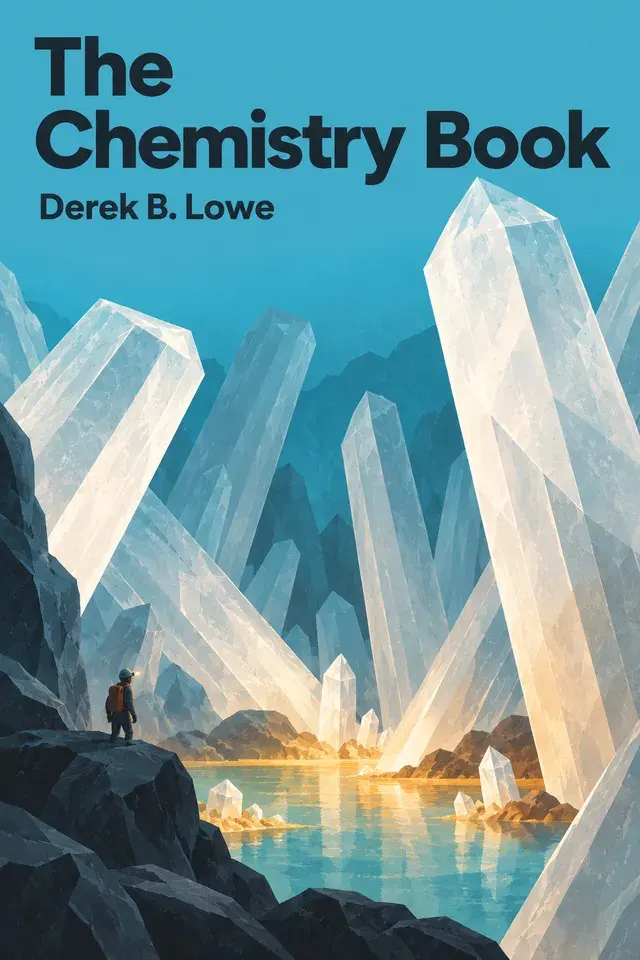
The Chemistry Book, by Derek B. Lowe.
Long before chemistry became a systematic science, people learned to change materials through repeated work. They found ways to combine metals, remove impurities, and produce useful substances. The recipes could be dependable even when no one could explain the changes in modern chemical terms. The surviving records are patchy, too: a date may mark an early written account or a later milestone, rather than the moment a craft began.
Crystallization shows how strongly a material’s surroundings can shape what it becomes. A substance dissolved in water may form crystals as the water cools, provided the solution is concentrated enough and the material is sufficiently pure. Temperature, cooling speed, and even stirring affect the result. The giant gypsum crystals in Mexico’s Naica caves offer a dramatic natural case. The favored explanation is that groundwater warmed by magma became saturated with calcium sulfate, then cooled very slowly over a vast span of time. The largest crystals grew to roughly forty feet. That account is a theory of their formation, not a recorded observation of the whole process.
Craft workers also learned that combining metals could produce materials with different properties. Around 3300 BCE, people in Mesopotamia were making bronze by adding a small amount of tin to copper. The resulting alloy was harder, more durable, and more resistant to corrosion than copper alone. Copper and tin ores were usually found in different places, so bronze depended on long-distance trade as well as skill at the furnace. Finds containing lead, arsenic, nickel, and other metals suggest that early metalworkers tried different mixtures, though the evidence cannot tell us exactly what they knew about each addition.
Soap offers a clear example of a useful preparation whose effects can now be described in molecular terms. Sumerian records refer to soap-like materials by around 2800 BCE, and a later formula combines water, ash-derived alkali, and oil. Oils and fats contain molecules built from glycerol joined to fatty acids. A strong alkali breaks those links, leaving glycerol and fatty-acid salts. One part of each salt interacts readily with water; its long carbon chain does not, and instead associates with grease. The water-compatible end lets the salt remain in the wash water, which can then carry grease away. Ancient makers could use the recipe without knowing this account of why it worked.
Ironworking required a different kind of control. Iron reacts with oxygen to form rust (iron oxide), so smelting had to reverse that process in a hot furnace. In a bloomery, charcoal and iron ore produced a crude, spongy mass of metal. Workers heated it again and beat out impurities, making iron production laborious. The shift from bronze to iron does not mean iron was simply better: good bronze could be harder and more corrosion-resistant. The disruption of trade around 1300 BCE may have made bronze harder to obtain, while iron ore was more widely available. Carbon from charcoal could also change iron’s properties. The right amount produced steel; too little left soft iron, while too much made the metal hard and brittle.
Other crafts show how far practical materials could develop without a general theory of matter. Roman builders used volcanic ash in water-resistant concrete. Aluminum and silicon form strong bonding networks with oxygen; calcium ions and a reaction with water help hold the concrete together. Romans adjusted mixtures for different uses, and the Pantheon’s great concrete dome remains a striking example of their engineering. Chinese potters developed porcelain gradually, probably through accumulated practice. Recipes varied, but commonly included kaolin and other minerals. Small differences in water content mattered, and firing above about 1,200 degrees Celsius produced glassy material threaded with fine mullite crystals. Both crafts depended on controlling ingredients and conditions, whether or not makers could explain the material’s internal structure.
Purification and separation grew out of similarly practical aims. A Babylonian tablet from around 1200 BCE describes Tapputi, a palace perfume maker, filtering scented materials and heating them in water to collect vapors. It is the oldest known written reference to filtration and distillation, but little else is known about her. Around 550 BCE, Lydian metalworkers refined electrum, a naturally occurring gold-silver alloy, using molten lead and common salt. Archaeologists reconstruct the process from pieces of ancient ovens, metal fragments in cracks of crucibles, and dirt floors; no written recipe survives. The method supplied metals for coinage, but the details of how it was performed remain uncertain.
Alchemy brought more elaborate aims to these practical operations. Some alchemists sought to transform ordinary metals into gold or make life-extending substances. Those goals rested on ideas that did not hold up, yet alchemical work developed equipment and procedures for heating, distilling, purifying, and examining materials. Works attributed to Jābir ibn Ḥayyān are difficult to interpret, and their authorship is uncertain. The more comprehensible works under his name indicate that he was a dedicated experimentalist. At one point, he warned readers that the only way to attain competence was to conduct practical work in the laboratory, a point most modern chemists would agree with. Al-Razi described apparatus and experiments, and grouped substances by their observed properties rather than by the classical four elements. In the sixteenth century, Georgius Agricola documented mining, ore testing, smelting, and purification in detail. He rejected dowsing as a way to find metals and emphasized observation or reliable testimony. These records show practical habits taking shape, though they did not yet amount to a modern experimental science.
The history of weapons makes the gap between useful knowledge and secure explanation especially visible. Byzantine Greek fire was projected as a liquid, produced heavy smoke, burned on water, and resisted attempts to extinguish it. The state kept its preparation secret, and the recipe may never have been written down. Petroleum is considered nearly certain as a base, with pine resin a probable ingredient and sulfur likely; beyond those, scholars have argued in every direction about the recipe. Chinese gunpowder had a more visible recipe: sulfur, charcoal, and potassium nitrate. Its discovery by alchemists pursuing other goals is likely, not certain. A ninth-century Taoist text warns of its flammability, while a military compendium from 1044 lists recipes. As the nitrate content increased, the mixture could produce larger explosions, and its uses spread from China into warfare elsewhere.
Across these examples, people learned reliable ways to transform and separate matter long before they could account for its behavior in a systematic theory. Craft knowledge could be precise about ingredients, heat, timing, or handling while remaining uncertain about causes. Alchemy’s speculative explanations did not erase the practical methods it preserved. Those accumulated methods formed part of the foundation on which later chemists could build more systematic accounts.
Chapter 2 of 13 · 7 min · Audio & textIn the app
Combustion Becomes an Experiment
A flame seemed to remove something from whatever burned. Wood dwindled, fires went out in enclosed spaces, and air plainly mattered.
Chapter 3 of 13 · 6 min · Audio & textIn the app
Atoms, Molecules, and Measurable Composition
Chemists could measure how much material entered and left a reaction, but they needed a way to connect those amounts to particles too small to weigh individually. Atoms and molecules provided a model for doing that.
Chapter 4 of 13 · 6 min · Audio & textIn the app
Shape, Order, and Molecular Identity
A molecular formula gives an inventory of atoms, but it cannot show every feature that makes a molecule distinct. Atoms can be connected in different ways, and a molecule can have a three-dimensional shape.
Chapter 5 of 13 · 7 min · Audio & textIn the app
Molecular Interactions, Energy, and Equilibrium
Chemical behavior depends on more than what each molecule is made of. Molecules attract and orient one another, while their motion and energy vary across a population.
Chapter 6 of 13 · 9 min · Audio & textIn the app
Frameworks for Following Reactions
Whether a reaction is energetically favorable or where equilibrium lies is one question. What bonds change, in what sequence, and how quickly is another.
Chapter 7 of 13 · 10 min · Audio & textIn the app
Separating and Seeing Matter
A chemical reaction may produce the substance a chemist wants, but the result often sits in a mixture. And even a purified sample does not announce what its molecules contain or how they are arranged.
Chapter 8 of 13 · 9 min · Audio & textIn the app
Scaling Chemistry into Industry
At laboratory scale, it may be enough to show that a reaction can make a desired substance. At industrial scale, the chemistry must supply material reliably and at a cost its users can bear.
Chapter 9 of 13 · 7 min · Audio & textIn the app
Materials by Molecular Design
A material is more than its chemical formula. Its behavior also depends on how many molecular units are joined, what links connect them, and how the resulting chains and structures are arranged.
Chapter 10 of 13 · 9 min · Audio & textIn the app
Molecular Logic of Living Systems
Fermentation had long been used to make foods such as bread, wine, yogurt, and pickles, but its chemistry remained tied to living organisms. After Louis Pasteur linked it to microorganisms, many researchers believed sugar breakdown could happen only inside living cells.
Chapter 11 of 13 · 7 min · Audio & textIn the app
Medicines Built from Chemical Insight
A medicine begins to take shape when chemists can connect a substance’s structure with an effect in living organisms. Cinchona bark was already used against malaria in Rome in 1631.
Chapter 12 of 13 · 8 min · Audio & textIn the app
When Chemistry Escapes Control
Chemical harm depends on how much of a substance reaches people or ecosystems, by what route, and how long it remains. A swallowed material, an inhaled cloud, and a persistent chemical that builds up in animals higher in the food chain create different risks.
Chapter 13 of 13 · 8 min · Audio & textIn the app
Making Molecules, Meeting New Frontiers
Making a molecule is no longer only a matter of choosing a reaction and combining ingredients. Chemists can use calculations to explore possible routes, select transformations that join particular fragments, run reactions in continuous equipment, and even alter enzymes to perform new tasks.
Chapter 1 of 13 · 9 min · Audio & text: Chemistry Before Its Name
Wiseley supports reading and listening to summaries in the app.
Continue in WiseleyWhat The Chemistry Book is about
The Chemistry Book follows chemistry from ancient craft and alchemy to modern work on molecules, materials, and energy. How do atoms combine, reactions proceed, and hidden structures become knowable? Through cases and experimental methods, it shows how chemical ideas shape medicine, industry, and living systems, while clarifying the hazards and unresolved limits that accompany chemical progress.