What you'll learn
Key ideas from The Call of the Wild and Free
These ideas compress the book's argument without treating the author's view as settled fact. Use them as an orientation before reading the full work or listening in Wiseley.
A family’s reason for homeschooling can guide decisions while remaining open to revision as children and circumstances change.
Parents need not begin as expert teachers, but must take responsibility, seek help when needed, and check local requirements.
Conversation, projects, tests, and portfolios can each provide evidence of learning, though no single measure captures everything.
A family rhythm offers direction and familiar anchors while leaving room for changes in timing and unfinished plans.
Nearby nature can be part of ordinary learning, play, and family life rather than an occasional destination.
Stories connect ideas with people, emotion, and imagination, helping knowledge become memorable and giving families common ground for conversation.
Play benefits from protected time, suitable resources, and challenges that fit a child’s development; it can coexist with structured learning.
Inside The Call of the Wild and Free
Read the first chapter in full here. The other 11 continue in the Wiseley app.
Chapter 1 of 12 · 7 min · Audio & text
The Turn Toward Childhood
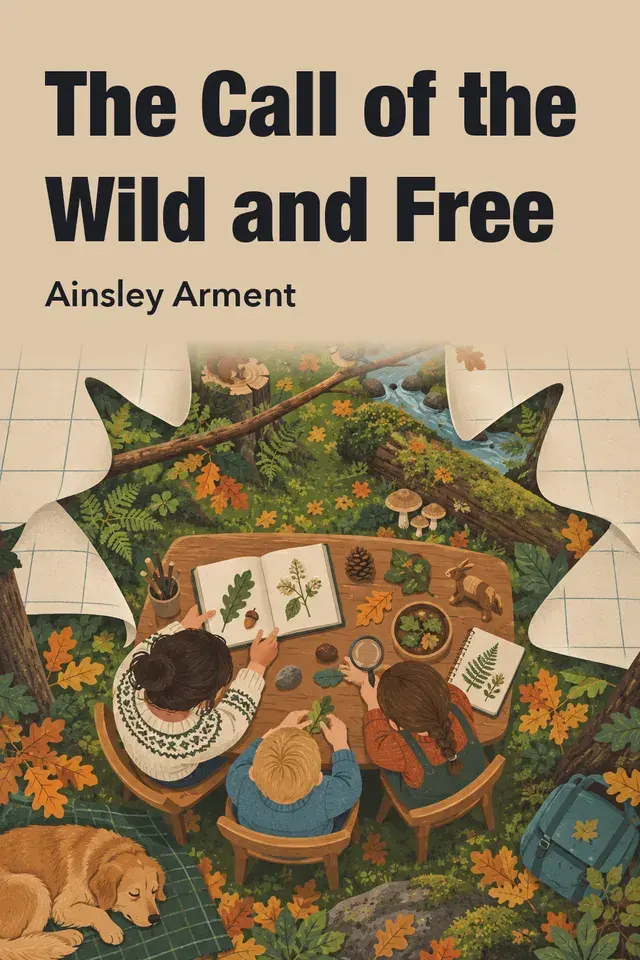
The Call of the Wild and Free, by Ainsley Arment.
A mother can be proud of her child’s success and still wonder whether the shape of his days is right for him. For Ainsley Arment, that question grew from an experience that was not an immediate failure. Her son made friends, earned good grades, impressed teachers, and learned to read. She took part in school events and was proud of him. Yet as his school day grew longer, she began to notice a distance she had not seen before.
The change became more apparent after he moved from half-day kindergarten to a seven-hour school day. Arment felt that her son had become more concerned with what peers thought and seemed less joyful and open than before. She remembered a child who noticed when others were suffering, took people’s words seriously, and had been troubled by coarse language. She worried that school brought influences and pressures she could not easily filter. These were her impressions as his mother, not proof that every child would have the same experience.
The schedule also changed how much time they had together. Her son was away from about eight in the morning until nearly four in the afternoon. There was a little time to play before dinner, then homework and bedtime. Arment resented that other adults were spending so much of his waking day with him. She wanted not only to give him a childhood, but to share it with him.
That longing sits at the heart of her argument. Childhood matters as a season of life, not merely as preparation for later achievement. Arment questions the assumption that children should be hurried toward more activity, more skills, and earlier accomplishments. Parents may pursue opportunities because they want their children to have a good life, or to receive chances they themselves lacked. But the pursuit of the best education and experiences can become a race. In that race, time for relationships, exploration, and simply being young may be squeezed out.
The point is not that children should never work hard or learn challenging things. It is that visible progress does not tell the whole story of a child’s well-being. Arment challenges the idea that starting earlier or moving faster must lead to a better destination. A child’s capacity to learn does not mean that every moment should be filled with instruction or that every ability should be advanced as quickly as possible. In her view, children need room to grow at their own pace, and parents should be wary of treating them as adults in miniature.
Her own path toward that conviction began before the school decision. As a new mother, she encountered advice about how babies should sleep, nap, and feed. She followed a book’s sleep guidance even when it conflicted with her instincts, lying outside her crying baby’s door. The experience became an early lesson in how outside expectations can weaken a parent’s confidence. Advice may sound authoritative, but it does not automatically fit the child or family receiving it.
Arment does not describe early motherhood as effortless or suggest that instinct supplies an instant answer to every problem. She recalls pain, colic, sleepless nights, and uncertainty. Over time, she learned to recognize her baby’s cries, find ways to soothe him, and decide what kind of closeness and care suited them. Her confidence came through paying attention and gaining experience, not through being a perfect parent or knowing everything in advance.
That kind of attention shapes her view of a parent’s role in education. A parent may not have formal credentials, polished lesson plans, or expertise in every subject. Still, a parent can know a particular child closely: what frustrates or energizes them, how they respond to difficulty, and when they need guidance or a break. Arment presents home education as an extension of that relationship. The parent learns alongside the child, offers help, and seeks outside support when it is needed. Becoming a child’s expert does not mean becoming infallible.
Arment’s son’s school experience helped bring these ideas together. He had succeeded by familiar measures, but his mother began to feel that success was costing the family time and that she was seeing a change in him. Rather than treating grades, friendships, or teachers’ approval as a complete account of how he was doing, she paid attention to the child she knew at home. Her concern was not simply that he could not manage school. It was that the daily arrangement seemed to leave too little room for the relationship and childhood she wanted to protect.
Homeschooling gave Arment a way to act on that concern, but she does not present every family’s reason as the same. Some parents choose it early; others arrive there after rejecting the idea or remain unsure. A family may consider it when a child is struggling, or when circumstances change. One household’s reason may be time together, another’s may be a child’s needs, and a family’s priorities may shift over the years. Arment recommends having a clear purpose, but also revisiting it. A “why” can steady a family during doubt without becoming a fixed rule that prevents it from changing course.
For Arment, the reasons broadened. She began by wanting more time with her son, a renewed sense of childhood, and more joy in learning. Later, she valued the chance for her children to learn at their own pace, follow individual interests, and make room for family travel.
Homeschooling can be demanding. Arment describes parenting as hard and full of missteps and mistakes, and says there is no perfect school or homeschool. Parents may seek advice or outside help, or take a break when they need one. Her story does not mean homeschooling is right for every family or season.
The turn toward childhood begins when parents take that question seriously. Arment’s experience moved her from following expectations by default toward observing her own child and reconsidering what success meant for their family. Her account is not a claim that school always harms children, or that parental instinct can never be mistaken. It is an invitation to look beyond outward achievement, stay attentive to the child in front of you, and let a family’s educational purpose grow from what that child and family need.
Chapter 2 of 12 · 7 min · Audio & textIn the app
Preparing a Flexible Home
Choosing to educate at home is only the beginning. The next step is to shape a workable approach for the particular people in the household.
Chapter 3 of 12 · 10 min · Audio & textIn the app
Testing Common Homeschool Fears
Common fears about homeschooling can sound like verdicts: family life will become tense, a parent will not know enough, or a child will miss something essential. The author treats these as real questions, but not as proof that homeschooling must fail.
Chapter 4 of 12 · 11 min · Audio & textIn the app
Rethinking Learning and Rigor
Parents who worry about homeschooling often carry three fears at once: a child will fall behind, learning will not be rigorous unless it looks busy and difficult, or the lack of a conventional school record will close the door to college. The author separates these questions.
Chapter 5 of 12 · 12 min · Audio & textIn the app
Select and Adapt Learning Traditions
Educational traditions can give families a way to imagine what learning might look like. Each brings a different emphasis, from ordered stages of study to hands-on discovery or child-led interests.
Chapter 6 of 12 · 6 min · Audio & textIn the app
Give the Day a Flexible Rhythm
A homeschool day can have direction without running like a timetable. A rhythm gives the family a familiar order and makes room for what matters, while a schedule expects activities to begin at set times whether or not anyone is ready.
Chapter 7 of 12 · 7 min · Audio & textIn the app
Build a Safe Family Culture
Every family already has a culture: the habits, expectations, and ways of relating that shape daily life. These patterns can be passed down without anyone choosing them.
Chapter 8 of 12 · 7 min · Audio & textIn the app
Make Nature Part of Learning
The author treats nature as part of ordinary learning, not a special trip added after the serious work is done. Children can explore, play, and notice things outside, then carry those encounters into conversation and study.
Chapter 9 of 12 · 7 min · Audio & textIn the app
Let Stories Carry Learning
Stories can give knowledge a human shape. A story places ideas among people, choices, places, and consequences, making them easier to remember than facts presented alone.
Chapter 10 of 12 · 7 min · Audio & textIn the app
Make Room for Serious Play
Play can look like a break from learning, but children often use it to do demanding developmental work. When they choose what to try, they meet problems without knowing in advance what answer an adult expects.
Chapter 11 of 12 · 6 min · Audio & textIn the app
Follow Curiosity Into Skill
An interest can become a skill when a child has room to follow it and an adult notices what is taking hold. The process is not about predicting a future career or choosing a specialty for a child.
Chapter 12 of 12 · 8 min · Audio & textIn the app
Protect the Habit of Wonder
The book closes by returning to wonder: an openness to beauty, novelty, and mystery that lets the world feel fresh. Wonder is not reserved for spectacular sights or special lessons.
Chapter 1 of 12 · 7 min · Audio & text: The Turn Toward Childhood
Wiseley supports reading and listening to summaries in the app.
Continue in WiseleyAbout Ainsley Arment
Ainsley Arment is the author of “The Call of the Wild and Free”. The book explores how families can protect a curious, unhurried childhood while still giving children a serious education.
Explore more books by Ainsley Arment