What you'll learn
Key ideas from The Business of Belonging
These ideas compress the book's argument without treating the author's view as settled fact. Use them as an orientation before reading the full work or listening in Wiseley.
Community involves membership, reciprocal influence, needs met through participation, and shared emotional connection.
A three-level strategy links business outcomes to community goals and the tactics intended to support them.
Growth shifts organizers toward facilitation, cultural stewardship, and formal support for emerging member leaders.
People, purpose, and participation clarify whom a community serves; specificity can strengthen shared context while narrowing its reach.
Onboarding works best when it clarifies what members should know, feel, and do, then offers a small, useful first action.
Intrinsic motivation draws on competence, relatedness, and autonomy; rewards work best when they affirm those motives.
Confidentiality, reciprocity, and idea-focused critique establish a memorable starting point for safer, more useful exchange.
Inside The Business of Belonging
Read the first chapter in full here. The other 8 continue in the Wiseley app.
Chapter 1 of 9 · 8 min · Audio & text
Why Belonging Creates Business Value
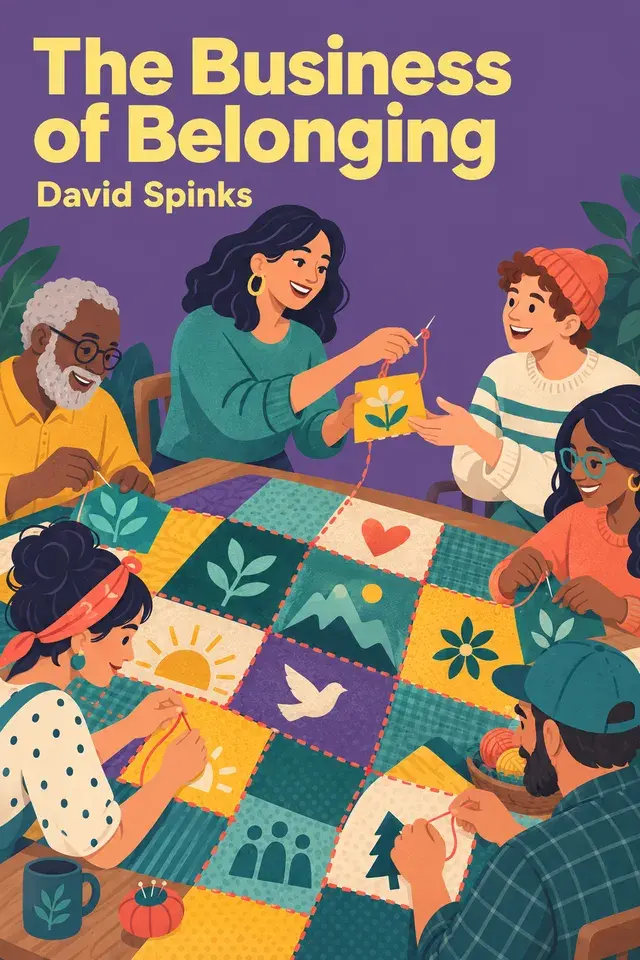
The Business of Belonging, by David Spinks.
Businesses often use the word community for customers, followers, or people gathered around a product. But naming a group does not make it a community. An audience may listen to a company, read its posts, or buy its products while having little connection with one another. Community begins when people experience membership, can affect the group and one another, find that participation meets meaningful needs, and build a shared emotional connection. David Spinks draws on a theory of sense of community associated with McMillan and Chavis to describe these conditions. He treats it as a useful lens, not a universal definition for every group.
Spinks’s own first experience of belonging came through online games. Growing up in a new immigrant family in suburban New York, he felt socially disconnected and was bullied. He describes online games as a place that could provide the connection he lacked locally. With Tony Hawk’s Pro Skater 4, or THPS4, he became a top competitive player and formed a clan. Its popular website and forum gave members a place to share stories and inside jokes. In retrospect, he says he was more attached to the social network around the game than to the game itself.
At fourteen, Spinks ran competitions, created content, moderated discussions, managed the forum, and dealt with trolls and spam. The work was more than maintaining a place where fans could gather. The group gave him a sense of belonging, and it also let him create that experience for other people. That reciprocal experience helped set the direction of his career: members were not simply receiving something he had made. Their presence, contributions, and relationships helped make the community what it was.
Membership is the first condition. A member recognizes a connection to the group and feels there is some boundary around it. That boundary can help create emotional safety; shared symbols or personal investment can make membership feel more concrete. It need not mean that every person participates in the same way. The important point is that belonging is experienced, rather than assigned by a company’s label.
The second condition is reciprocal influence. Members need some ability to shape the community, and the community needs to matter enough to shape members’ choices or behavior. People who acknowledge others’ needs, values, and opinions are often more influential. Members should also feel that someone is listening, even if it is only the community manager. If a company speaks and members only receive its messages, the relationship remains one-directional. If members contribute but do not feel heard, their influence is limited as well.
Third, a community must fulfill needs. People give time and effort when participation offers something meaningful in return. That reward can be practical, such as an answer or useful connection, or intangible, such as friendship, purpose, and belonging. The business has to understand what its members need; otherwise it may provide activity that looks like engagement without giving people a reason to return.
The fourth condition is shared emotional connection. Members build it through a shared history and the expectation of future experiences together. Significant moments can strengthen a sense of connection, and a crisis may give people a difficult experience in common. McMillan and Chavis regard this emotional bond as a defining feature of community, while emphasizing that all four conditions work together. A label or a busy channel by itself cannot supply them.
This distinction matters to businesses because most communication has traditionally moved either one-to-one, as in direct customer support, or one-to-many, as in a broadcast. One-to-one contact can be personal but reaches fewer people; broadcasting can reach many while offering less depth. Community creates room for many-to-many exchange, where members can answer, teach, encourage, and learn from one another. The company remains part of the relationship, but it is no longer the only source of help or information.
That exchange can extend a company’s capacity. Members bring knowledge, skills, and energy that can help with support, content, product feedback, or other work. When people with relevant experience help one another, they can receive value more quickly, while the business can serve more needs than its employees could address alone. This does not mean member effort is free or that professional support is unnecessary. Spinks’s account makes clear that useful communities still require investment in capable people and systems. The opportunity is to let members contribute alongside the organization, rather than treating them only as consumers.
A community can also earn trust around a topic. When it repeatedly helps people solve a kind of problem reliably, they may begin to think of it as the first place to turn with a related question or idea. That trust can make the group useful to members and distinctive for a business. It grows from repeated value and relationships, not from a company simply claiming ownership of a subject.
Apple’s early customer groups show how this kind of connection can create a channel for both listening and response. Communications specialist Ellen Petry Leanse joined Apple in 1981. In 1985, after the Macintosh launch, she encountered letters from dissatisfied Apple II users. Some letters included access codes to bulletin-board groups where customers were already discussing Apple products. Leanse saw that these existing conversations could connect Apple to its users, and she argued for an Apple bulletin-board system node despite internal resistance to online engagement.
Apple initially viewed users more as a cost than a benefit. Leanse gathered their feedback and shared it inside the company, eventually gaining the support of chief executive John Sculley. Apple’s User Group Connection brought users together, gave them a channel for their voices, and let Sculley share updates and listen through digital discussions. Spinks says the program helped improve customer sentiment. Leanse said it began to humanize the company at a time when technology was all about the machine. The case illustrates more than the value of hearing complaints: customers already had relationships and conversations, and Apple gained by making those connections easier to engage with.
The business case is durable because features and interfaces can be copied more quickly than a group’s accumulated relationships, identity, and emotional investment. When customers value the help and social ties they have built, leaving a product can mean giving up more than its functions. That can make a real community a competitive advantage, although no label guarantees one. The advantage depends on members finding genuine value and continuing to participate.
Spinks’s central promise is that business value and human value can reinforce each other. A program driven only by the company’s return may feel inauthentic and fail to attract the involvement it needs. At the same time, belonging does not sustain itself without resources. Community becomes a lasting capability when people feel they belong, can influence the group, and create value for one another—and when the business takes that human contribution seriously enough to support it.
Chapter 2 of 9 · 10 min · Audio & textIn the app
Linking Community Strategy to Results
A community can look busy while contributing little to a company’s priorities. Posts, comments, and attendance show activity, but they do not by themselves explain business value.
Chapter 3 of 9 · 7 min · Audio & textIn the app
Investing Across the Community Lifecycle
A community’s work changes as it grows, so the way an organization invests in it should change too. The lifecycle offers four stages: seed, growth, maturity, and pollination.
Chapter 4 of 9 · 11 min · Audio & textIn the app
Building an Identity People Share
A community takes shape when people come to recognize a shared identity in its beliefs, habits, language, and ways of treating one another. Its events, conversations, symbols, and other shared experiences can all reinforce that identity.
Chapter 5 of 9 · 8 min · Audio & textIn the app
Moving Members Toward Deeper Participation
Once people can recognize the kind of community they have entered, the next question is how they can take part. Spinks describes this as a commitment curve: a range of actions, from small and low effort to larger commitments.
Chapter 6 of 9 · 11 min · Audio & textIn the app
Motivation, Rewards, and Health
Once a member takes part, the question is what makes that participation feel worth repeating. Spinks treats validation as the third part of the social identity cycle: people identify with a community, participate, then receive a signal that their contribution was welcome or useful.
Chapter 7 of 9 · 9 min · Audio & textIn the app
Designing Spaces and Experiences
Good community experiences begin with a question: what kind of relationship should this space make possible? The software or venue is only where people gather.
Chapter 8 of 9 · 6 min · Audio & textIn the app
Facilitating Trust and Participation
A well-designed space still needs someone to help people use it. Facilitation turns a place to gather into a dependable setting for speaking, listening, and contributing.
Chapter 9 of 9 · 10 min · Audio & textIn the app
Activating Engagement Through Leadership
A community does not become active simply because its leaders planned well. People may hesitate, miss a post, or find that a proposed activity does not fit them.
Chapter 1 of 9 · 8 min · Audio & text: Why Belonging Creates Business Value
Wiseley supports reading and listening to summaries in the app.
Continue in WiseleyAbout David Spinks

David Spinks is a community builder and cofounder of CMX. “The Business of Belonging” explores how community can create real belonging and durable business value.
Explore more books by David Spinks