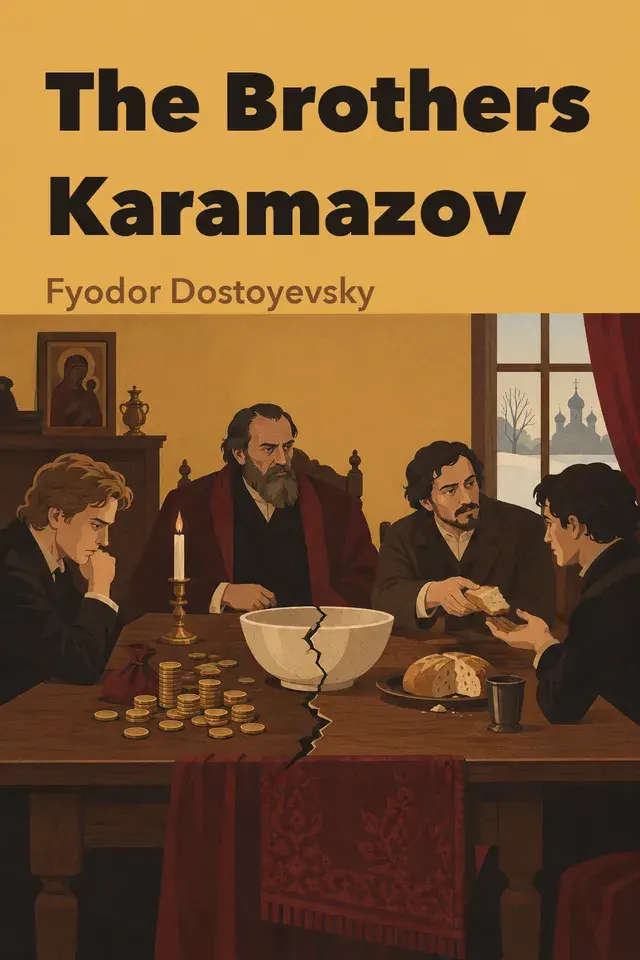
What you'll learn
Key ideas from The Brothers Karamazov
These ideas compress the book's argument without treating the author's view as settled fact. Use them as an orientation before reading the full work or listening in Wiseley.
The afterlife is not demonstrated; Zossima presents active love as a practice through which conviction may grow.
Ivan accepts God and the possibility of divine harmony, yet refuses to endorse a world justified by future reconciliation.
The Inquisitor argues that people may trade freedom of conscience for bread, certainty, and authority promising relief from choice.
Ivan admits wanting his father dead and anticipating trouble, but distinguishes those thoughts from knowingly authorizing a killing.
Fetyukovitch distinguishes begetting a child from caring for one and argues that justice should leave room for reform.
The boys’ shared memory of Ilusha may restrain later wrongdoing, but Alyosha offers it as guidance rather than a guarantee.
Inside The Brothers Karamazov
Read the first chapter in full here. The other 19 continue in the Wiseley app.
Chapter 1 of 20 · 5 min · Audio & text
Inheritance and Abandonment
The Brothers Karamazov, by Fyodor Dostoyevsky.
The Karamazov family’s crisis begins with care repeatedly left to someone else. Fyodor Pavlovitch is not simply foolish or incapable. He starts with little, manages his business successfully, and accumulates substantial wealth. The narrator suggests that his methods may have been unscrupulous. His senselessness is instead a failure of judgment and feeling: he can protect his own interests while neglecting the people who depend on him. He has three sons by two wives, but fatherhood brings no steady responsibility toward any of them.
The story of his first marriage is also uncertain. Adelaïda Ivanovna is a wealthy, intelligent heiress, and the narrator can only guess why she married Fyodor. He proposes that she may have been drawn to defying family authority or to the drama of elopement; these are interpretations, not her own stated reasons. Fyodor, meanwhile, wanted a career, a connection to a good family, and a dowry. The marriage soon became disorderly. Adelaïda left with a destitute divinity student, leaving their young son Dmitri with his father. The accounts of her later death differ: one attributes it to typhus, another to starvation. Even Fyodor’s response is reported in conflicting ways, as either joyful relief or grief.
Dmitri’s childhood shows what abandonment meant in practice. The narrator says Fyodor did not leave him behind out of a deliberate plan or simply from anger at his wife; he forgot the boy. While Fyodor drank and carried on with his own life, the servant Grigory cared for Dmitri. The child’s maternal relatives initially overlooked him too, and he spent nearly a year in Grigory’s cottage. Adelaïda’s cousin, Miüsov, eventually intervened and offered to oversee Dmitri’s education. But Miüsov soon left him with a cousin in Moscow and returned to Paris. After that cousin died, Dmitri passed to another relative. A succession of people took responsibility briefly, yet no stable home or account of his future followed.
That instability made property a lasting grievance. Dmitri grew up believing that his mother had left him a small house and land, and that he would become independent when he came of age. As an adult, he met his father for the first time to settle their affairs. He received some money and an arrangement for future payments, but no clear accounting of the property’s value or income. Fyodor was content for Dmitri to keep an exaggerated, vague idea of what was his, and sent him occasional installments. Four years later, Dmitri returned expecting to settle matters and learned that he might already have received the property’s full value, perhaps even owing his father money under agreements he had made himself. He suspected deception, but the narrator does not resolve the balance. The uncertainty itself turns money into a source of anger and mistrust.
Fyodor’s second marriage repeats the pattern of vulnerability, though its circumstances differ. Sofya Ivanovna was an orphan raised by a wealthy widow who acted as both benefactress and tormentor. The narrator has heard that the widow’s nagging once brought Sofya close to suicide, but admits he does not know the full circumstances. At sixteen, Sofya accepted Fyodor’s proposal to elope, apparently seeing escape as preferable to remaining with her guardian. The narrator thinks she might not have married him had she known him better. Fyodor did not initially seek a dowry, yet later treated Sofya as though she had wronged him by bringing none. He exploited her meekness, brought other women into their home, and held revels of debauchery in her presence. Grigory, who had also cared for Dmitri, sometimes defended her and once broke up the revels.
After Sofya died, Fyodor abandoned their sons, Ivan and Alyosha, as he had Dmitri. Grigory again cared for the children until the widow who had raised Sofya came to take them away. Her intervention did not erase her earlier cruelty toward Sofya, but it removed the boys from a neglected household. She left each child a bequest for education. Yefim Petrovitch Polenov, her principal heir, recognized that Fyodor would not provide for them. He kept the boys’ money intact so interest could increase it and paid for their education, spending more than the bequest. The brothers’ early lives therefore depend on outsiders who supply care and resources their father repeatedly fails to give. Yet those acts of rescue cannot settle what Dmitri was owed. The family’s conflict grows from both the missing care and the disputed meaning of its property arrangements.
Chapter 2 of 20 · 6 min · Audio & textIn the app
The Elder’s Way of Love
The spiritual standard here is not spectacle, but the way belief shapes ordinary conduct. The narrator presents Alyosha as a realist whose faith does not depend on miracles as proof.
Chapter 3 of 20 · 7 min · Audio & textIn the app
Faith, Justice, and Fury
At the monastery, a debate about the Church and the State becomes a question about what justice should do with offenders. Ivan argues that Christianity should not be confined to a corner of public life.
Chapter 4 of 20 · 8 min · Audio & textIn the app
Dmitri’s Divided Confession
Dmitri asks Alyosha to hear him before he either breaks away from his old life or falls into ruin. He wants more than a sympathetic audience: he wants someone who can judge and forgive him.
Chapter 5 of 20 · 6 min · Audio & textIn the app
Arguments Inside the Household
At a family dinner, Grigory tells of a Russian soldier captured in Asia who refused to deny Christianity, endured torture, and died praising Christ. Fyodor jokes that the soldier’s skin could be kept at a monastery to attract visitors and earn money.
Chapter 6 of 20 · 6 min · Audio & textIn the app
Pride, Desire, and Humiliation
Alyosha’s errands make him a messenger among people who want reconciliation but cannot set aside pride or fear of shame. He carries Dmitri’s emphatic farewell to Katerina: Dmitri sends his compliments and says he will never come again.
Chapter 7 of 20 · 6 min · Audio & textIn the app
A Child’s Dignity and Repair
Alyosha keeps trying to turn concern into repair, but concern alone cannot tell him what another person can bear. When he finds schoolboys throwing stones at a solitary child, he steps in to shield him.
Chapter 8 of 20 · 6 min · Audio & textIn the app
Ivan’s Love and Refusal
At the tavern, Ivan has come to meet Dmitri by arrangement, but Dmitri is not there. When Alyosha happens to pass, Ivan takes the opportunity to say goodbye before his own departure.
Chapter 9 of 20 · 8 min · Audio & textIn the app
Freedom, Suffering, and the Inquisitor
Ivan’s argument with Alyosha moves from suffering to freedom: can anyone accept a future harmony if a child’s pain must serve as its price? Ivan narrows his case to children, whom he considers innocent of the sins adults invoke to explain suffering.
Chapter 10 of 20 · 9 min · Audio & textIn the app
Zossima’s Life, Testament, and Death
Zossima’s life reaches the reader as a bundle of memories and sayings, not a continuous biography. Alyosha’s manuscript is incomplete.
Chapter 11 of 20 · 6 min · Audio & textIn the app
Funeral, Scandal, and Alyosha’s Return
As Zossima lies in his coffin, monks read the Gospel and a crowd gathers around him. Many expect his body to remain incorrupt as a sign of sanctity.
Chapter 12 of 20 · 7 min · Audio & textIn the app
Dmitri’s Race Against Debt
Dmitri spends these two days trying to turn financial panic into a way out. He imagines taking Grushenka far away, marrying her, and beginning a different, more honorable life.
Chapter 13 of 20 · 8 min · Audio & textIn the app
Mokroe: Reunion, Spending, and Suspicion
Dmitri slips into Fyodor Pavlovitch’s garden because he believes Grushenka may be there. He climbs the fence, hides near the lighted window, and uses the agreed signal to test Fyodor’s response.
Chapter 14 of 20 · 10 min · Audio & textIn the app
Interrogation and Moral Guilt
The formal questioning turns Dmitri’s own words into part of the case against him. He denies killing his father, yet admits to hatred, threats, and wanting to kill him.
Chapter 15 of 20 · 8 min · Audio & textIn the app
The Boys Learn to Remember
Kolya, Ilusha, and their schoolmates offer a close study of how children shape one another. Pride surfaces in dares and deliberate coldness; cruelty can turn a joke into an injury; and care depends on returning after people have hurt one another.
Chapter 16 of 20 · 6 min · Audio & textIn the app
Waiting for the Trial
With Dmitri’s trial due the next day, those closest to him remain caught between care, fear, and volatile feeling. Alyosha finds Grushenka changed after a grave illness: more thoughtful, but still capable of sudden anger.
Chapter 17 of 20 · 9 min · Audio & textIn the app
Ivan’s Guilt and Smerdyakov’s Confession
As Dmitri’s trial approaches, Ivan faces two questions that he has struggled to keep together: who physically killed Fyodor, and whether Ivan himself bears responsibility for what happened. Ivan has not killed his father.
Chapter 18 of 20 · 9 min · Audio & textIn the app
Witnesses and Public Judgment
By the time Dmitri’s trial begins, the courtroom is packed with visitors and local spectators. People arrive with opinions about his character, and they watch the witnesses as closely as the evidence.
Chapter 19 of 20 · 10 min · Audio & textIn the app
Two Arguments and a Verdict
The trial now turns on what the evidence can prove. Ippolit Kirillovitch asks the jury to see a chain of motives and actions that ends in murder.
Chapter 20 of 20 · 6 min · Audio & textIn the app
Escape, Forgiveness, and Memory
After Mitya’s conviction, he lies ill in the hospital while Alyosha continues to believe him innocent. The verdict shapes what happens next, but it does not settle for Alyosha what Mitya owes or what could help him change.
Chapter 1 of 20 · 5 min · Audio & text: Inheritance and Abandonment
Wiseley supports reading and listening to summaries in the app.
Continue in WiseleyAbout Fyodor Dostoyevsky
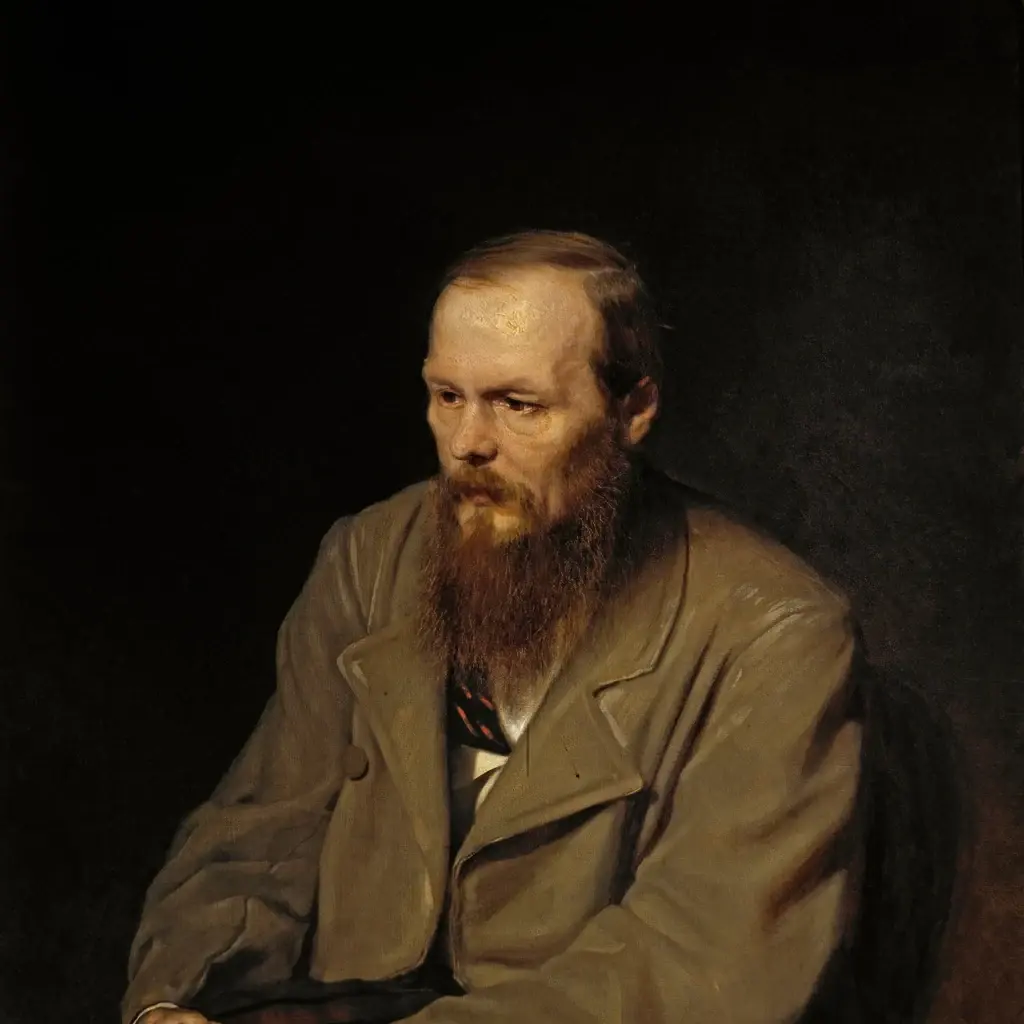
Fyodor Dostoyevsky was a Russian novelist and philosopher. “The Brothers Karamazov” explores what can justify belief, responsibility, and forgiveness through a fractured family and a murder trial.
Explore more books by Fyodor Dostoyevsky