What you'll learn
Key ideas from The Book
These ideas compress the book's argument without treating the author's view as settled fact. Use them as an orientation before reading the full work or listening in Wiseley.
Watts names the isolated, body-bound ego as a culturally reinforced picture of selfhood and asks readers to question it.
Focused attention yields precise local knowledge while concealing the wider context and intervals that make an event intelligible.
Order and chance are paired conditions of experience; total prediction would remove the uncertainty that makes life engaging.
Society forms the independent self through dependence, then asks that self to choose freely within rules it did not choose.
Trying to eliminate the ego through virtue, willpower, or spiritual achievement can preserve the separate achiever.
Shared fallibility can shape how opponents are treated while civil-rights, peace, and disarmament causes proceed with full vigor.
Nonduality means that unity and difference depend on each other; it does not erase distinctions into sameness.
Inside The Book
Read the first chapter in full here. The other 8 continue in the Wiseley app.
Chapter 1 of 9 · 7 min · Audio & text
The Taboo of the Separate Self
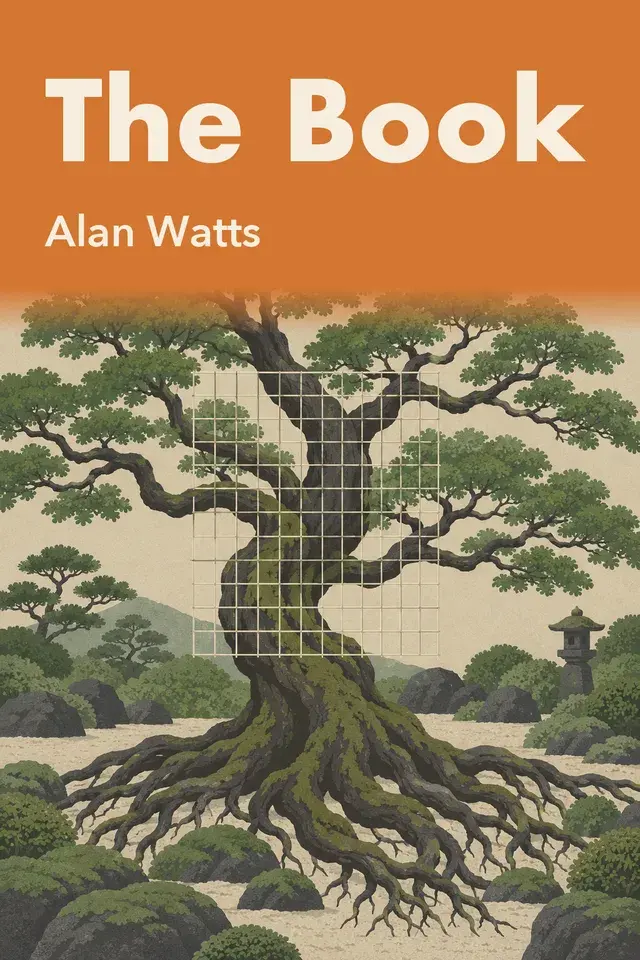
The Book, by Alan Watts.
Watts begins with a question people may rarely ask aloud: what are we, beneath the familiar picture of being a separate self? He calls the silence around this question a taboo. The hidden matter is not simply some fact kept from children. It is the possibility that the self we take for granted—a private center enclosed inside a “bag of skin”—may be a misleading account of who we are. Watts asks readers to examine that account instead of assuming it is the truth.
To show how taboos shift, he recalls a Japanese pillow book that passed on sexual information through illustrated woodblock prints. The images let parents communicate what might have been embarrassing to explain face to face. Watts contrasts that indirect teaching with a modern Western setting in which sexual information has become readily available, sometimes more familiar to young people than to adults. But when one subject becomes speakable, another can remain unacknowledged. His deeper question is what people are, and what their lives mean, beyond the body-bound identity they ordinarily call “I.”
Religion might seem to address that question, yet Watts observes that even religious people can treat private belief as awkward to discuss. Familiar traditions may carry symbols and teachings that are difficult for modern readers to enter. He does not set out to provide a standard religious textbook or a conventional introduction to Vedanta. Instead, he wants to make an old and unsettling possibility intelligible in a modern Western voice.
The everyday self, in Watts’s account, feels like an isolated center of thought and action facing a world outside it. Ordinary phrases help express this picture: we speak of “coming into the world,” “facing reality,” and “conquering nature,” as though we stood apart from what surrounds us. Watts calls the separate-ego feeling a hallucination—not because people or their experiences are unreal, but because this feeling may distort their relation to the whole in which they live.
He connects that sense of separation to alienation from nature. If the world beyond the skin seems foreign, it can appear to be an adversary to control. Watts argues that the impulse to subdue the natural environment, aided by technology, can damage the very conditions on which human life depends. That consequence gives his question practical weight: a picture of the self is not only an inward idea if it shapes how people meet the world around them.
Against the image of a visitor arriving from outside, Watts suggests that people emerge from the universe as leaves emerge from a tree or waves from an ocean. Each person is a particular expression of the natural whole. This is the direction of his book’s modern restatement of Vedantic insight, set alongside Western science and contemporary ways of speaking. It is an interpretive meeting of traditions, not a proof that science has established a spiritual doctrine.
The distinction matters because Watts is not mainly asking readers to adopt a belief. He presents the claim about selfhood as something to test in experience. In the view associated with Vedanta, realization is not merely agreeing with a sentence about unity; it is a change in the felt sense of what “I” means. The book’s words and images are meant to point toward that possibility, not replace it with a new formula to memorize.
For the same reason, Watts resists treating the inquiry as a moral checklist. He is not telling the reader to imitate a saint, perform unselfishness, or become good through duty and guilt. In his account, love and conduct are not reliably produced by ordering an ego to adopt the right motives. He asks what might follow from seeing more clearly, while leaving open whether awakening will produce behavior that matches conventional ideas of virtue. The political consequences are also uncertain. He makes no promise that people will awaken, or that recognition will automatically repair the world.
Because the question concerns the very awareness doing the questioning, Watts turns to myth and analogy. He uses “myth” in the sense of an image that can make an elusive possibility easier to approach, rather than a scientific description of how the universe began. A picture can prompt recognition, but taking it literally would confuse the pointer with what it points toward.
For a child, a circle can suggest a world of recurring patterns rather than a line with a single, simple beginning. A watch’s circular movement offers an image of return. Day and night, waking and sleeping, and life and death can be imagined as paired phases of appearing and disappearing. Breathing makes the rhythm bodily: something goes out, something comes in, and the movement continues. These comparisons do not demonstrate a cosmic cycle. They give ordinary experiences that help the mind approach the idea of alternation.
Watts then offers a hide-and-seek story. If the whole has no outside, the myth imagines it appearing as every person, animal, plant, rock, and star, and hiding so completely that each form forgets the identity of the one playing. The game can be understood as concealment followed by recognition: the many forms are not described as separate creations standing outside the whole, but as its disguises. The God of this story is not a human-shaped man or woman somewhere beyond the universe. The image points to a reality with no external location or separate skin.
The story is an analogy, not a literal report about a cosmic person who physically changes costumes. Its value lies in inviting a different feeling of belonging: perhaps we do not stand alone against the universe, but are the universe appearing in particular forms. Watts draws on Vedanta for this reversal, while presenting it in a way intended to reach readers without requiring them to join a religion or accept an authority’s claim.
That invitation remains an experiment, not a conclusion readers must repeat. The separate ego may feel fundamental, but Watts asks whether that feeling is the only possible account of selfhood. His opening chapter frames the stakes and offers myth as a prompt for recognition. It does not settle what every awakened person would do, or whether anyone can make the insight happen on command. The question is whether belonging to the whole can be experienced, rather than only believed or denied.
Chapter 2 of 9 · 7 min · Audio & textIn the app
How Attention Creates Separation
Watts asks us to notice that experience comes in pairs that depend on each other. We tend to notice one side and treat it as complete, but a sound is heard against silence, a shape against space, and life against death.
Chapter 3 of 9 · 6 min · Audio & textIn the app
When Control Cancels Surprise
Having treated opposites as mutually defining, Watts turns to a practical conflict: our wish for order and our dependence on chance. Applied science and cybernetics, as he describes them, seek to make surroundings and behavior more predictable, prevent mistakes, and make systems foolproof.
Chapter 4 of 9 · 8 min · Audio & textIn the app
The Ego as a Learned Fiction
Attention can select one part of experience and let the rest recede. Watts now asks how that partial view comes to feel like a person stationed inside it, separate from what is seen and felt.
Chapter 5 of 9 · 9 min · Audio & textIn the app
Life Inside Social Double Binds
The separate-self picture has a social life. Society teaches people to think of themselves as free, independent sources of action, even as family and community shape their language, feelings, and choices.
Chapter 6 of 9 · 9 min · Audio & textIn the app
The Organism Is Its World
An organism is often described as a thing inside a world of other things, with an inner self that decides and then acts on its surroundings. Watts argues that this picture mistakes a convenient way of speaking for how living activity exists.
Chapter 7 of 9 · 7 min · Audio & textIn the app
Presence Without a Reward
After tracing the ego as a learned fiction, Watts turns to the question of how to live with that recognition. The temptation is to turn it into a new assignment: get rid of the ego, become perfectly good, or attain spiritual illumination.
Chapter 8 of 9 · 8 min · Audio & textIn the app
Opponents Within One Game
Interdependence gives conflict a different meaning without making it unreal. An opponent is still someone who may block, injure, or defeat us.
Chapter 9 of 9 · 8 min · Audio & textIn the app
The Indescribable Self Called It
Watts brings his inquiry to a name, though not to a definition: IT. The question of what everything is cannot be answered like a question about one object.
Chapter 1 of 9 · 7 min · Audio & text: The Taboo of the Separate Self
Wiseley supports reading and listening to summaries in the app.
Continue in WiseleyAbout Alan Watts
Alan Watts was a British and American writer and lecturer. “The Book” explores whether a person is an isolated ego or an expression of the whole universe.
Explore more books by Alan Watts