What you'll learn
Key ideas from The Biology of Trauma
These ideas compress the book's argument without treating the author's view as settled fact. Use them as an orientation before reading the full work or listening in Wiseley.
Overwhelm depends on the relationship between perceived demand and current capacity, which shifts over time and varies between people.
Nervous-system state coordinates metabolism, attention, immune activity, and digestion across the body.
Neuroception can keep reading present cues through a learned expectation of danger, even when circumstances have changed.
Recurring patterns can connect symptoms, emotions, thoughts, and behaviors, helping make stored trauma recognizable.
The book's three proposed disease pathways are metabolic disruption, immune dysfunction, and epigenetic change.
The sequence begins with felt safety, uses support and repair to move through returning activation, and reaches expansion when capacity is ready.
Healing extends beyond symptom relief toward agency, connection, and fuller participation in life.
Inside The Biology of Trauma
Read the first chapter in full here. The other 14 continue in the Wiseley app.
Chapter 1 of 15 · 7 min · Audio & text
From Startle to Shutdown
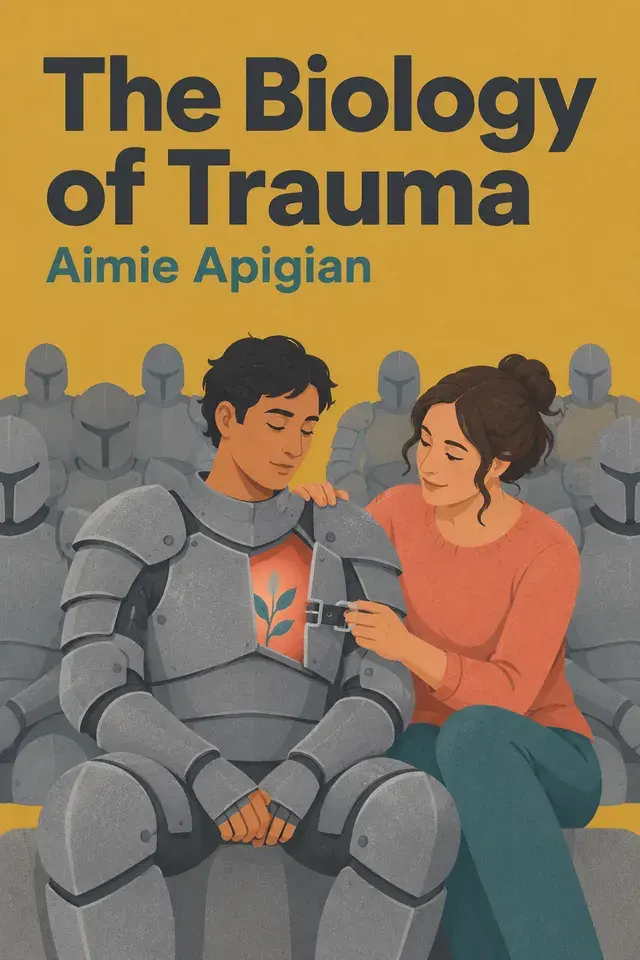
The Biology of Trauma, by Aimie Apigian.
Elena hears tires skid as she drives. Before she can think through what is happening, her body jolts into alertness. She sees a car approaching, grips the wheel, brakes, and tries to steer away. When she realizes a collision cannot be avoided, her efforts give way to stillness. The author uses this moment to introduce a five-stage map: startle, stress, wall, freeze, and shutdown. It describes how the body may move from assessing danger and mobilizing action to conserving itself when action feels impossible.
Startle is an ordinary reflex to something sudden or unexpected. In Apigian’s account, heightened attention and a brief surge of energy help the body assess what is happening and prepare to respond. The reflex itself does not prove that danger is present, and a startle response alone does not establish trauma. Elena’s senses quickly confirm the approaching car, and her body moves into the next stage: stress. Her heart pounds, her grip strengthens, and she brakes and steers. This high-energy response can help meet a threat. If action works and danger passes, the body may relax; the surge is not meant to continue indefinitely.
The wall is the point where effort meets powerlessness. Elena recognizes that she cannot steer clear of the collision. In the author’s sequence, the wall is not another action the body takes. It marks the failure of available action and the shift toward a different kind of protection. The account locates trauma in the person’s internal experience of being trapped and powerless, rather than in the external event alone. The sequence can unfold quickly or slowly, and its timing does not make every stressful event traumatic.
After Elena sees that impact is unavoidable, she freezes. Her body locks, her breath would have caught, and time seems to slow. Apigian presents this as an involuntary protective halt, not a choice or a sign of weakness. When movement could no longer change the outcome, stopping may protect the body from further action. The author describes freeze as a bridge between the wall and shutdown: the shock of being unable to act cannot be sustained indefinitely.
Shutdown is the final stage in this map. The author describes it as a last-ditch way of reducing activity and distance from sensations that feel unbearable. It may involve disconnection, immobility, and conserving energy. Someone might feel heavy, cold, alone, or confused, find it hard to speak, or notice slow, shallow, or irregular breathing. After the crash, Elena’s memory is fragmented and she feels detached and heavy. Calm directions from paramedics help anchor her; as her awareness returns, so does pain. The sequence portrays these reactions as the body trying to protect itself when it senses no workable escape.
Elena’s story continues after her injuries heal. Similar drives bring anxiety, and she becomes more emotionally sensitive and irritable. A year later, fatigue and swelling lead to a lupus diagnosis, and she wonders whether trauma work could help with the crash. The narrative raises that question but does not show that the accident caused lupus. Nor does the map make every startle or stressful response evidence of trauma. Its focus here is how a protective sequence can occur and why it may remain relevant after immediate danger has passed.
Apigian’s interest in this sequence also grew from her experience with Miguel, her adopted five-year-old son. He threatened to kill her and pushed away the affection she thought would help. Despite her preparation and their stable routine, she felt alone and searched for answers. Her caregiving and work with adopted children informed her later clinical inquiry. She says the response map helped her understand Miguel’s behavior as a survival pattern and supported their growing bond. This experience forms context for her effort to make bodily reactions understandable, rather than treating them as deliberate or irrational.
To help people narrate a response, Apigian describes an art exercise that moves through the stages at a careful pace. The person draws the experience in the third person, using named characters to create some distance from the present-day self. They represent each stage and add sensory details and bodily sensations: what was heard or seen, and what the body did. Then they draw a later moment when there is enough safety. The author says this can bring fragmented sensory memories together with a more linear account and give the story an ending that includes safety.
The pacing matters. Apigian cautions that therapy or personal-development work can become overwhelming, and that repeated overwhelm may reinforce freeze and shutdown. The exercise is her method, not a requirement to revisit an experience all at once. Her five-stage map offers a first way to recognize how the body may move from alertness and attempted action, through powerlessness, into protective stillness and disconnection. It also leaves room to ask what made the response feel inescapable, without assuming that the event alone supplies the answer.
Chapter 2 of 15 · 7 min · Audio & textIn the app
The Moving Threshold of Overwhelm
Stress is not, by itself, evidence that something has gone wrong. It can supply energy for action, and when effort is followed by recovery, it may help build capacity.
Chapter 3 of 15 · 7 min · Audio & textIn the app
Survival Across Cells and Systems
The previous chapter established how overwhelm begins when perceived demand exceeds available capacity. Here Apigian follows that shift into the cell and outward through the body's systems.
Chapter 4 of 15 · 8 min · Audio & textIn the app
Protective Strategies and Reset
When a person feels powerless, the body may use protective responses that help in the moment. The harder question is what happens when danger passes but the response does not finish.
Chapter 5 of 15 · 7 min · Audio & textIn the app
How the Trauma Loop Persists
Sarah's loop begins with childhood ridicule and powerlessness. Both her perfectionism and people-pleasing have childhood roots; her perfectionism grew from a fear of ridicule.
Chapter 6 of 15 · 6 min · Audio & textIn the app
Four Patterns of Stored Trauma
Aimie Apigian describes five patterns as a way to connect experiences that can otherwise seem unrelated. This chapter focuses on the first four: disconnection, disruption, depletion, and dysregulation.
Chapter 7 of 15 · 8 min · Audio & textIn the app
When Trauma Becomes Disease
The book calls disease its fifth pattern: an extension of the idea that stored trauma can be recognized in the body's responses. Earlier chapters describe dysregulation as a protective pattern.
Chapter 8 of 15 · 6 min · Audio & textIn the app
Attachment and the Personal Filter
Two people can face a similar demand and experience it very differently. The author explains this through a personal filter: an automatic process that predicts a response to a stimulus, with neuroception assessing danger and the capacity to respond.
Chapter 9 of 15 · 7 min · Audio & textIn the app
Safety, Support, Then Expansion
The author presents healing as a sequence: establish felt safety, build support for what emerges, and then expand gradually. The order matters because a person may move out of shutdown and encounter activation before feeling ready for deeper work.
Chapter 10 of 15 · 7 min · Audio & textIn the app
Practicing Felt Safety
The practical question is how safety becomes something the body can register. In the author’s approach, it is built through repeated experiences that help a person notice bodily signals and respond to them.
Chapter 11 of 15 · 7 min · Audio & textIn the app
Repairing Capacity at Its Roots
Therapeutic work can build understanding and new ways of responding, yet a person may still struggle to stay regulated. The author argues that biological limits can reduce the energy and flexibility needed to sustain change.
Chapter 12 of 15 · 8 min · Audio & textIn the app
Biochemical Burdens and Pacing
Claire's recurring fatigue and brain fog could leave her unable to attend her daughter's track meet. Therapy or activity beyond her limits sometimes left her depleted, and she began restricting her life to avoid another crash.
Chapter 13 of 15 · 7 min · Audio & textIn the app
Reprogramming Fear and Balancing Immunity
Bruce Lipton is quoted as saying that the subconscious is largely formed before age six. A child who experiences connection as overwhelming may learn to stay close by hiding needs, pleasing others, or becoming busy and perfectionistic.
Chapter 14 of 15 · 9 min · Audio & textIn the app
Repairing Gut and Oxidative Stress
The book’s repair sequence turns here to digestion and oxidative stress: processes that can keep the body under strain even as a person works toward greater regulation. The gut responds to emotional and physiological signals, and its neural activity also helps shape internal states.
Chapter 15 of 15 · 6 min · Audio & textIn the app
From Healing Toward Living
After the work of stabilizing and repairing, the question can change. The aim is not simply to have fewer symptoms or to return to exactly who one was before trauma.
Chapter 1 of 15 · 7 min · Audio & text: From Startle to Shutdown
Wiseley supports reading and listening to summaries in the app.
Continue in WiseleyAbout Aimie Apigian

Aimie Apigian is the author of “The Biology of Trauma”. The book explores how overwhelming experiences become lasting patterns in the body and what helps it recover.
Explore more books by Aimie Apigian