
What you'll learn
Key ideas from The Art of Public Speaking
These ideas compress the book's argument without treating the author's view as settled fact. Use them as an orientation before reading the full work or listening in Wiseley.
Preparation and repeated exposure to listeners help confidence grow.
Pitch, tempo, pauses, and inflection make changes in thought and attitude audible.
An outline classifies support, proportions it toward a climax, and guides revision for listeners rather than readers.
Audience knowledge guides what needs explanation or description, while irrelevant detail and ornament can weaken unity.
A case grows more dependable when its question, sources, inference, and opposing claims are examined fairly.
Vivid speech turns abstract claims into sensory scenes, with reason guiding the image toward its purpose.
Inside The Art of Public Speaking
Read the first chapter in full here. The other 12 continue in the Wiseley app.
Chapter 1 of 13 · 6 min · Audio & text
Begin With Subject and Courage
The Art of Public Speaking, by Dale Carnegie.
In the foreword, J. Berg Esenwein begins with the speaker’s inner life. Public speaking, he argues, is a person’s thoughts and feelings made public. If those thoughts offer nothing worthwhile, polished delivery only makes the speaker a more efficient carrier of someone else’s ideas. Training in delivery therefore rests on developing valuable material and enough self-command to express it.
That principle shapes Esenwein’s first instruction to a learner: speak. A beginner need not master vocal or physical technique before trying. Start with a subject you know and put your thoughts into words before listeners. The attempt supplies experience that reading rules alone cannot provide. It also gives you something real to examine. Speaking skill begins with action, then grows as the speaker learns from each effort.
Esenwein says examination should be informed rather than merely severe. He asks learners to notice the qualities of effective speakers, consider how those qualities might be acquired, and identify their own habits that get in the way. Their experience is useful, but should be supplemented and corrected by the experience of others and by principles they have judged sound. Listeners’ criticism can help reveal a problem; the speaker must still decide whether it identifies a genuine obstacle. The purpose is to learn, not to condemn every attempt.
Confidence grows from preparation and use. A blank mind leaves room for worries about appearance, technique, or failure. Knowing the subject and having a general idea of how to present it gives attention somewhere more useful to go. The chapter also recommends preparing the opening sentences, so the speaker does not begin by searching for words. It urges a modest expectation of success: the learner can speak with inward confidence without imagining themselves superior to the audience. A beginner need not wait for confidence to arrive before beginning; preparation and experience help build it.
Preparation also changes where attention rests. The chapter describes self-consciousness as excessive concern with oneself, including the wish to appear impressive. It asks the speaker to think of themselves as a messenger whose task is to serve the subject and its truth. When a subject matters deeply, attention can gather around what needs to be said, leaving less room for fears about appearance. This does not make the speaker unimportant; it gives the speaker a purpose larger than self-display.
Repeated exposure is part of how fear may lose its hold. The chapter contrasts horses that feed near the track without pausing at passing trains with a separate horse frightened at a crossing. It then asks how to accustom a frightened horse to cars: by keeping it where it never sees machines or letting it see them often. Applying that analogy to speakers, it advises facing an audience frequently, which can reduce self-consciousness. Confidence cannot be gained through theory alone; the learner has to encounter listeners.
The chapter makes the point through swimming, too. Reading about swimming cannot take the learner’s plunge for them. Advice may help, but skill comes through entering the water and practicing. In the same way, nobody else can do the actual speaking on a learner’s behalf. Early attempts may feel awkward or frightening, yet that discomfort is part of beginning rather than evidence that the learner should stop.
The chapter does not promise that nervousness will disappear for everyone. Stage fright can affect even experienced speakers; it recalls nervousness in Daniel Webster, Gladstone, and Beecher. Temperament, nerves, illness, and modesty may also contribute to fear. Repeated action and a purposeful attitude remain the proposed path, though individual experience can differ. Courage, in this account, means facing the audience and speaking despite fear, not requiring a person to feel no fear.
A learner’s working method follows from these ideas: speak about something familiar, observe what happened, seek useful criticism, and compare the result with sound principles and the practice of capable speakers. Then apply what seems relevant to your own habits and speak again. In the foreword, Esenwein rejects fixed formulas and unexamined imitation, urging students to use principles in their own personal way. Natural ability can give someone a starting point, but it needs development; it cannot replace worthwhile thoughts, genuine feeling, or practice. This foundation prepares the way for technical study while keeping the message and the human speaker at the center.
Chapter 2 of 13 · 6 min · Audio & textIn the app
Make Every Vocal Change Mean Something
A sentence carries more than its dictionary meanings. It also has a shape: some words carry the main thought, while others support it.
Chapter 3 of 13 · 6 min · Audio & textIn the app
Make Conviction Audible
Carnegie treats force as the quality that makes a message reach and grip its hearers. It begins within the speaker.
Chapter 4 of 13 · 7 min · Audio & textIn the app
Train Voice and Body
A speaker’s ideas must be heard and seen clearly across a room. Carnegie treats the voice and body as trainable means of carrying those ideas, not as decorations added after the words.
Chapter 5 of 13 · 9 min · Audio & textIn the app
Prepare Material for Listeners
A speech takes shape before the speaker stands before an audience. Carnegie’s next step is to turn the abilities developed so far toward building a complete address.
Chapter 6 of 13 · 8 min · Audio & textIn the app
Explain, Then Create a Picture
Once a subject has been gathered and arranged, the speaker must help listeners understand it and, when useful, picture it. These are related but distinct tasks.
Chapter 7 of 13 · 5 min · Audio & textIn the app
Tell Stories That Do Work
A public story is not just a record of what happened. Narration arranges an incident, or a group of facts, so one thought prepares the next and listeners experience a chosen effect.
Chapter 8 of 13 · 12 min · Audio & textIn the app
Reason, Suggest, Persuade
An explanation aims to make a subject understood. Persuasion asks something further: that listeners believe a claim, choose a course, or act.
Chapter 9 of 13 · 8 min · Audio & textIn the app
Activate Imagination and Memory
A speaker’s words become vivid when they awaken something listeners can picture, hear, or feel. Carnegie treats imagination as the mind’s ability to reproduce earlier sensations after the original experience has passed.
Chapter 10 of 13 · 4 min · Audio & textIn the app
Build Character and Recover
Public speaking, as this book presents it, is connected to the habits that form a life. Thought and feeling shape action; repeated actions become habits; habits shape character; and character determines destiny.
Chapter 11 of 13 · 7 min · Audio & textIn the app
Fit the Occasion, Listen Well
A short ceremonial address begins with the people and event gathered before the speaker. Carnegie advises learning the meeting’s purpose, its importance, the audience’s size and character, and the place where it will be held.
Chapter 12 of 13 · 7 min · Audio & textIn the app
Study the Public Models Critically
The public addresses in this book are useful as workshops. Each lets us see how a speaker shapes a claim for particular listeners, then combines evidence, feeling, and form to move them.
Chapter 13 of 13 · 6 min · Audio & textIn the app
Look for Opportunity Close By
Conwell’s “Acres of Diamonds” joins a memorable story to practical cases about work and enterprise. The story sets out a pattern, then examples from commerce show how it can apply to ordinary decisions.
Chapter 1 of 13 · 6 min · Audio & text: Begin With Subject and Courage
Wiseley supports reading and listening to summaries in the app.
Continue in WiseleyAbout Dale Carnegie
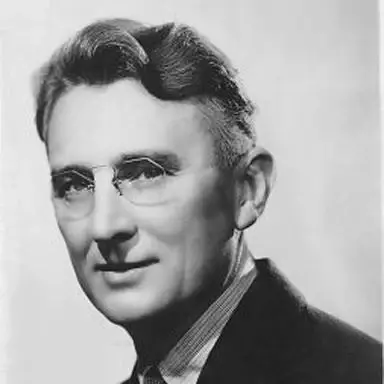
Dale Carnegie was an American writer and lecturer. “How to Win Friends and Influence People” explores practical approaches to communication, cooperation, and building relationships.
Explore more books by Dale Carnegie