What you'll learn
Key ideas from The Art of Letting Go
These ideas compress the book's argument without treating the author's view as settled fact. Use them as an orientation before reading the full work or listening in Wiseley.
The control distinction separates circumstances and outcomes from the judgments, desires, intentions, and actions a person can guide.
Excellentism keeps high standards while replacing demands for flawless results with attainable effort, learning, and progress.
Nonattachment accepts impermanence while preserving love and engagement with people and things that matter.
A growth mindset treats abilities as developable and failure as information for learning, rather than a final measure of worth.
Clear boundaries state what behavior is unacceptable and the limits a person will maintain, including in online contact.
Forgiving someone does not require renewed friendship, contact, trust, or reconciliation.
Self-forgiveness combines compassion for oneself with responsibility for the harm one caused.
Inside The Art of Letting Go
Read the first chapter in full here. The other 10 continue in the Wiseley app.
Chapter 1 of 11 · 7 min · Audio & text
The Control You Can Actually Exercise
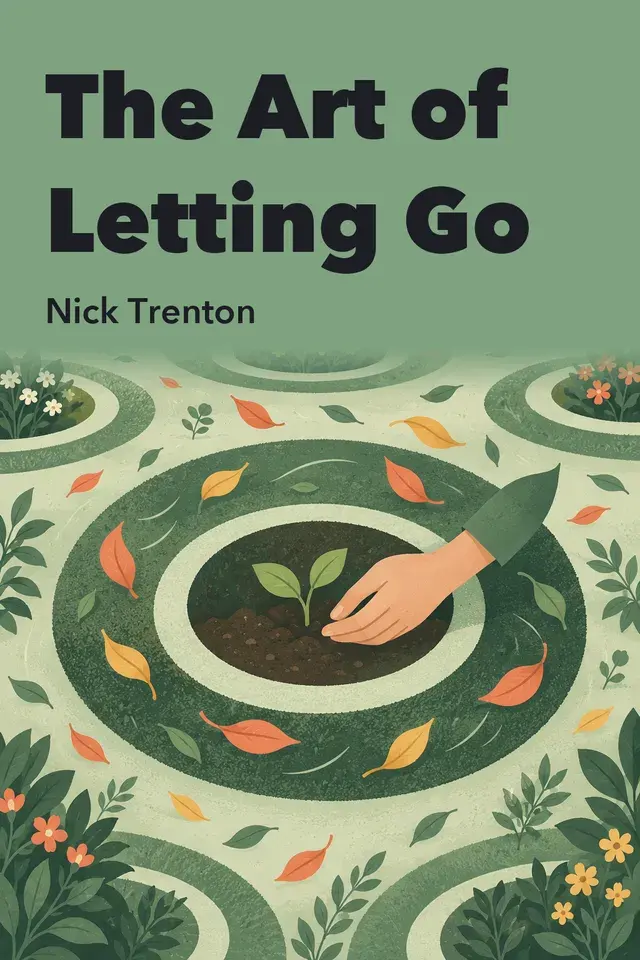
The Art of Letting Go, by Nick Trenton.
Letting go can feel like defeat. Releasing a relationship, job, dream, belief, or familiar behavior may seem like loss, failure, or even betrayal of yourself. The book acknowledges that reaction rather than promising instant relief. Letting go does not mean giving up responsibility. It means accepting the limits of your control while acting deliberately on the choices that remain yours.
A Stoic distinction associated with Epictetus helps clarify those limits. Some parts of life are up to us; others are not. You cannot determine every circumstance or outcome. Other people have their own thoughts and feelings, and events may turn on conditions you cannot change. But you can attend to your judgments, desires, intentions, decisions, and actions. The point is to direct effort toward those parts instead of spending it trying to command the rest.
The distinction is not a claim that every feeling or first reaction can be switched off. Judgment concerns the thoughts, feelings, and beliefs through which you understand what is happening. You can pause to assess an interpretation rather than treating the first, emotionally charged reading as the whole truth. Desire concerns what you want and fear. It can be aimed at choices you can make, rather than tied entirely to an outcome that depends on other people or circumstances. Will guides intentions, decisions, and actions: the way you choose to proceed. Together, these faculties describe room for considered conduct, even when the situation itself is not yours to control.
This makes acceptance different from passivity. A situation may contain both things you can influence and things you cannot. The useful response is to do what you can with the first group and acknowledge the second. You might not be able to decide what someone else thinks, but you can choose how you speak and act. You may not be able to guarantee a particular result, but you can prepare, make a decision, and respond to what follows. Letting go of an outcome is not the same as refusing to take a worthwhile step.
A student facing an exam can make this distinction concrete with two circles. In the smaller circle are study habits, focus, time management, and the decision to seek help. In the larger circle are the course's difficulty, the questions on the exam, grading criteria, time limits, and classmates' results. Drawing the circles does not change the exam. It makes clear where effort can go: the student can study effectively or ask for help, while recognizing that the external factors cannot be directed at will. The grade still matters, but worrying about its difficulty or criteria does not prepare the student as deliberate study can.
John and Olivia show the same limit in a relationship. John likes order and tries to control his home, business, and relationships. Olivia is more carefree and independent, challenging the expectations he relies on. If John focuses on making her thoughts, feelings, or behavior conform to his preferences, the attempt strains their relationship. He cannot choose Olivia's response for her. In the story, he recognizes that replaying the past and rehearsing what-ifs keeps him stuck. He redirects attention toward being present, accepting, empathetic, and loyal. His example is not a promise that another person will change. It shows how attention to one's own conduct offers a more workable responsibility than trying to manage a partner.
Present-moment attention supports this shift. Regret can pull attention toward what has already happened; worry can carry it into what might happen next. Mindfulness means noticing what is happening now with openness, rather than being absorbed by either. During an ordinary morning routine, for example, you can attend to your breathing, bodily sensations, the room's temperature, sounds, or the feel of water. The practice is to meet the immediate experience instead of racing ahead through the day's concerns.
A body scan gives this attention a simple path. Sit or lie somewhere quiet and supported, and begin by noticing your breathing. Then move attention slowly from your toes toward your head, observing each area of the body in turn. Notice whatever sensations are present without analyzing them or deciding they should be different. If you find discomfort, acknowledge it without trying to fix it during the scan. When attention wanders, gently bring it back to the body and continue. The book describes scans lasting from five to thirty minutes. Their purpose here is not to control sensation, but to notice experience as it is, without immediately judging it.
Judgments may still arise during the practice. The basic move is simply to notice thoughts and feelings as experiences, rather than treating them as verdicts about yourself or commands that must be followed. This kind of observation can make room between what happens and the response you choose. The book presents present-moment attention and the body scan as ways to build that awareness; more detailed methods for working with judgments come later.
At first, releasing control may still feel like losing something or failing to hold it together. That feeling does not prove that acceptance is passivity or that you should stop caring. It marks the difficulty of separating what matters from what you can actually direct. The chapter's starting point is to accept limits on outcomes while taking responsibility for the attention, intentions, and actions still available to you.
Chapter 2 of 11 · 8 min · Audio & textIn the app
Notice, Then Choose a Response
A thought can sound like a fact simply because it arrives with force. “He is selfish,” “I always fail,” or “I am hopeless” turns an interpretation into a verdict.
Chapter 3 of 11 · 8 min · Audio & textIn the app
From Inner Critic to Excellentism
The inner critic can sound as if it is stating the truth about who you are. It may scold you for a mistake, compare you with others, or insist you are not good enough.
Chapter 4 of 11 · 9 min · Audio & textIn the app
Release Clinging, Choose Inputs
Letting go can reach beyond judgments about a single moment. It can also change how you hold your identity, your relationships, and the influences competing for your attention.
Chapter 5 of 11 · 8 min · Audio & textIn the app
Meet Change with a Growth Mindset
A growth mindset changes what difficulty means. It starts with the belief that abilities and intelligence can develop through effort, dedication, and persistence.
Chapter 6 of 11 · 5 min · Audio & textIn the app
Clear Mental Clutter into Actions
When worries, unfinished tasks, doubts, and negative self-talk stay tangled together, it can be hard to focus or decide what deserves attention. This accumulation is mental clutter.
Chapter 7 of 11 · 8 min · Audio & textIn the app
Rewrite Scripts, Separate Problems from Self
A disappointment can grow heavier when one event becomes a verdict about a whole life. A missed opportunity may prompt the thought that nothing ever works out, or that a person is simply incapable.
Chapter 8 of 11 · 8 min · Audio & textIn the app
Set Boundaries Around Harmful Relationships
A relationship can leave you depleted, uneasy, less confident, or unsure whether your needs and limits matter. Those reactions are worth taking seriously, especially when they recur.
Chapter 9 of 11 · 7 min · Audio & textIn the app
Forgive Without Excusing Harm
Forgiveness can be a choice about what to do with anger and hurt after someone has caused harm. It may help reduce resentment and loosen the hold of the event on the person who was hurt.
Chapter 10 of 11 · 5 min · Audio & textIn the app
Take Responsibility, Forgive Yourself
When you have harmed someone, self-forgiveness cannot mean pretending the harm did not happen. Nick Trenton presents it as a way to face your actions, show yourself compassion, and move forward through accountability.
Chapter 11 of 11 · 7 min · Audio & textIn the app
See Conflict from Another View
In a conflict, our own account can feel like the whole story: what happened, how it hurt, and what the other person should have done. Perspective-taking asks us to make room for another account as well.
Chapter 1 of 11 · 7 min · Audio & text: The Control You Can Actually Exercise
Wiseley supports reading and listening to summaries in the app.
Continue in WiseleyAbout Nick Trenton
Nick Trenton is the author of “The Art of Letting Go”. The book explores how to release unhelpful thoughts, expectations, and resentment while still acting where action is possible.
Explore more books by Nick Trenton