What you'll learn
Key ideas from The Art of Laziness
These ideas compress the book's argument without treating the author's view as settled fact. Use them as an orientation before reading the full work or listening in Wiseley.
Responsibility concerns the effort and response a person can choose, not control over other people or every outcome.
Small, specific, measurable, time-bound goals turn broad intentions into visible next steps.
Limited energy favors concentrating on a few selected tasks instead of spreading effort until exhaustion.
Daily practice and showing up through difficulty are linked to improving skills such as painting, writing, and speaking.
Worry about a controllable factor can become action when linked to a concrete next step.
Starting a consequential difficult task early keeps easier work from quietly taking its place.
The two-day rule permits missing a day if necessary, then calls for returning before two missed days become a pattern.
A self-directed life follows considered priorities instead of being shaped by every outside judgment.
Inside The Art of Laziness
Read the first chapter in full here. The other 10 continue in the Wiseley app.
Chapter 1 of 11 · 4 min · Audio & text
Take Responsibility and Begin
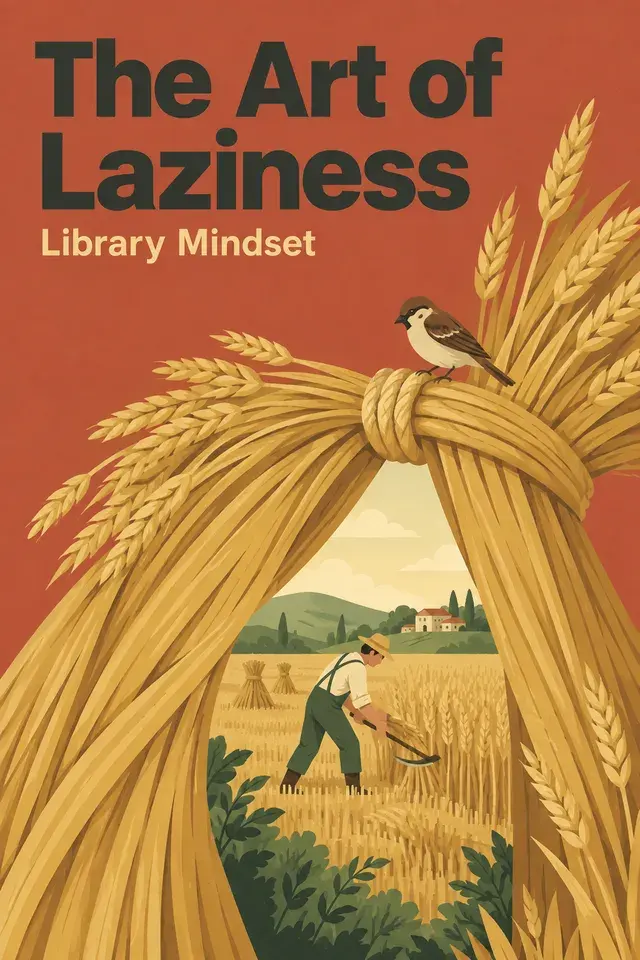
The Art of Laziness, by Library Mindset.
Change begins when a person takes responsibility for the part of a situation they can influence. The book opens with this idea because blame can become a stopping point: a job, a friend, a family member, a spouse, or circumstances may be part of a problem, but naming them does not solve it. The author asks the reader to move from explaining why action is difficult to asking what response is still possible. This is a case for agency, not a claim that a person chooses every condition or controls every result.
The book makes the point through a sparrow and a farmer. The farmer has wheat ready to harvest, but the crop remains uncut. At first, he expects his sons to do the work. The sparrow hears the farmer’s plan and stays calm; the work still depends on whether the sons come. The farmer next says that he will call laborers. Again, the sparrow does not treat the announcement as decisive. The field has not changed, and the farmer is still waiting for someone else to begin.
Then the farmer decides to come and cut the crop himself. This time, the sparrow treats the plan differently. The change is not a stronger promise or new control over other people. The farmer has made himself the person who will do the work. The story separates intention from action: saying who might harvest does not harvest anything. The farmer moves forward when he accepts the task as his own.
The story does not have to mean that help is useless. It shows what happens when progress depends on help that remains only expected. Cooperation can contribute to work, but waiting for another person to act is not the same as taking a step oneself. In the story, neither the sons nor the laborers harvest the wheat. The farmer’s own decision gives the work a clear next move. That is the responsibility the book emphasizes: doing what is within reach instead of making someone else’s future action the condition for any action at all.
The book sometimes expresses its challenge as taking complete responsibility. Read alongside its distinction between what can and cannot be controlled, that language is a call to own one’s response, not proof that a person caused every difficulty. Blaming another person or circumstance can leave someone feeling powerless, while doing nothing does not address the problem. Responsibility begins when a person refuses to treat an obstacle as the whole story if some response remains available.
The book also frames present actions and omissions as influential. This makes waiting a choice with consequences, even when it feels like avoiding a decision. It recommends taking lessons from the past rather than letting old mistakes dominate current judgment. Mistakes are expected; responsibility means letting a mistake inform what happens next, not repeating it or remaining stuck in regret. Beginning today matters because an intention for later can keep a person waiting just as a promise of help keeps the farmer’s crop uncut.
Yet effort has a limit. The text distinguishes controllable factors, such as mindset and how much work a person undertakes, from matters outside personal control, including other people’s thoughts. The farmer can decide to harvest, but he cannot make every circumstance obey him. Nor can anyone guarantee how others will respond. A result may depend on conditions beyond the person trying. The responsibility at stake is choosing one’s effort and response, not claiming ownership of every cause or power over every outcome.
The sparrow and farmer story gives this opening argument its shape. The farmer moves from waiting on others to taking up the work himself. Progress begins in that choice: making the effort within reach while leaving the rest of the outcome uncertain.
Chapter 2 of 11 · 4 min · Audio & textIn the app
Set Goals and Accept Useful Difficulty
Once the choice to act has been made, the next task is to give effort a shape. The author treats familiar comfort as a common source of delay: routines, passive entertainment, or scrolling can occupy time while leaving a person uneasy about what was postponed.
Chapter 3 of 11 · 4 min · Audio & textIn the app
Choose Worthwhile Work and Calibrate Care
When time and energy are limited, choosing what deserves your attention matters as much as deciding how hard to work. The book suggests that what looks like laziness can sometimes come from spending effort on work that feels meaningless or was chosen by someone else.
Chapter 4 of 11 · 5 min · Audio & textIn the app
Protect Attention and Leave Room for Life
Attention is easier to protect when the day and work setting make one task the natural focus. Trying to handle several important tasks at once can create the feeling that more is getting done, but the book argues that attention cannot be fully given to multiple tasks at the same time.
Chapter 5 of 11 · 3 min · Audio & textIn the app
Work Consistently While Results Take Time
Starting is one challenge; continuing when there is little visible feedback is another. The time spent doing the work and the time when its effects become apparent do not always line up.
Chapter 6 of 11 · 4 min · Audio & textIn the app
Choose Advice and Act on Worry
What we do is shaped partly by who is close to us. The author argues that habits spread through ordinary companionship: friends who procrastinate can make that pattern feel normal, while hardworking or book-reading friends can encourage different habits.
Chapter 7 of 11 · 4 min · Audio & textIn the app
Order, Share, and Learn Through Difficult Work
The author ties three choices together: which difficult task to begin, which lower-value work to share, and what is worth learning. The common idea is to make room for effort that matters.
Chapter 8 of 11 · 3 min · Audio & textIn the app
Find Leverage and Set Time Limits
Productivity starts with choosing what deserves the day. A full schedule can still be filled with low-value activity, so the book’s practical starting point is to plan, write down what you intend to complete, and record goals on paper.
Chapter 9 of 11 · 3 min · Audio & textIn the app
Use the Source’s Japanese Principles
The book presents several named Japanese principles as complementary ways to sustain effort. They address different parts of the same problem: what gives effort direction, how change can proceed, how to stay open, and how to continue when work becomes difficult.
Chapter 10 of 11 · 4 min · Audio & textIn the app
Build Flexible Habits and Support Energy
The book’s practical habit advice is meant to make it easier to begin, keep going, and return after a lapse. It pairs small rules for action with ways to notice and support your energy.
Chapter 11 of 11 · 3 min · Audio & textIn the app
Spend Time on a Self-Directed Life
The book’s methods find their purpose in a larger question: What kind of life are our hours helping create? Planning, habits, and focused effort matter because they can make room for things a person values.
Chapter 1 of 11 · 4 min · Audio & text: Take Responsibility and Begin
Wiseley supports reading and listening to summaries in the app.
Continue in Wiseley