What you'll learn
Key ideas from The Art of Influence
These ideas compress the book's argument without treating the author's view as settled fact. Use them as an orientation before reading the full work or listening in Wiseley.
Character and skills work together: character sustains trust, while skills make leadership useful.
Patient influence preserves the other person’s agency and leaves room for later decisions or a continuing relationship.
Trust repair includes admitting mistakes, correcting them, and addressing damage before small cracks become larger breaches.
Optimism is presented as a chosen interpretation of difficulty that keeps attention on possibilities without denying failure or its causes.
Genuine concern shifts influence from winning a transaction toward relationships that can sustain cooperation.
Bobby’s support for Marcus turns influence into a responsibility to use future success for other people.
Inside The Art of Influence
Read the first chapter in full here. The other 5 continue in the Wiseley app.
Chapter 1 of 6 · 8 min · Audio & text
Why People Grant You Influence
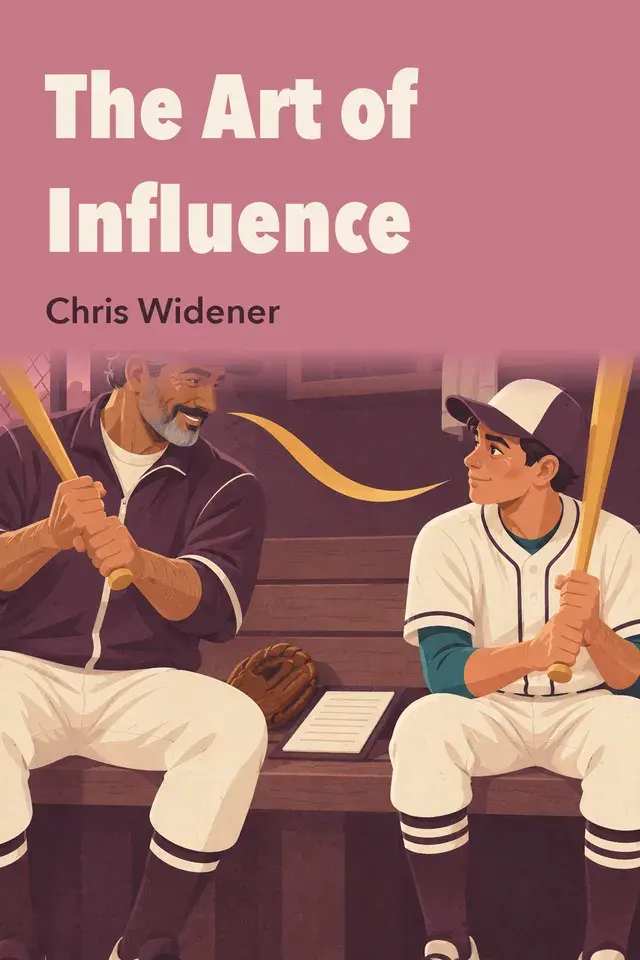
The Art of Influence, by Chris Widener.
The Art of Influence opens with a question that ambition alone cannot answer: why do some people get others to listen, cooperate, follow, or buy? The book presents that question through fiction. Its people, businesses, and events are imagined, so the episodes function as teaching illustrations rather than independent evidence.
At a family barbecue celebrating Marcus Drake’s graduation from Northwestern’s Kellogg School of Management, his achievements sit beside a much larger ambition. He has wanted a business life since childhood, tried small ventures, worked in a corporation, and earned an MBA. Now he proposes connecting American companies with foreign investors and reducing currency-exchange costs. Marcus believes the efficiencies could save organizations billions, including nonprofits that move money internationally, but the story offers no demonstration that this estimate is accurate. It is an aspiration, not a proven result.
His grandmother, Beatrice, gives him an unusual opportunity: several days with Bobby Gold, a businessman she had once been a nanny for. The gift is time and access, not money or a seminar. Bobby agrees to bring Marcus along on a trip. The arrangement briefly puts Marcus near someone whose business record is presented as exceptional, but its real value is the question Bobby raises. Marcus already has education, confidence, and a business idea. What he lacks is an understanding of how people decide whether another person is worth following or buying from.
Bobby calls influence the key to success and the art of business. Business school teaches what he describes as the science: calculations and other predictable parts of running a company. Those matters still count. So do hard work, persuasion, and technical knowledge. Bobby’s point is that they cover only part of the work, because business happens through human decisions. Influence is the capacity to affect another person’s thoughts, beliefs, or actions. In practice, it can make people want to listen, learn, cooperate, work with, or buy from someone. It is central to both sales and leadership.
This is why the book separates persuasion from influence. Persuasion concerns techniques: making an argument, delivering a presentation, or trying to win someone over. Influence concerns the person using those techniques. A polished pitch may change a decision once, but durable influence depends on who the listener believes the speaker to be. Bobby says the strongest way to manage perception is to make the desired positive impression real, rather than manufacture it. People do business with people, not with abstract numbers or corporate names alone. Their judgment of character therefore affects whether the relationship continues.
Most importantly, influence is not self-assigned. A person cannot simply declare himself a leader. Buyers and followers decide whether to grant influence; they can choose to purchase, follow, listen, or walk away. The individual controls only the kind of person he becomes and the capabilities he develops. That makes influence a gift from another person’s judgment, not a possession someone can claim. It also makes leadership more demanding than appearing confident. The task is to become someone others find trustworthy and useful, not merely to look persuasive.
To make that judgment concrete, Bobby asks Marcus to list qualities people want in executives. Marcus names honesty, passion, vision, empowerment, fairness, decisiveness, listening, communication, courage, and a positive attitude. The exercise is practical because it shifts attention away from the speaker’s self-image and toward what listeners value. The qualities divide between character and skills, and Marcus reports eight character traits and two skills; the story does not identify the individual assignments. The categories work together: people want both a person they can trust and a person who can perform.
Bobby reports that when thousands of executives complete similar exercises, their lists usually contain roughly 70 to 80 percent character traits. The book presents that proportion as Bobby’s observation from his work with executives, not as an independently established research finding. His larger point is not that skills are secondary in every situation or that character can replace competence. Someone with character but no ability may be admirable, yet people will not want to follow ineffective leadership. Conversely, someone with strong skills but weak character may lead temporarily, until people stop trusting the person and no longer do business with them. Leadership, sales, and business relationships ultimately depend on trust.
Bobby also says organizations often devote more training to skills than to character, and he links that imbalance to companies failing or never getting started. Again, the argument is not anti-education. Knowledge, effort, technical skill, and persuasive ability remain useful tools. The issue is whether those tools are carried by a person whose conduct supports confidence. A powerful speech cannot compensate indefinitely for dishonesty or unfairness. To attract people who value vision, passion, fairness, honesty, and positivity, the leader must embody those qualities.
The story then adds a harder test: what happens to character when success requires a painful choice? Bobby rejects the impression that his achievements came only from luck or privilege. He describes decades of decisions and overlooked hardships, then tells Marcus about his first business. The company stalled because Bobby’s partner would not continue growing as a person or leader. Bobby bought him out. The decision produced a severe personal cost: the former best friend sued him and never spoke to him again. Bobby believed the agreement was sound and that the company’s later growth justified the outcome, but the financial resolution did not restore the friendship.
That episode illustrates the book’s broader view of adversity. People cannot control every good or bad event, Bobby says, but they can control their responses. Experience can become part of leadership when a person learns and grows from it; fear, paralysis, or refusal to change can instead narrow future choices. The book does not present hardship as automatically beneficial. Its claim is that growth is a response, and that response helps shape the character other people later encounter. Bobby’s business separation therefore matters less as a formula for handling partners than as an example of development through loss.
That is the foundation of the chapter. Influence is granted by other people when character and capability make someone worth trusting, following, or buying from. Education, effort, persuasion, and technical skills still matter, but they do not remove the other person’s choice. The central question is not simply how to convince someone. It is who the influencer is becoming, what that person can reliably do, and whether experience is being turned into greater usefulness. Every later practice rests on that combination of trustworthy character and developed skill.
Chapter 2 of 6 · 8 min · Audio & textIn the app
Attract Interest Without Applying Pressure
Influence can be pursued like hunting or like fishing. Hunting follows and pressures a target until the target retreats, literally or figuratively.
Chapter 3 of 6 · 7 min · Audio & textIn the app
Make Integrity Consistent and Repairable
Influence becomes durable when a person's word and conduct can be treated as one thing. Bobby presents this as the first Golden Rule of Influence: live a life of undivided integrity.
Chapter 4 of 6 · 8 min · Audio & textIn the app
Use Optimism to Restore Agency
The book’s second Golden Rule is to always demonstrate a positive attitude. It treats optimism as more than a pleasant mood.
Chapter 5 of 6 · 6 min · Audio & textIn the app
Put Others at the Center
The third Golden Rule turns attention outward: consider other people’s interests more important than your own. The point is not to erase your goals or become passive.
Chapter 6 of 6 · 10 min · Audio & textIn the app
Practice Excellence and Share Its Returns
By the time the story reaches the fourth Golden Rule, excellence is more than doing one job well. It is a pattern of repeated choices across a life.
Chapter 1 of 6 · 8 min · Audio & text: Why People Grant You Influence
Wiseley supports reading and listening to summaries in the app.
Continue in WiseleyWhat The Art of Influence is about
What makes people willing to trust, follow, or buy from someone? Through a fictional business mentorship, Chris Widener connects influence with character and competence. The summary explores how integrity, optimism, genuine interest in others, and everyday excellence can shape relationships, leadership, and the responsible use of success.
About Chris Widener

Chris Widener is an American author and motivational speaker. “The Art of Influence” explores how influence grows from character and competence, told through a fictional business mentorship.
Explore more books by Chris Widener