What you'll learn
Key ideas from The Art of Conscious Conversations
These ideas compress the book's argument without treating the author's view as settled fact. Use them as an orientation before reading the full work or listening in Wiseley.
Stories join emotions, documentable events, and opinions; autopilot can make their interpretations feel like a single truth.
Private thoughts can aid problem-solving or intensify fear, blame, and shame; examining them differs from blurting them out or suppressing them.
Mindful listening attends to words, feelings, tone, and reactions, though it takes effort to quiet inner dialogue.
Accepting facts can end futile resistance and clarify what remains open to influence; it does not require approval or passivity.
Dialogue lets perspectives influence one another before a group settles on a conclusion.
A reliable commitment depends on shared expectations for completion and a considered yes, no, or counteroffer.
Trust rests on competence, sincerity, and reliability, and can reopen through clear agreements and kept promises over time.
Inside The Art of Conscious Conversations
Read the first chapter in full here. The other 7 continue in the Wiseley app.
Chapter 1 of 8 · 6 min · Audio & text
Waking Up to Conversational Choice
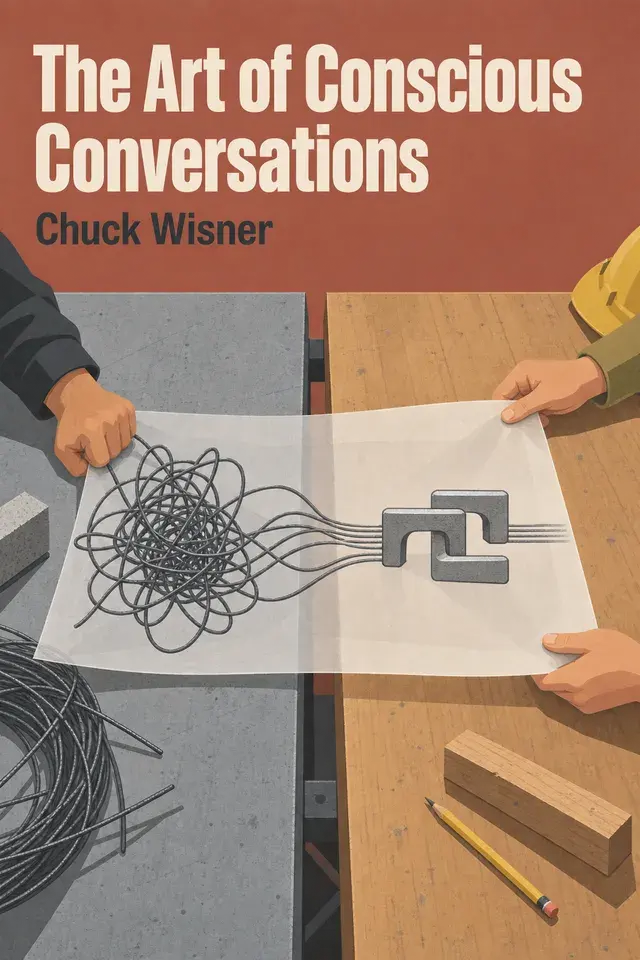
The Art of Conscious Conversations, by Chuck Wisner.
At one construction meeting, the facilitators expected to approve eighty percent of a payment request. The owner’s representative pressed for more concessions and argued that a request for one hundred fifty thousand dollars had not been earned. Without the full payment, Joe and his son could not pay their subcontractors, and the project would come to a screeching halt. The disagreement sharpened into personal insults. Then Joe’s son attacked the representative, and the facilitators had to break up the fight. The people in the room were working on the same project, but that shared purpose did not keep the exchange from collapsing.
The participants were intelligent, and they had good intentions. They also brought separate agendas, concerns, and reasons for their positions. Wisner recalls that disputes like this were common in construction, where high stakes and hardened positions could make conversations fail. Avoiding difficult encounters, he argues, does not teach people how to handle them. The practical question is how to notice what is shaping a conversation before it takes over.
The book’s answer begins with awareness. People often speak and listen without noticing the thoughts beneath their emotions. Private stories and quick reactions affect what seems important, what another person’s words appear to mean, and what gets said in response. When these habits go unexamined, people can repeat familiar patterns without seeing the choices available to them. Becoming more conscious means noticing that thoughts and stories are part of the conversation and can influence its direction.
Wisner organizes the book around four complementary kinds of conversation. A client’s question about how several helpful tools fit together prompted him to group them into a framework. The four modes give listeners a map of different kinds of work a conversation can do: examine one’s stories, understand other perspectives, open possibilities, and coordinate action.
Storytelling conversations concern the narratives people tell themselves and others. These stories help define how people show up in the world. The chapter explores unspoken narratives and their complex relationship to emotions, facts, and opinions. This mode matters because people bring their own accounts of what is happening into every interaction, even when they do not say those accounts aloud.
Collaborative conversations turn toward perspectives beyond one’s own. They make space to listen to what another person thinks and to consider differences in view. Collaboration involves both sharing a perspective and remaining open to inquiry. The purpose is not simply to smooth over disagreement. It is to make understanding another person’s position part of the conversation, alongside expressing one’s own.
Creative conversations make room for insight, intuition, and possibility. They can help people generate ideas and notice opportunities that were not apparent at the outset. This mode widens attention beyond the immediate exchange of arguments or established answers. Wisner presents it as a way to open minds and hearts to new ideas, while leaving the detailed practices for later chapters.
Commitment conversations coordinate action. Everyday life depends on promises and agreements, from household tasks to major contracts. Such conversations establish who will do what, and determine when, how, where, or why. The overview’s point is that commitments are a central part of communication: they turn what people discuss into coordinated plans, and mindful commitments can support trust.
The four modes are not isolated stages that must always happen in a fixed order. They can appear together quickly, or one may need more attention in a particular situation. A disagreement over payment, for example, has a story about what has been earned, differing perspectives about the work, possible paths forward, and a need to coordinate what happens next. That does not mean one mode alone explains or solves the dispute. The framework helps identify the kinds of conversation taking place, so the exchange is easier to understand.
The book’s progression moves from personal stories to other perspectives, then to intuition and creative possibility, and finally to commitments. Each mode receives practical attention in the chapters that follow. Here, the map establishes why noticing matters: the words in a conversation are only part of what shapes it. The habits and stories beneath them can influence how people interpret one another and what actions seem possible.
Wisner invites readers to observe themselves and their conversations with curiosity and less self-judgment, and suggests writing down observations. This is a demanding practice of attention, not a promise of bliss. The aim is to become more aware of familiar patterns and to make more conscious choices over time. The opening conflict shows the stakes: a shared project and good intentions may not be enough. Awareness can help people see the conversation they are having, and the choices within it.
Chapter 2 of 8 · 11 min · Audio & textIn the app
How Stories Take Over
We do not meet events as blank slates. A situation reaches us through what we notice, what we expect, and what we remember.
Chapter 3 of 8 · 10 min · Audio & textIn the app
Reading the Private Conversation
A conversation has an audible side and a private one. While we speak, an inner committee may be weighing what happened, rehearsing what to say, or imagining what might happen next.
Chapter 4 of 8 · 11 min · Audio & textIn the app
Listen With Curiosity and Candor
Private reflection can help someone notice the stories and reactions they bring to a conversation. Collaboration begins when those insights affect how people speak and listen together.
Chapter 5 of 8 · 9 min · Audio & textIn the app
Accept Reality, Reopen Possibility
Creative thinking can begin with acknowledging a limit. When events contradict what we hoped would happen, it is tempting to argue inwardly with reality or defend a familiar story.
Chapter 6 of 8 · 8 min · Audio & textIn the app
Co-Create Beyond Hierarchy
Co-creation begins when participants share their views and stay open long enough for those views to affect one another. Wisner distinguishes dialogue from a conversation aimed mainly at settling a decision.
Chapter 7 of 8 · 10 min · Audio & textIn the app
Make Promises That Can Hold
People coordinate their lives through ordinary commitments: asking someone to do a task, offering help, or agreeing to take responsibility for an action. These promises connect one person’s next steps to another’s.
Chapter 8 of 8 · 8 min · Audio & textIn the app
Repair and Rebuild Trust
Even a promise made with good intentions can fail. A missed commitment may damage a task, a relationship, or confidence in what people say.
Chapter 1 of 8 · 6 min · Audio & text: Waking Up to Conversational Choice
Wiseley supports reading and listening to summaries in the app.
Continue in WiseleyAbout Chuck Wisner

Chuck Wisner is the author of “The Art of Conscious Conversations”. The book explores how people can speak, listen, and make agreements without being ruled by untested stories.
Explore more books by Chuck Wisner