What you'll learn
Key ideas from The Anatomy of Anxiety
These ideas compress the book's argument without treating the author's view as settled fact. Use them as an orientation before reading the full work or listening in Wiseley.
Bodily stress and meaningful distress can coexist, so one explanation may not account for the whole experience.
Anxiety can interrupt sleep, while short or mistimed sleep can increase vulnerability to anxiety.
Intentional limits on apps, news, and device access can ease anxiety without rejecting technology, journalism, or accountability.
Psychiatric medication can bring real relief while side effects or withdrawal can also produce anxiety-like symptoms.
Movement, expression, and connection offer distinct routes for completing activation, while brief enjoyable exercise makes repetition more realistic.
Feelings offer evidence about experience, but they need interpretation alongside context, practical consequences, and reason.
Early attachment strategies can persist into adulthood, while self-compassion, reliable relationships, and trauma-informed support may help revise them.
Surrender means releasing control over outcomes while continuing to take practical action where it remains possible.
Inside The Anatomy of Anxiety
Read the first chapter in full here. The other 12 continue in the Wiseley app.
Chapter 1 of 13 · 8 min · Audio & text
Anxiety as Signal and Symptom
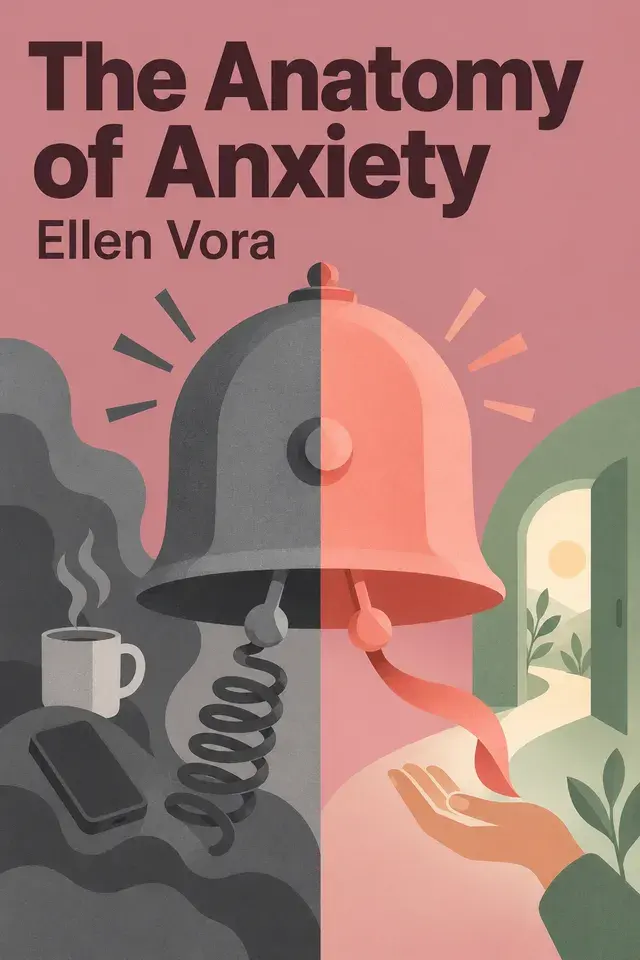
The Anatomy of Anxiety, by Ellen Vora.
Anxiety can feel like proof that something is wrong with us or with our lives. Ellen Vora proposes a more open question: what might this alarm be responding to? Sometimes the body is under strain, and its stress response is experienced as anxious thoughts and sensations. Sometimes anxiety carries information about a need, a relationship, trauma, or a life that no longer fits. Vora’s approach begins by considering both possibilities, because the source can change what kind of response may help.
She calls these possibilities “false anxiety” and “true anxiety,” but the terms are not diagnoses. “False” describes a proposed source, not whether the distress is real. Anxiety caused by a bodily imbalance can be severe and frightening. The label simply suggests that a direct physical contributor may be worth addressing. “True” anxiety describes distress that may be a meaningful response to loss, unmet needs, misalignment, or human vulnerability. These terms are ways to inquire, not boxes that settle a person’s story.
Vora argues that a bodily alarm can arrive before the mind knows why. Hunger, poor sleep, caffeine, or other physical strain may activate a stress response. The mind then tries to explain the unease, perhaps by fastening on a work problem or relationship worry. That explanation may be plausible without being the whole cause. Seeing this possibility can loosen the feeling that every anxious thought is an accurate forecast. It does not prove that the concern is imaginary or that nothing in life needs attention.
The other possibility matters just as much. Anxiety can point toward something that is painful to acknowledge: a relationship that leaves needs unmet, a life out of line with one’s values, or the effects of trauma. Vora does not treat every persistent feeling as a message with an obvious answer. She presents it as a reason to become curious about what may need care or change. And even when a bodily contributor is reduced, deeper fears and conflicts may remain.
As a first check, Vora offers the False Anxiety Inventory. It is a pause to consider immediate contributors before settling on an explanation. Have you eaten, or might hunger be adding to the unease? Are you tired? Could caffeine, including having too much or less than usual, be affecting you? Are you thirsty? Has internet or social-media use become overwhelming? Is alcohol having an effect, or is a medication due at its usual time? The inventory makes these ordinary possibilities easier to notice.
The point is not to turn the list into a demanding health program. It is to match a likely contributor with a simple, proportionate response: eat if you are hungry, drink water if you are thirsty, take a break from digital stimulation, or notice whether tiredness is part of the picture. With medication, the check is about timing a dose as prescribed, not changing or stopping it. If one small adjustment helps, that is useful information. If it does not, the result does not invalidate the distress; it may mean that another factor needs attention.
Vora’s larger framework also calls for humility about explanations. A diagnosis can give shape to confusing experience and guide care, but it need not become the whole account of a person. Biology matters, but so do thoughts and circumstances. Personal choices can influence well-being, yet anxiety should not be reduced to blame for failing to make the right choices. Vora presents body-based changes as one possible route, not a universal answer or a replacement for professional care.
Janelle’s story illustrates the bodily side of the framework. After hospitalization for mania and a bipolar diagnosis, she was later identified as having Hashimoto’s thyroiditis. Vora reports that dietary and lifestyle changes, alongside a gradual medication taper, preceded improvement. This is a reported case involving several factors, not proof that one physical cause explains everyone’s anxiety or that anyone should change medication on their own. It does show why a psychiatric label need not end the search for other contributors.
So-young’s story points toward a different source. As she became less medicated, she experienced a wider emotional range and recognized entrenched behavior in her marriage that she found unacceptable. After years of people-pleasing, she began advocating for rest, sexual autonomy, friendships, and respect. Difficult conversations were followed by some improvement in how her husband treated her, though Vora does not claim to know how the marriage would ultimately develop. Her anxiety became less prominent as she took her needs seriously. The case shows how distress can reveal a relational problem that bodily adjustments alone would not resolve.
The contrast is not a choice between a physical explanation and a meaningful one. Anxiety can involve both: bodily stress may intensify distress about a real problem, while trauma or life circumstances can affect how the body responds. A first check of sleep, hunger, caffeine, hydration, medication timing, or digital stimulation may reduce avoidable strain and make the remaining concern easier to understand. It cannot guarantee that the deeper concern will disappear.
Vora’s central invitation is to treat anxiety as both something to address and something to interpret. First ask what the body might need; then stay open to what the feeling may be saying about life. Neither a diagnosis, a biological account, nor personal choice explains every case on its own. Understanding the possible source can help a person respond with care instead of dismissing the alarm or assuming it tells the whole story.
Chapter 2 of 13 · 8 min · Audio & textIn the app
Sleep and the Wired Body
Sleep sits on both sides of anxiety. Worry and physical alertness can keep a person awake, while too little or mistimed sleep can leave them more vulnerable to anxiety the next day.
Chapter 3 of 13 · 6 min · Audio & textIn the app
Technology's Anxious Environment
Technology brings real conveniences, but it can also create recurring sources of anxiety. Screens may stand between people and nourishing contact, carry work into every hour, and keep attention fixed on whatever will provoke another check.
Chapter 4 of 13 · 10 min · Audio & textIn the app
Food, Mood, and Safety
Food can become a source of anxiety before anyone takes a bite. Nutrition advice shifts, and foods once praised may later be treated as harmful.
Chapter 5 of 13 · 11 min · Audio & textIn the app
When the Body Signals Danger
Anxiety can arise alongside many kinds of strain. In this chapter, Vora adds inflammation and immune activity to the possible bodily contributors.
Chapter 6 of 13 · 8 min · Audio & textIn the app
Hormones, Gender, and Anxiety
Women’s anxiety can be shaped by hormonal physiology and by the way care systems respond to women’s reports. Vora’s point is not that every anxious feeling has a hormonal cause.
Chapter 7 of 13 · 6 min · Audio & textIn the app
Medication, Relief, and Withdrawal
Psychiatric medication can bring meaningful relief, and it can also cause side effects or changes that feel like anxiety. Vora does not stigmatize people who take medication or assume that physicians intend harm.
Chapter 8 of 13 · 7 min · Audio & textIn the app
Completing the Stress Response
Anxiety can linger after immediate danger has passed because the body may still be mobilized. In this chapter, Ellen Vora turns to the practical question of how to help that activation settle.
Chapter 9 of 13 · 8 min · Audio & textIn the app
Learning to Hear Anxiety
After bodily contributors have been considered, anxiety that keeps returning may call for a different response: listening for the pattern it carries. Vora treats some anxiety as information about needs, values, or circumstances that deserve attention.
Chapter 10 of 13 · 9 min · Audio & textIn the app
Feelings, Therapy, and Altered States
Listening to anxiety can reveal what needs attention, but acting on that information requires another skill: distinguishing an inner signal from fear, habit, or someone else’s expectations. Ellen Vora argues that feelings belong in decision-making alongside reason.
Chapter 11 of 13 · 6 min · Audio & textIn the app
Rest Against the Work Imperative
Vora links burnout to a culture that treats rest as a reward for finishing everything, rather than as a basic human need. When productivity becomes the measure of worth, the workday has no natural end: there is always another task, another goal, or another way to prove that you are doing enough.
Chapter 12 of 13 · 7 min · Audio & textIn the app
Connection as a Calming Practice
Anxiety can make connection feel like one more task to manage, yet Vora treats belonging as a basic human need. She invokes the Grant Study’s conclusion that happiness is fundamentally tied to love, and argues that relationships matter deeply to well-being.
Chapter 13 of 13 · 7 min · Audio & textIn the app
Letting Go Without Giving Up
By this point, anxiety has been treated as both distress and a possible signal. Vora’s closing question is how to live with what a signal cannot settle: what will happen, how other people will act, or what a painful event ultimately means.
Chapter 1 of 13 · 8 min · Audio & text: Anxiety as Signal and Symptom
Wiseley supports reading and listening to summaries in the app.
Continue in WiseleyAbout Ellen Vora

Ellen Vora is a psychiatrist and author. “The Anatomy of Anxiety” explores when anxiety is a bodily stress response and when it signals a deeper problem.
Explore more books by Ellen Vora