What you'll learn
Key ideas from The Ageless Brain
These ideas compress the book's argument without treating the author's view as settled fact. Use them as an orientation before reading the full work or listening in Wiseley.
Bredesen argues that improvement is less likely or less complete later in decline, making early attention important.
Brain aging can be understood as a mismatch between the support a neural network needs and the demands placed on it.
A meaningful reason can connect health intentions to repeatable choices, while access, cost, and individual circumstances shape what is realistic.
Testing is most useful when a baseline and a focused question guide follow-up over time.
Food quality depends on recognizable ingredients, degree of processing, retained fiber, and carbohydrate absorption; health claims such as “plant-based” do not establish quality.
A useful exercise routine is regular, sustainable, and adapted to a person’s ability and health.
Novel cognitive challenges, social contact, and emotional practice offer complementary ways to exercise resilience when paced to capacity.
Seven foundational modalities form an adaptable plan, with actions selected around the person’s findings and circumstances.
Inside The Ageless Brain
Read the first chapter in full here. The other 13 continue in the Wiseley app.
Chapter 1 of 14 · 7 min · Audio & text
Detecting Decline Before Dementia
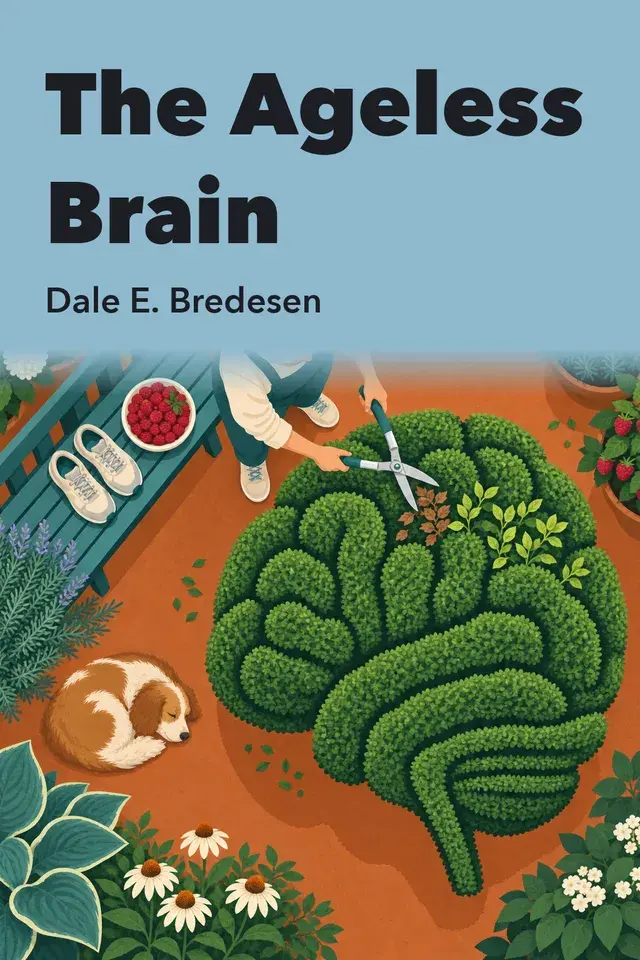
The Ageless Brain, by Dale E. Bredesen.
Memory lapses are often written off as an unavoidable part of getting older. Dale Bredesen challenges that assumption. He argues that cognitive decline is not simply inevitable, and that waiting until dementia disrupts daily life can mean missing earlier opportunities to respond. His opening argument is prevention first: notice changes as early as possible, while there may still be room to protect function.
That argument depends on distinguishing two aims. One is cognitive performance: how clearly and quickly a person thinks now. The other is protection: preserving the brain’s ability to function over time. Bredesen argues that strong performance at a particular moment does not necessarily mean the brain is protected against future decline. He also warns that some approaches that make someone feel sharper in the short term may come at a cost to longer-term protection. For him, the goal is not simply to improve today’s performance, but to sustain it.
Bredesen says care should begin before a person reaches a crisis. He compares cognitive decline with other chronic illnesses, where prevention, treatment after problems emerge, and crisis care address different stages. In his view, waiting for severe symptoms before taking cognition seriously leaves less opportunity to act. This is why he favors identifying the transition from wellness toward disease, rather than treating dementia as the first meaningful point for attention.
To explain that transition, he describes four stages. First come presymptomatic biochemical changes, before a person notices a problem. Next is subjective cognitive impairment: someone senses that memory or thinking has changed, while cognitive testing remains within the normal range. In mild cognitive impairment, test results are below normal, but everyday activities remain intact. Dementia is the stage at which cognitive problems interfere with daily tasks and independence. Bredesen presents these stages as a process that can extend over roughly two decades, leaving time to respond before ordinary life is substantially affected.
The stages also clarify why an occasional lapse should not be treated as proof of dementia. Healthy people sometimes forget something, and a single mistake says little on its own. Bredesen notes that early concerns are often explained away as distraction, exhaustion, overwork, poor sleep, or stress. Those explanations may fit a particular lapse, but they can also postpone attention to a pattern of change. His point is not that every memory slip signals disease; it is that persistent concerns deserve more than automatic reassurance that aging explains them.
Nina’s experience shows how a change can first look ordinary. In her forties, with a family history of Alzheimer’s, she described misplacing things, brain fog, and trouble focusing. She regarded these as minor age-related lapses. On the Montreal Cognitive Assessment, a quick screening test scored out of thirty, she received a twenty-three. After assessment and an intervention regimen, Bredesen reports that her score rose to thirty over a year and that the problems she had described resolved. He offers this as one person’s reported course, not a guarantee that the same result will follow for others.
The case also shows why a score needs context. The MoCA is a screening snapshot, not a diagnosis of dementia, and Bredesen cautions that the test can be wrong. Nina’s score alone could not establish what caused her difficulties or settle what would happen next. Her experience supports his case for taking concerns seriously and following up, while the reported improvement illustrates that some early problems may change. A test can describe performance at one point; it cannot, by itself, answer the broader question of how well the brain is protected over time.
Richard Feynman’s experience illustrates a different limit: a person may not recognize changes in their own thinking. After an injury, he was confused, drove poorly, and gave lectures that made little sense. He did not recognize the extent of the change until his wife insisted that he see a doctor. Bredesen uses this episode to show that self-assessment can fail. Someone close to a person may notice a change that the person experiencing it cannot see clearly.
Together, Nina’s and Feynman’s stories make early attention more complicated than simply asking whether someone feels impaired. Nina initially minimized her symptoms as normal aging, while Feynman did not recognize the changes after his injury. A reassuring self-assessment cannot always settle the question, just as a low screening score cannot establish dementia. Bredesen’s argument is to consider concerns, observations from others, and assessment together, without turning any one sign into a verdict.
He says improvement becomes less likely, and may be less complete, as decline advances. In his account, people treated later can sometimes regain abilities or stabilize, but gains in advanced dementia may be partial, and care can become more extensive and difficult. He also acknowledges that the field does not yet know enough to reverse symptoms in every case. His prevention-first argument rests on this asymmetry: there may be more opportunity to preserve or regain function earlier, while delay can narrow the possibilities.
Bredesen introduces individualized care as a response to the fact that cognitive decline can unfold differently from person to person; the later chapters examine how he proposes to assess and address those differences. He acknowledges that his approach is outside mainstream medicine. The broader claim here is more limited: cognitive change should not be dismissed as an inevitable price of age, and evaluation need not wait for dementia. Earlier attention does not promise a particular outcome, but it keeps the possibility of timely action in view.
Chapter 2 of 14 · 6 min · Audio & textIn the app
How Aging Stresses the Brain
Brain aging is easier to make sense of, Bredesen argues, when we ask two questions together: what does a neural network need to keep working, and what biological burdens are competing for its capacity? In his model, a subnetwork can falter when support declines, demand rises, or both.
Chapter 3 of 14 · 5 min · Audio & textIn the app
Defining a Hundred-Year Brainspan
Brainspan is the length of time a person can live with sound cognitive abilities. Bredesen’s practical benchmark is reaching 100 without losing mental capacity.
Chapter 4 of 14 · 6 min · Audio & textIn the app
Prevention, Evidence, and Profit
Bredesen places his prevention-first argument inside a dispute about what health care is organized to reward. In his account, medicine often steps in after symptoms become serious, when patients may need ongoing treatment.
Chapter 5 of 14 · 5 min · Audio & textIn the app
Finding a Reason to Persist
Knowing what may support health does not make change automatic. The author points to the gap between understanding a benefit and choosing it repeatedly in daily life.
Chapter 6 of 14 · 7 min · Audio & textIn the app
Measuring Risk and Brain Change
Measurements can help turn concern into a clearer question: could a bodily condition be adding strain, is the brain showing signs of change, and is the pattern shifting? A result is a signal to interpret, not a diagnosis or a forecast by itself.
Chapter 7 of 14 · 9 min · Audio & textIn the app
Building a Brain-Supportive Diet
The author presents diet as a practical starting point for supporting brain health, but not as a single pattern that suits everyone. His preferred approach is KetoFLEX 12/3: plant-rich rather than plant-only, mildly ketogenic, and built around varied whole foods.
Chapter 8 of 14 · 8 min · Audio & textIn the app
Training the Brain Through Movement
Movement is more than the muscles doing their job. Following a trainer’s spoken instruction requires the brain to register sound, interpret what it means, and send motor signals through the spinal cord to the muscles.
Chapter 9 of 14 · 8 min · Audio & textIn the app
Sleep, Clearance, and Restoration
Sleep is part of the brain’s maintenance, but its value depends on more than time spent in bed. Bredesen’s approach is to improve the night while also reducing the strain the brain carries into it.
Chapter 10 of 14 · 7 min · Audio & textIn the app
Plasticity in Mind and Relationship
The brain can continue changing throughout life. Its connections can strengthen, weaken, or reorganize in response to what a person does and experiences.
Chapter 11 of 14 · 9 min · Audio & textIn the app
Investigating Environmental Exposures
When changes to eating, movement, or sleep do not bring enough improvement, the author widens the inquiry to a person’s home and workplace. These settings can contain burdens that are harder to change than daily habits.
Chapter 12 of 14 · 8 min · Audio & textIn the app
Microbes, Immunity, and the Brain
The author widens the discussion of brain aging to include the communities of bacteria, viruses, fungi, and other microbes living on and within the body. Some relationships are useful, others harmful, and their effects remain incompletely understood.
Chapter 13 of 14 · 8 min · Audio & textIn the app
Promise and Limits of Emerging Therapies
The author first returns to an eighty-year-old who still has strong memory, focus, orientation, and mood. He imagines this person adding brain-supportive changes over time: improving diet, then building regular exercise, and later making room for cognitive challenge and social connection.
Chapter 14 of 14 · 7 min · Audio & textIn the app
A Personalized Prescription in Practice
The practical prescription is a continuing cycle: measure, investigate, choose actions suited to the person, and reassess. A test result is a signal to interpret alongside symptoms, history, and other findings.
Chapter 1 of 14 · 7 min · Audio & text: Detecting Decline Before Dementia
Wiseley supports reading and listening to summaries in the app.
Continue in WiseleyAbout Dale E. Bredesen

Dale E. Bredesen is an American neurologist who studies neurodegenerative disease. “The Ageless Brain” explores why memory and reasoning change with age and how much of that change can be influenced before serious impairment.
Explore more books by Dale E. Bredesen