What you'll learn
Key ideas from The ADHD Advantage
These ideas compress the book's argument without treating the author's view as settled fact. Use them as an orientation before reading the full work or listening in Wiseley.
The effects of traits depend on persistence, developmental age, setting, and interference with everyday functioning.
Curiosity, movement, and novelty may support exploration, while routine and fading interest can make sustained effort difficult.
Interest-led lessons and short work periods can coexist with clear expectations, tailored course levels, and coaching.
Setbacks may build adaptability when support, reflection, and adjusted attempts help a person recover; hardship alone does not guarantee growth.
Bounded exploration and external notes preserve ideas while helping them stay separate from current priorities.
Urgency is most useful when tied to a worthwhile goal, buffered before the real deadline, and paired with reminders and clear communication.
Shared, brief reminders can make tasks visible without assigning one partner the enforcer role.
Career fit becomes clearer when interests, strengths, difficulties, and daily work conditions are considered together.
Inside The ADHD Advantage
Read the first chapter in full here. The other 10 continue in the Wiseley app.
Chapter 1 of 11 · 10 min · Audio & text
ADHD Traits, Context, and Diagnosis
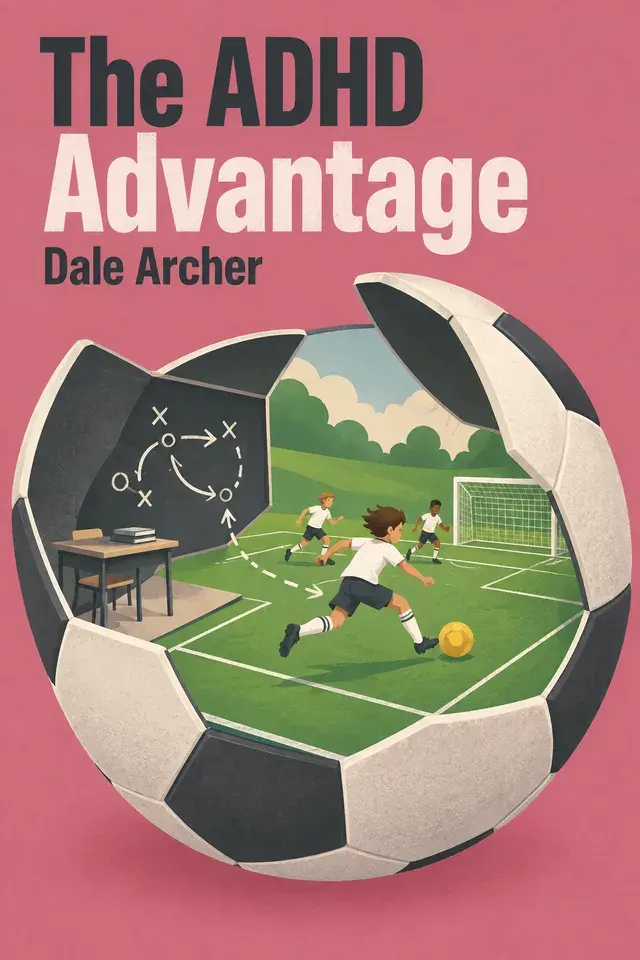
The ADHD Advantage, by Dale Archer.
Archer’s starting point is a continuum: ADHD-associated traits vary in degree, rather than dividing people neatly into those who have them and those who do not. He uses a one-to-ten scale to illustrate this range, marking where normal ends and something diagnosable and treatable begins. Still, a high score does not necessarily mean dysfunction: a person may have prominent traits and function well, and the score alone does not show that support is needed.
The traits also differ from person to person. Inattention, restlessness, impulsivity, and difficulty with routine may appear in different combinations and intensities. Archer describes possible strengths linked to some of these patterns, but they are neither exclusive to ADHD nor shared by everyone with ADHD. At their extremes, or in a setting that repeatedly demands what is difficult for a person, the same tendencies may interfere with daily life. Their meaning depends on their effects, not just their names.
Ty Pennington’s school years show how context can make those effects visible. The book describes him as energetic and bored in class, sometimes disruptive as he tried to entertain himself. He was punished and stigmatized. A move to a new school briefly improved his grades, which Archer connects to the novelty and stimulation of a changed environment; when that wore off, the difficulty returned. The episode suggests that a change in circumstances can ease a problem temporarily without resolving it.
Soccer offered a different setting. Ty says it gave his energy an outlet and helped his confidence grow; he learned to read the field and began scoring. Later, drawing and visual cues helped him work with material that was hard to retain from written text. A therapist recognized promise in his drawings and encouraged him toward carpentry and art. He went on to work in painting, modeling, and set design before finding roles in television that involved visual work, movement, quick changes, and demanding deadlines. Archer presents Ty’s reported ADHD diagnosis and varied career as one person’s history, not a formula for what others with similar traits will need or excel at.
The central question, then, is whether a pattern causes lasting difficulty in ordinary functioning. The diagnostic criteria Archer discusses look for symptoms across more than one setting, persistent over time, and clearly interfering with social, school, or work life. They also require attention to whether behavior is beyond what is expected for a person’s development. A single trait, a difficult stretch, or a problem in one class cannot answer all of those questions. Similar behaviors may have other explanations, too. The book names poor sleep, anxiety, and problems at home as possibilities to consider, and notes that ADHD-like difficulties can overlap with other conditions.
Age changes how behavior should be read. Running, climbing, or fidgeting can be ordinary in very young children, while the same movement may become disruptive in a classroom where students are expected to sit still and follow routines. Archer also points to research he cites about younger children within a school grade being more likely to receive a diagnosis than older classmates. He treats relative maturity as a reason to be cautious when judging behavior. As people grow, outward hyperactivity may diminish, and more freedom to choose activities can change how troublesome traits appear. That change does not mean every difficulty has disappeared; it means assessment should consider age and setting together.
Because the book describes diagnosis as relying on interviews, observations, and reports rather than a single accepted blood test or brain scan, the quality and breadth of the information matter. Archer contrasts a brief visit with a fuller assessment that gathers medical, school, work, and social history; considers symptoms over time and across settings; seeks relevant reports from people who know the individual; and screens for other explanations. He favors careful review when impairment persists. Such an assessment can ask both what is going wrong and where the person functions well, so a label does not flatten a varied profile.
The book raises a further question about differences in recognition by sex and gender. Archer reports that boys are diagnosed more often than girls, but argues that diagnosis counts do not establish that the underlying traits are equally common or uncommon in each group. He suggests that girls’ difficulties may be less visible when they involve daydreaming, worry, perfectionism, or low self-esteem rather than conspicuous hyperactivity. He also notes that much of the research has focused on boys and men and says it has not explained the pattern. His account is therefore qualified: the possible role of presentation and gender expectations needs more research, and it should not become a template for diagnosing any individual.
Shanna Pearson’s story illustrates why less visible difficulties may go unrecognized. She questioned a depression diagnosis because it did not fit how she felt. At thirty-two, someone she trusted suggested ADHD. Shanna described nervous energy, scattered thoughts, daydreaming, and boredom, without being hyperactive. Learning about ADHD-associated patterns helped her make sense of her experience and build on her strengths in coaching. Her story shows a route to later recognition; it does not make those experiences proof of ADHD or mean that everyone with a similar profile has the same explanation.
The chapter’s self-rating quiz belongs in this same spirit of inquiry. It asks about experiences such as trouble sustaining focus, restlessness, impatience, acting before thinking, boredom, and disorganization. The author presents it as a way to notice patterns and decide whether to investigate further, not as an official diagnosis. He also warns that some online quizzes are oversimplified. A score can prompt reflection, but it cannot establish impairment, account for age or context, or rule out other causes.
Archer also describes ADHD-associated traits recurring among blood relatives and cites greater similarity in identical than fraternal twins. He takes those family patterns as evidence of an inherited contribution, while emphasizing that the genetic picture is complex and requires further research. His account points to several genes and many possible variations, not one settled explanation. The Neeleman family story likewise describes traits and diagnoses across siblings and generations, with different experiences within the family. Family resemblance can make a pattern worth exploring, but it cannot determine by itself what any one person’s difficulties mean.
The lens this chapter offers is neither a diagnosis by checklist nor a reason to dismiss persistent struggle. It asks how strongly traits appear, how they change with age and setting, and whether they keep interfering with daily life. Individual strengths belong in that picture, too, without being assumed or used to erase difficulties. When impairment persists, a fuller assessment can help distinguish variation from a pattern that warrants support.
Chapter 2 of 11 · 10 min · Audio & textIn the app
Treatment Choices and Their Costs
Treatment decisions, Archer argues, should begin with the person’s actual difficulties and circumstances. A prominent trait or diagnosis does not by itself mean medication is needed.
Chapter 3 of 11 · 9 min · Audio & textIn the app
Curiosity, Novelty, and Fit
Curiosity, movement, and appetite for novelty can draw attention toward unfamiliar places, changing questions, and active settings. Dale Archer argues that these tendencies may help a person explore and adapt.
Chapter 4 of 11 · 8 min · Audio & textIn the app
Designing School for Learning
A student can be capable and curious yet struggle in a classroom built around sitting still, listening for long stretches, and learning in one standard way. Archer argues that this mismatch can make learning look like an ability problem.
Chapter 5 of 11 · 8 min · Audio & textIn the app
Resilience Through Supported Practice
A setback can leave someone feeling incapable, or it can offer information for a different attempt. Dale Archer presents resilience as the capacity to recover and try again, but repeated hardship does not automatically create it.
Chapter 6 of 11 · 8 min · Audio & textIn the app
Turning Ideas Into Direction
Some minds move through ideas by branching quickly from one subject to another. Dale Archer calls this “bingo brain”: thoughts that may seem scattered from the outside can feel connected to the person having them.
Chapter 7 of 11 · 9 min · Audio & textIn the app
Attention Under Pressure
Some people find their attention easier to engage when work moves quickly, changes shape, or carries a clear consequence. Routine tasks may leave them restless, while several active demands can feel absorbing.
Chapter 8 of 11 · 9 min · Audio & textIn the app
Entrepreneurship With Structure
A new venture can bring variety, movement, uncertainty, and room to make decisions. For some people with ADHD-associated traits, that mix may be more engaging than work built around repetition.
Chapter 9 of 11 · 8 min · Audio & textIn the app
Sports as a Learning Laboratory
Sport can provide a setting where movement, stimulation, and structure work together. In a compelling activity, the next action is clear, feedback arrives quickly, and practice offers repeated chances to respond.
Chapter 10 of 11 · 8 min · Audio & textIn the app
Relationships Built on Shared Systems
A forgotten errand or a late arrival can carry different meanings for two partners. One may experience it as a lapse in attention; the other may read it as evidence of indifference.
Chapter 11 of 11 · 10 min · Audio & textIn the app
Finding Work That Fits
Finding work that fits begins with noticing how different settings affect your attention and energy. Dale Archer argues that repetitive tasks, little choice, and long periods at a desk may drain some people, while interesting, varied, active work can make it easier to stay engaged.
Chapter 1 of 11 · 10 min · Audio & text: ADHD Traits, Context, and Diagnosis
Wiseley supports reading and listening to summaries in the app.
Continue in Wiseley