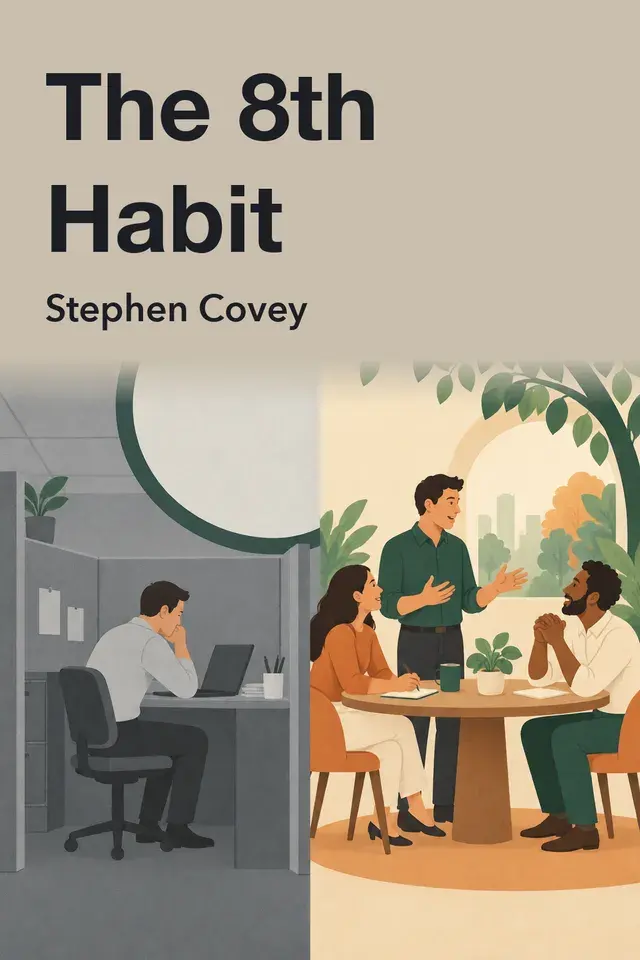
What you'll learn
Key ideas from The 8th Habit
These ideas compress the book's argument without treating the author's view as settled fact. Use them as an orientation before reading the full work or listening in Wiseley.
Voice is the convergence of talent, passion, a meaningful need, and conscience, making it more than self-expression.
The space between an event and a response allows principled choice, even though circumstances shape how much freedom is initially available.
Vision names a worthwhile need and possible contribution; discipline accepts the facts and schedules the effort required to make it real.
The four roles diagnose chronic organizational neglect and connect trust, shared direction, alignment, and empowerment in a sequence requiring continual maintenance.
A Third Alternative is a jointly discovered outcome better than either opening position, not a midpoint compromise.
A mission gains credibility when structures, information, rewards, recognition, staffing, and feedback reinforce the behavior it names.
Weekly translation and mutual accountability connect goals to daily actions, obstacles, Third Alternatives, and shared path clearing.
Voice fulfills its purpose when capability is directed toward serving human needs rather than merely increasing performance.
Inside The 8th Habit
Read the first chapter in full here. The other 11 continue in the Wiseley app.
Chapter 1 of 12 · 7 min · Audio & text
Why Human Potential Goes Unused
The 8th Habit, by Stephen Covey.
The book opens with a gap between what people are capable of and what their roles allow them to contribute. People may feel stuck, burned out, undervalued, unnecessary, or micromanaged, while organizations struggle to focus on their most important priorities. Covey treats this as more than widespread dissatisfaction. It is a failure to release human potential.
His response has two connected parts: find your own voice, then inspire others to find theirs. The eighth habit builds on the original seven habits and their emphasis on character, principles, and effectiveness. Covey argues that effectiveness remains necessary, but the new reality demands more: fulfillment, meaningful contribution, passionate execution, and access to creativity that older systems often suppress.
That new reality is the Knowledge Worker Age. Industrial-Age organizations were designed around factories, specialization, hierarchy, procedures, and scalable control. They treated machines and capital as primary assets, while people were often considered replaceable inputs. Knowledge work depends more directly on judgment, creativity, initiative, and the ability to connect effort with results. Yet many institutions still manage people through the older model. They live in a new economy while operating with an old view of human nature.
Covey calls that old view the Thing Mind-set. It treats people as objects to be measured, controlled, rewarded, or punished. In practice, it wants their bodies for labor while treating their minds, hearts, and spirits as complications. Centralized decisions, rigid procedures, carrot-and-stick motivation, and accounting systems that treat people as expenses all express the same assumption: someone else should think, and everyone else should comply.
This creates a reciprocal cycle. When managers control every detail, followers stop seeing leadership as something they can choose. They wait for instructions, avoid responsibility, and then blame formal leaders when things fail. Their reluctance encourages managers to direct even more intensely. Each side’s weakness becomes evidence that the other side must remain controlling or dependent. Over time, responsibility disappears into an unconscious pact.
The fictional Max story makes this pattern concrete. Max begins with energy, initiative, and a sense of purpose. His manager micromanages him as though he were a hunting dog, correcting and controlling every movement until Max becomes gun-shy. He loses his freedom, stops trusting his own judgment, and resolves never to take initiative again. The story does not make the manager the only cause. The manager’s own boss treats him similarly, so the pattern extends through the company. Everyone equates leadership with position, and no one breaks the cycle.
The alternative is Covey’s Whole-Person Paradigm. A person has a body, mind, heart, and spirit, and each dimension corresponds to a basic human need. The body asks whether treatment is materially fair. The mind needs learning, growth, and a genuine chance to think and use judgment. The heart needs respect, belonging, and relationships in which people are treated as people. The spirit needs meaningful contribution: work connected to purpose, conscience, and the possibility of leaving something worthwhile behind.
These dimensions affect how much of themselves people choose to give. Their responses can range from rebellion or quitting, through malicious obedience and willing compliance, to cheerful cooperation, heartfelt commitment, and creative excitement. Fair pay alone does not create commitment if people are treated without respect. Kind treatment is not enough if their opinions are predetermined and their minds are unused. Creative involvement cannot compensate for meaningless work, and meaningful work is compromised when an organization tolerates dishonesty toward customers, suppliers, or employees. Neglecting any one dimension reduces a whole person to a thing and invites control.
Voice is the point where talent, passion, need, and conscience meet. Talent means the gifts and abilities a person can draw on. Passion is what gives energy to the effort. Need is a real problem or human requirement that matters. Conscience helps distinguish a worthy contribution from mere self-expression and urges a person toward what is right. Voice is therefore not simply speaking more loudly or choosing whatever feels interesting. It is personal significance expressed in response to meaningful need.
Covey illustrates this with Muhammad Yunus. Instead of looking at poverty from an abstract distance, Yunus examined one village problem directly. A woman who made bamboo stools worked hard but earned only about two U.S. pennies a day because she lacked the roughly twenty to twenty-five cents needed to buy bamboo. Dependent on a trader, she had to sell at his price. Yunus responded by lending money to forty-two villagers himself.
When bankers insisted that poor people lacked collateral and could not be trusted to repay, Yunus challenged their assumptions by guaranteeing loans. Repayment in one village, then two, five, and more villages contradicted the predictions. The evidence did not immediately change the bankers’ beliefs, so Yunus eventually stopped trying to persuade the existing institution. After securing permission for a separate one, he helped develop a formal bank designed to serve people the old system had excluded.
Covey presents Yunus as an illustration, not as a universal formula. The important progression is from a concrete need to a small experiment, then to learning, trust, institutional development, and wider service. Purpose did not have to appear as a complete plan before action began. It became clearer as Yunus used his abilities to answer a problem his conscience could not ignore.
That progression explains the book’s larger movement. Finding one’s voice is personal, but it is not private. The second part is to inspire others by recognizing their significance and creating room for their bodies, minds, hearts, and spirits to contribute. The goal is not merely to become a more fulfilled individual. It is to help human potential become visible and useful in other people as well.
Chapter 2 of 12 · 9 min · Audio & textIn the app
Developing the Capacity to Choose
Covey’s argument now turns to the resources that make choice usable. He calls three features of human nature birth-gifts: freedom to choose, natural laws or principles, and four capacities that can be developed.
Chapter 3 of 12 · 9 min · Audio & textIn the app
Turning Personal Voice into Contribution
Voice becomes contribution when an inner sense of purpose is turned into work that meets a real need. Building on capacities introduced earlier, Covey describes four expressions.
Chapter 4 of 12 · 11 min · Audio & textIn the app
Leading Within Your Actual Influence
Once a person begins turning personal gifts and conscience into contribution, the next question is how that contribution can help an organization release human potential. Covey defines leadership as communicating people’s worth and potential so clearly that they come to recognize it in themselves.
Chapter 5 of 12 · 8 min · Audio & textIn the app
Making Trustworthiness Visible in Practice
Covey treats modeling as the first test of leadership. A person may sound inspiring and still be unworthy of trust.
Chapter 6 of 12 · 8 min · Audio & textIn the app
Building and Repairing Relational Trust
Trust is the condition that lets a relationship move without constant defensive friction. Covey's Emotional Bank Account compares interactions with deposits that build confidence and withdrawals that damage it.
Chapter 7 of 12 · 9 min · Audio & textIn the app
Creating Better Alternatives Through Understanding
Cooperation often breaks down before people reach the real issue. They may be looking at the same facts but assigning them different meanings.
Chapter 8 of 12 · 8 min · Audio & textIn the app
Finding a Shared Organizational Direction
Finding a direction begins before choosing a route. If the destination is unknown, selecting a road cannot solve the problem.
Chapter 9 of 12 · 9 min · Audio & textIn the app
Making Systems Honor Shared Values
Once a group has a shared mission, it still faces a practical test: do its systems make that mission easier to live, or quietly contradict it? A mission may praise cooperation, service, dignity, or long-term responsibility.
Chapter 10 of 12 · 9 min · Audio & textIn the app
Replacing Supervision with Responsible Autonomy
Empowerment is not a slogan or a decision to leave people alone. Covey presents it as the fruit of trustworthy modeling, shared direction, and supportive systems.
Chapter 11 of 12 · 7 min · Audio & textIn the app
Turning Priorities into Consistent Execution
Once an organization has a shared direction, the harder question is how that direction survives contact with daily work. The source treats execution as a chain, not a final push.
Chapter 12 of 12 · 6 min · Audio & textIn the app
Using Voice in Lasting Service
The book’s final question is not simply how to unlock human capability, but what that capability is for. Better execution and stronger institutions can serve self-interest.
Chapter 1 of 12 · 7 min · Audio & text: Why Human Potential Goes Unused
Wiseley supports reading and listening to summaries in the app.
Continue in WiseleyWhat The 8th Habit is about
How can people find meaningful work and help others contribute their full abilities? Stephen Covey connects personal purpose with leadership, tracing how conscience, trust, shared direction, and disciplined execution can turn individual potential into collective contribution. Practical methods address initiative, difficult conversations, organizational systems, and responsible autonomy.
About Stephen R. Covey
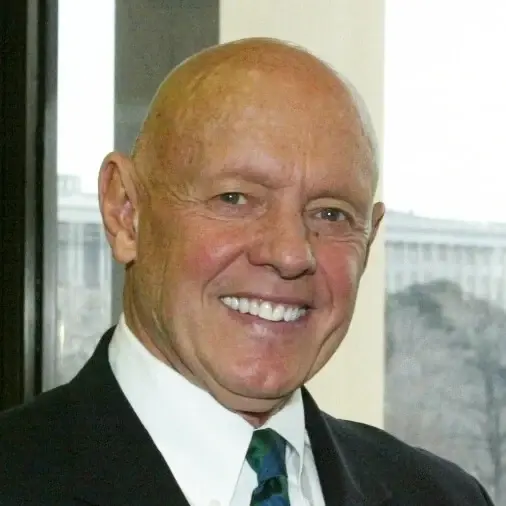
Stephen R. Covey was an American educator, author, businessman and motivational speaker. “The 7 Habits of Highly Effective People” explores principles of personal responsibility, cooperation, and long-term effectiveness.
Explore more books by Stephen R. Covey