What you'll learn
Key ideas from The 7 Habits Of Highly Effective Teens
These ideas compress the book's argument without treating the author's view as settled fact. Use them as an orientation before reading the full work or listening in Wiseley.
Proactivity means taking responsibility for a response and available actions, even when circumstances remain outside personal control.
A mission can evolve while giving teens a basis for weighing peer, media, and school influences.
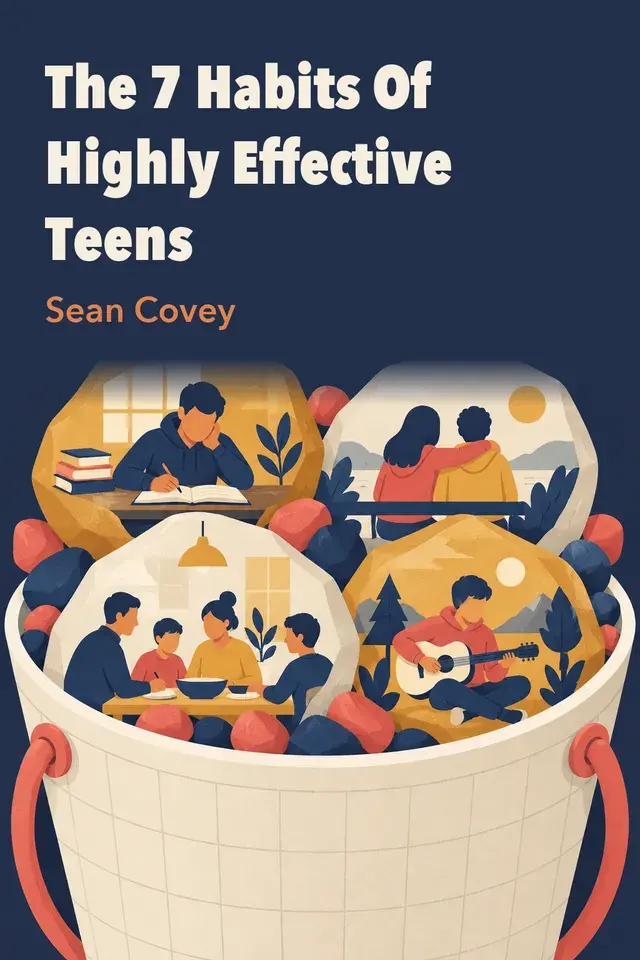
Weekly planning protects role-based big rocks by scheduling them first, fitting smaller tasks around them, and adapting as the week changes.
Win-Win pairs concern for another person’s success with respect for one’s own needs; it does not require yielding on every issue.
Habit 5 pairs sincere understanding with responsible expression of one’s own view; listening is neither manipulation nor agreement.
Synergy combines distinct contributions into a shared result that can exceed compromise or ordinary cooperation.
Physical renewal combines sleep, relaxation, movement, and moderate food choices that account for individual responses.
Setbacks do not erase the possibility of returning to a chosen direction and moving toward a meaningful future.
Inside The 7 Habits Of Highly Effective Teens
Read the first chapter in full here. The other 12 continue in the Wiseley app.
Chapter 1 of 13 · 7 min · Audio & text
The Lens Behind Every Choice
The 7 Habits Of Highly Effective Teens, by Sean Covey.
Teen life brings pressures that cannot simply be switched off. Sean Covey presents the habits as tools for dealing with real problems, not as a promise to remove them. Together, they form a progression: take responsibility, choose a direction, and put important things first; then seek mutual benefit, understand others, and work together. The seventh habit, regular renewal, supports the other six. The first three build self-mastery, the next three focus on relationships, and renewal helps sustain both.
Covey also sketches the opposite patterns: blaming and reacting, drifting without a direction, postponing important work, treating others as rivals, pretending to listen, refusing cooperation, and wearing yourself out. He exaggerates these contrasts for effect, while admitting that people, including himself, fall into them. The point is that repeated behavior matters. Some habits help; others make life harder, and some preferences matter little either way.
A habit is a repeated action that can start to run on autopilot. Covey links thought to action, action to habit, and habit to character and life direction. But automatic does not mean unchangeable. A familiar way of folding your arms may feel natural simply because you have repeated it; a new way may feel awkward at first, then become familiar. Covey’s argument is that people are stronger than their habits and can practice a better pattern. Change may take effort, and no one has to be perfect for the habits to be useful.
To understand what shapes a choice, Covey introduces the word “paradigm.” A paradigm is a point of view or mental lens through which a person interprets themself, other people, and life. It influences what seems possible. If someone is convinced they cannot get along with a stepfather, for example, that belief may make them less likely to try. A changed self-image can also open possibilities: Linda, who had a poor opinion of herself, was encouraged to enter a demanding pageant. Taking part helped her see herself differently, and she later became a student body officer. The example shows a shift in perception and action, not a guarantee that every new belief will lead to the same result.
Covey compares a changed paradigm to seeing through corrected glasses. The world may not have changed, but details that were blurred can come into view. That matters when judging someone else, because a first impression often leaves out important context. Becky saw Kim as annoying until she learned that Kim’s family was going through a painful divorce. With that information, Becky understood Kim’s behavior differently and regretted her judgment.
The cookie story makes the problem of incomplete information especially clear. At an airport, a woman sits beside a young man with a packet of cookies between them. She believes the cookies are hers. When he takes one, she is offended, but she takes one too. They continue sharing the packet, and when only one cookie remains, he breaks it in half and offers her a piece. She takes it while thinking he has been rude. After he leaves, she finds her own, untouched packet in her bag. The cookies she thought he was taking had been his. Her judgment of him reverses when she discovers the missing fact. The lesson is not that every troubling action has an innocent explanation. It is that a confident interpretation can still be wrong when the information is incomplete.
The book applies this idea to the center of a person’s life. A “life-center” is what claims the most attention, time, energy, and importance in someone’s identity. It may be popularity, possessions or appearance, a romantic relationship, school achievement, or a parent’s approval. These things can matter without becoming the whole measure of a person. If approval is the center, choices may become attempts to earn praise. If grades are the center, self-worth can rise or fall with school results. If a relationship is the center, another person’s changing feelings can unsettle one’s sense of security. Friends, learning, family, and love are not the problem; the risk is depending on one unstable part of life to define the whole self.
As a steadier foundation, Covey proposes principles. He presents them as reliable standards that apply regardless of status or personal preference, like honesty, fairness, respect, responsibility, and love. A person centered on approval may ask what will win praise; a principle-centered person can also ask what honesty or fairness requires. The book treats principles as a more dependable guide than whatever happens to dominate a person’s attention at the moment. Its advice is practical: consider which principle fits the difficulty. It points to balance when exhaustion is the problem, and honesty when trust is missing.
When a situation feels clear but your judgment is strong, pause over three questions: What information might be missing? What lens is shaping how I see this? Which principle applies? Those questions summarize the chapter’s foundation. Before choosing how to act, notice whether the view is complete. A more effective choice begins with seeing the situation more clearly.
Chapter 2 of 13 · 7 min · Audio & textIn the app
Build Trust in Yourself
Self-confidence is not built only by praise, a single achievement, or trying to feel positive. It grows when your own actions give you reason to trust yourself.
Chapter 3 of 13 · 8 min · Audio & textIn the app
Choose Your Response
Habit 1, Be Proactive, begins with a choice that appears in ordinary moments: how to respond when something goes wrong. Bad weather, a disappointing test, conflict with a sibling, or an insult can trigger an immediate reaction.
Chapter 4 of 13 · 8 min · Audio & textIn the app
Give Your Future a Direction
Choosing a response is one kind of freedom; choosing what your responses are for is another. Habit 2, “Begin with the End in Mind,” asks teens to picture a direction before filling in every step.
Chapter 5 of 13 · 7 min · Audio & textIn the app
Translate Purpose into Goals
Choosing a direction for life is a start, but a broad mission does not say what to do next. Goals break that purpose into manageable steps.
Chapter 6 of 13 · 9 min · Audio & textIn the app
Make Room for First Things
Habit 3, “Put First Things First,” turns priorities into choices about how time is spent. Earlier work in the book identifies what matters; this habit asks how to give those things space in a crowded week.
Chapter 7 of 13 · 6 min · Audio & textIn the app
Build Trust Through Deposits
The trust you build in yourself has a counterpart between people. Sean Covey calls it the Relationship Bank Account, or RBA: a way to think about the trust and confidence held in each relationship.
Chapter 8 of 13 · 6 min · Audio & textIn the app
Create Wins Without Losing Yourself
Disagreement does not have to be a contest where one person’s success requires the other’s defeat. Covey describes several ways people approach conflict, and each reveals what they believe winning means.
Chapter 9 of 13 · 8 min · Audio & textIn the app
Understand Before You Answer
Many conversations turn into contests over whose point of view will prevail. Each person prepares a reply while the other is still speaking.
Chapter 10 of 13 · 7 min · Audio & textIn the app
Make Difference a Shared Strength
Once people have heard one another, a conversation can move from understanding to invention. Covey calls the result synergy: creative cooperation that produces a better solution than any participant could create alone.
Chapter 11 of 13 · 7 min · Audio & textIn the app
Renew Your Body and Mind
Covey calls Habit Seven “Sharpen the Saw”: taking time to renew yourself so you can keep meeting life’s demands. Care for the body and mind is regular maintenance, not a reward for finishing everything else.
Chapter 12 of 13 · 8 min · Audio & textIn the app
Renew Heart, Soul, and Attention
Renewal in Habit 7 reaches beyond caring for the body and mind. This chapter turns to the heart, the inner life, and the attention that outside influences compete for.
Chapter 13 of 13 · 4 min · Audio & textIn the app
Return to the Flight Plan
After a framework built around seven habits, it can seem as though change means keeping every habit in mind and getting everything right. Covey's closing advice offers a smaller beginning: notice which habit most needs attention now, then choose a few practical changes.
Chapter 1 of 13 · 7 min · Audio & text: The Lens Behind Every Choice
Wiseley supports reading and listening to summaries in the app.
Continue in WiseleyAbout Sean Covey

Sean Covey is an American author, speaker, and business executive. “The 7 Habits Of Highly Effective Teens” explores how teenagers can respond to pressure and build a life shaped by their own values.
Explore more books by Sean Covey