What you'll learn
Key ideas from The 6 Phase Meditation Method
These ideas compress the book's argument without treating the author's view as settled fact. Use them as an orientation before reading the full work or listening in Wiseley.
The method treats meditation as active mental training that uses thought, not as a demand for an empty mind.
Its six phases balance a present-focused Pillar of Happiness with a future-focused Pillar of Vision.
The book treats compassion as trainable, citing guided practice and reported neural, behavioral, and physiological support.
The forward gap keeps moving when happiness depends on the next achievement; gratitude redirects attention toward present value and past progress.
Forgiveness is presented as self-liberation from resentment, rejection, and regret, not as approval of harm or a favor granted to the offender.
The method commits to the desired outcome and its meaning while leaving the route open to unexpected possibilities.
Phase 5 turns a distant direction into a sequence of intentional, positively rehearsed segments across the next day.
The six phases are presented as daily training for moving from survival-driven reactivity toward compassion, gratitude, flexibility, wisdom, and connection.
Inside The 6 Phase Meditation Method
Read the first chapter in full here. The other 6 continue in the Wiseley app.
Chapter 1 of 7 · 7 min · Audio & text
From Stillness to Active Practice
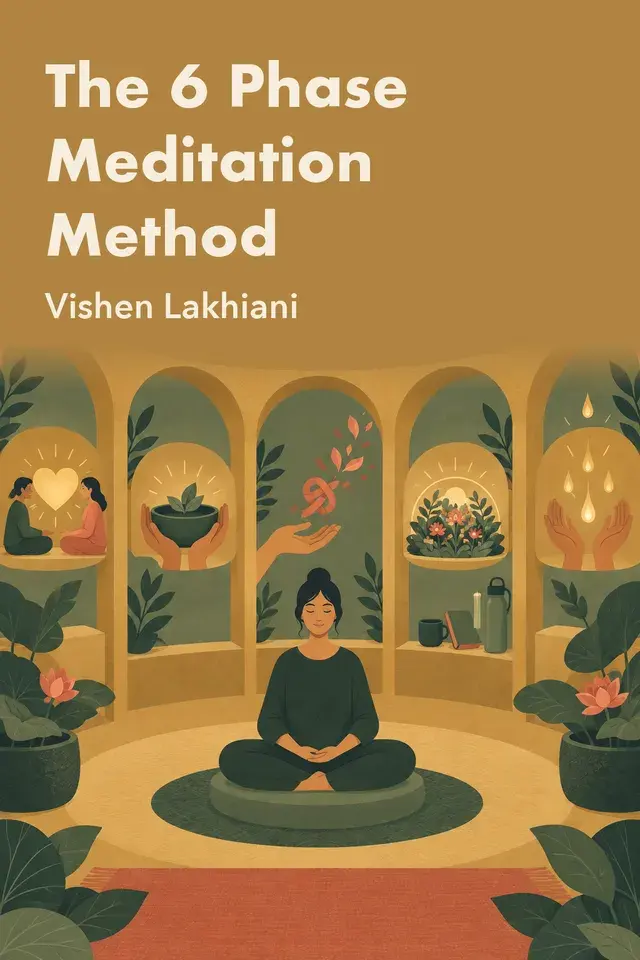
The 6 Phase Meditation Method, by Vishen Lakhiani.
The book opens by challenging the idea that meditation must mean an empty mind, a rigid posture, or a long retreat. Those expectations can make beginners think distraction means failure. Lakhiani proposes an active, targeted form: the mind is given deliberate work that aims at compassion, gratitude, forgiveness, future vision, daily direction, and a closing blessing. He sometimes calls this a transcendent practice, but keeps meditation because it is the familiar word. He also presents the method as a modern adaptation, not a dismissal of older traditions; previous meditation can still be valuable.
The rationale is practical and partly personal. After encountering the Silva Ultramind approach, Lakhiani reports that daily meditation changed both his performance and his sense of purpose. He went on to teach meditation and assemble the six-phase sequence from years of learning, research, and conversations with people interested in human performance and spirituality. The book therefore offers his synthesis and reported experience. Its strong claims about results should be read as the author's framing, especially where the introduction emphasizes anecdotes and adoption more than detailed independent evidence.
The method's governing idea is minimum effective dose. A complete session is intended to take roughly fifteen to twenty minutes, in a comfortable place, rather than requiring a retreat or many hours of sitting. Lakhiani compares this efficiency principle with Tabata exercise, while the comparison remains an analogy rather than proof that the practices are equivalent. The six phases are Circle of Love and Compassion; Happiness and Gratitude; Peace Through Forgiveness; A Vision for Your Future; Mastering Your Day; and The Blessing. The order is deliberate. The first three work across the past and present, building emotional capacity, present joy, inner peace, and release from past negativity. The last three turn toward the future, giving the practitioner a direction, a way to connect that direction with action, and a final source of support.
Together these phases form two pillars. The Pillar of Happiness joins compassion, gratitude, and forgiveness. It represents being more at peace with the present and less burdened by what has happened. The Pillar of Vision concerns the life one wants to move toward: who to become, how to feel, what to achieve, and what to contribute. The author's point is not that one pillar can replace the other. Fulfillment requires present contentment and meaningful direction at the same time.
The book explains this balance through four verbal quadrants. When both happiness and vision are weak, the result is the Negative Spiral, which Lakhiani associates with dissatisfaction, depression, and apathy. Present happiness without a future vision becomes the Current Reality Trap: contentment depends on circumstances and can drift into passivity. Vision without present happiness becomes the Anxiety Corner, where life is repeatedly postponed until the next achievement. At the upper end, the author calls the combination of happiness and vision Bending Reality. He describes it as a state in which gratitude, purpose, engagement, and contribution reinforce one another, sometimes accompanied by flow or synchronicity. Those spiritual descriptions belong to his motivational framing, not to a guaranteed outcome.
That distinction also changes how success is measured. Meditation is not validated by sitting perfectly still or silencing every thought. The relevant test is what changes afterward: whether a person becomes more aligned with their values, aspirations, and highest intentions, and whether destructive reactions become easier to notice before they cause harm. Thinking, planning, and mental wandering are treated as normal. Instead of fighting the mind, this method gives its activity a constructive direction. The aim is to become better at life, not merely better at meditating.
The setup is deliberately forgiving. The book says no special skills, ritual objects, clothing, diet, guru, or lotus posture are required. An upright, comfortable position works, and morning practice is recommended because the sequence includes the coming day, not because another time is invalid. Stillness may help concentration, but movement is allowed when the body hurts or a real interruption needs attention; the practitioner can return afterward. Silence, music, and binaural beats are presented as preferences or optional aids. A beginner need not wait to feel calm, and even an experienced meditator is asked to approach the practice with an open mind.
This is the governing map for the chapters that follow. The first three phases strengthen the capacity to inhabit the present and loosen the past. The final three supply vision, direction, and support. The method's promise is therefore modest in its entry requirements but ambitious in its purpose: use a short, adaptable practice to rehearse a better way of living, then judge it by the life that practice helps create.
Chapter 2 of 7 · 6 min · Audio & textIn the app
Compassion Expands the Circle
Phase 1 begins with a practical premise: compassion is emotional hygiene. The author contrasts daily care of the body with leaving anxiety, stress, and regret unprocessed.
Chapter 3 of 7 · 6 min · Audio & textIn the app
Gratitude Closes the Happiness Gap
The book challenges a familiar bargain: happiness will begin after the next achievement. People may postpone it until graduation, partnership, marriage, a home, promotion, children, or even a small pleasure.
Chapter 4 of 7 · 6 min · Audio & textIn the app
Forgiveness Releases the Past
In the book’s third phase, forgiveness is presented as a way to release the past’s continuing grip. Resentment, rejection, and regret can remain active long after an event ends.
Chapter 5 of 7 · 6 min · Audio & textIn the app
Vision Without Attachment to How
After compassion, gratitude, and forgiveness have made the present more workable, Phase 4 asks what that steadiness is for. It turns meditation toward a future that can be felt before it arrives.
Chapter 6 of 7 · 4 min · Audio & textIn the app
Intend the Day You Enter
Phase 5 answers a practical question: how can a long-range direction shape the day in front of you? Once the broader future has been chosen, the method narrows attention to the next twenty-four hours.
Chapter 7 of 7 · 7 min · Audio & textIn the app
Blessing and the Higher Mind
The blessing is the six-phase sequence’s closing gesture. After compassion, gratitude, forgiveness, future vision, and intention for the day, Phase 6 changes the practitioner’s posture.
Chapter 1 of 7 · 7 min · Audio & text: From Stillness to Active Practice
Wiseley supports reading and listening to summaries in the app.
Continue in WiseleyAbout Vishen Lakhiani

Vishen Lakhiani is a Malaysian entrepreneur, author. “The Code of the Extraordinary Mind” explores the author's framework for questioning inherited assumptions and pursuing personal development.
Explore more books by Vishen Lakhiani