What you'll learn
Key ideas from The 5 Resets
These ideas compress the book's argument without treating the author's view as settled fact. Use them as an orientation before reading the full work or listening in Wiseley.
The five resets form a gradual framework for retraining learned stress responses through priorities, bandwidth, body, daily constraints, and language.
The Rule of 2 limits initial change to two feasible adjustments that fit real responsibilities and allow adaptation.
Attention is finite, and nearby phones, alerts, and repeated input can consume mental bandwidth even when technology remains useful.
Stop–Breathe–Be turns ordinary transitions into five-second pauses that interrupt automatic behavior and restore present-moment awareness.
The Fourth Reset treats recovery as a redesign of work, using useful stress, intentional breaks, and focused intervals to reduce overload.
Stress can turn the inner critic into a scarcity-driven threat detector, making small mistakes feel like evidence of personal failure.
Missed days become information when a compassionate restart protects a practice from all-or-nothing thinking.
Inside The 5 Resets
Read the first chapter in full here. The other 8 continue in the Wiseley app.
Chapter 1 of 9 · 10 min · Audio & text
When Resilience Becomes Relentless Endurance
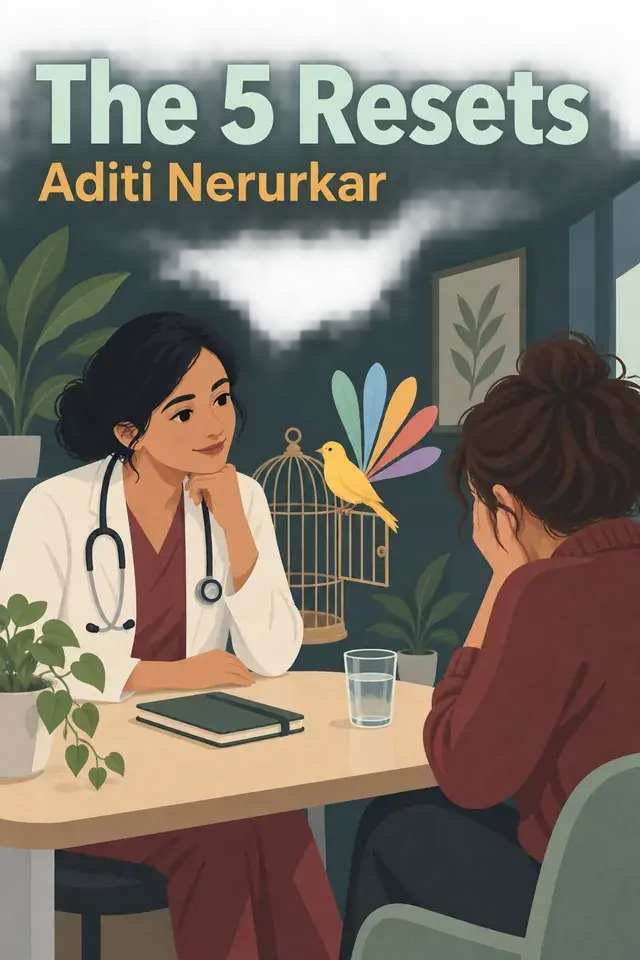
The 5 Resets, by Aditi Nerurkar.
Stress is not the opposite of health. In the author’s framework, it is a normal biological response to life’s demands. A manageable amount can help people act, pursue goals, support relationships, enjoy recreation, and plan ahead. The important question is not whether stress exists, but whether its intensity fits the life it is serving. When stress becomes runaway—constant, disproportionate, and difficult to contain—it loses its useful function and can damage well-being. A productive, capable person can still be chronically overloaded.
Liz makes that contradiction visible. She had built her identity around exceptional physical capability and saw herself as resilient. Yet she could not unplug from work, felt depleted, and abruptly stopped exercising. The change mattered because exercise had been central to her life. Continued output and a history of toughness had concealed a serious loss of capacity. In the book’s account, two practical changes preceded her return to regular early-morning five-mile runs three months later. The clinical stories are composites of common patterns, with paraphrased quotations, so they illustrate mechanisms rather than document actual individuals.
This is the resilience myth: strength supposedly means tolerating extreme discomfort, pushing past every boundary, and never needing help. The author distinguishes that from resilience as the capacity to adapt, recover, and grow through challenge. Toxic resilience turns adaptation into productivity at all costs. It can produce shame about stress and postpone self-care until work, parenting, finances, or caregiving somehow become easier. Symptoms can then serve as alarms, like a canary warning of dangerous air. Recognizing a shared pattern can reduce shame and isolation without minimizing anyone’s particular struggle.
The book explains this with a deliberately simplified brain-and-body model. In calmer conditions, the prefrontal cortex supports planning, organizing, prioritizing, and everyday decisions. When the amygdala detects threat, attention shifts toward fear and self-preservation. It recruits the hypothalamus, pituitary gland, and adrenal glands—the HPA axis—which releases cortisol and adrenaline. Heart rate and breathing quicken, and vigilance rises. This response suits a short emergency. But deadlines, bills, conflict, family pressure, and work demands can keep the same system activated even when there is no literal predator. Chronic stress becomes an overuse problem: a system built for acute survival cannot comfortably remain switched on for months or years. This model is explanatory rather than a complete account of neuroscience, but it separates biology from blame.
The author’s own experience shows why symptoms may arrive after the demanding period. During medical residency, she worked roughly eighty-hour weeks, took overnight calls, saw traumatic cases, slept irregularly, ate poorly, exercised little, and relied heavily on caffeine. During a shift in a cardiac intensive care unit, she became sweaty and dizzy, felt frightening chest sensations, and struggled to breathe. Later, palpitations began jolting her awake at night, when she finally relaxed enough to sleep. Blood tests, vital signs, an electrocardiogram, and a heart ultrasound were normal, and a doctor suggested stress. She resisted because she considered stress benign and believed resilient people were protected from it. Movies, shopping, socializing, and a spa did not end the symptoms. After an exhausting shift, yoga and breathing improved her sleep. She then added walking, less caffeine, earlier sleep, and a silent phone at bedtime. In her account, the palpitations faded over three months. She also acknowledges that this was a bundle of changes, not proof that one technique caused the recovery.
The delayed timing is the point. During acute danger or overwhelming demand, the brain may set aside emotions that do not help immediate survival and keep a person moving. Once safety returns, those emotions and bodily sensations may surface as anxiety, insomnia, depletion, irritability, poor concentration, or a sense of being unlike oneself. A crisis can end before the nervous system has finished responding to it. That reaction is not imaginary or evidence of weak discipline. It is also not a reason to label every new symptom as stress. Because stress symptoms overlap with medical problems, other causes should be evaluated first.
Lina’s lupus experience shows a second complication: stress and illness can reinforce one another. She is presented as a single mother, court reporter, and caregiver to twins. She can endure short-term demands, but chronic pressure and childcare crises leave her exhausted, anxious, guilty, and in pain, with swollen and reddened finger joints. Her lupus symptoms raise her stress, while stress may aggravate those symptoms. The claim is reciprocal, not simplistic. Stress is not presented as the sole cause of lupus or of every flare. The broader lesson is to notice both directions without turning a clinical story into a universal law.
That is why the book treats stress as a diagnosis of exclusion rather than a label to apply casually. Palpitations, headaches, stomach trouble, pain, and insomnia may have several possible causes. High-tech medical care remains essential when acute threats must be assessed. The book’s stress practices are meant to supplement, not replace, licensed medical or mental-health care.
To help people notice patterns, the author introduces the Personalized Stress Score. It is an educational, reflective self-check, not a diagnosis or treatment instrument. It considers the previous month across five areas: warning signs, feeling overloaded, depleted energy, disrupted sleep, and interference with daily activities. Responses yield a total from zero to twenty. A higher score suggests a greater likelihood of maladaptive stress, while a lower score suggests a lower likelihood. Repeating it about every four weeks can show a personal trend, but it should not be mistaken for a clinical measurement.
The Lifestyle Snapshot adds context the score cannot provide. Modeled on a clinical conversation, it records current routines and circumstances across sleep, screens and phone use, home and social support, movement, and food. It considers what bedtime and sleep feel like, how media enters the day, whether dependable connection exists, what exercise looks like, and whether processed food, cravings, or emotional eating are part of the pattern. Its purpose is to identify strengths and pressure points, not assign moral blame. Daily habits can incrementally raise or lower unhealthy stress, but no single habit is offered as a universal cause or cure.
These tools prepare the ground for the five resets. The first clarifies priorities and mindset. The second protects limited mental bandwidth from external noise. The third coordinates brain and body during high stress. The fourth embeds new understanding within ordinary life. The fifth offers a new language for the relationship with stress. Their coherence comes from the same premise: stress is a learned brain-and-body response, not a fixed identity. The book links that premise to neuroplasticity, the brain’s ability to change with experience. Repeated behavior can strengthen new pathways, so responses can be retrained gradually. That possibility is not a promise of instant relief. It is the foundation for sustainable recovery: once chronic stress is understood as biology rather than personal failure, later practices can be chosen with greater accuracy, compassion, and patience.
Chapter 2 of 9 · 10 min · Audio & textIn the app
Choose What Matters and Start Small
When stress has made life feel like a series of emergencies, the first task is not to design a perfect life. It is to choose a destination.
Chapter 3 of 9 · 8 min · Audio & textIn the app
Reclaim Attention From Constant Input
The Second Reset begins with a practical limit: attention is not infinite. The brain has only so much bandwidth for focusing, learning, deciding, and staying on track.
Chapter 4 of 9 · 8 min · Audio & textIn the app
Protect Sleep and Restore Connection
After the Second Reset establishes boundaries around attention, the chapter asks what those boundaries should protect. Sleep and meaningful social contact are restorative resources, not luxuries added after recovery.
Chapter 5 of 9 · 7 min · Audio & textIn the app
Use the Body to Find Calm
The Third Reset starts with a premise easy to miss in daily life: the brain and body are in continuous, two-way communication. A meeting can leave the body tense before the mind names the concern; embarrassment can change bodily sensations; gut signals can influence what feels possible.
Chapter 6 of 9 · 10 min · Audio & textIn the app
Build Habits That Support the Body
The Third Reset extends immediate regulation into habits that keep the brain and body connected. Its central idea is modest but demanding: small, repeatable changes in movement and eating can interrupt stress-related patterns.
Chapter 7 of 9 · 9 min · Audio & textIn the app
Create Room to Recover During Work
The Fourth Reset, which the author calls Come Up for Air, treats recovery as a design problem inside the workday. If a break must wait until every obligation disappears, it may never happen.
Chapter 8 of 9 · 11 min · Audio & textIn the app
Change the Inner Conversation
The Fifth Reset begins with an inner conversation that stress can distort. The inner critic is shaped by upbringing, personality, experience, and society.
Chapter 9 of 9 · 6 min · Audio & textIn the app
Make Progress Sustainable Through Setbacks
Lasting change rarely comes from a single breakthrough. The closing chapter presents recovery as a practice that is small enough to repeat, visible enough to evaluate, and compassionate enough to survive lapses.
Chapter 1 of 9 · 10 min · Audio & text: When Resilience Becomes Relentless Endurance
Wiseley supports reading and listening to summaries in the app.
Continue in WiseleyWhat The 5 Resets is about
How can stress become manageable without making self-care another demand? Aditi Nerurkar’s five resets connect stress biology with practical changes in attention, sleep, movement, relationships, and daily routines. Meaningful goals and gradual practice offer a way to build resilience while acknowledging difficult circumstances and the limits of self-help.
About Aditi Nerurkar

Aditi Nerurkar is the author of “The 5 Resets”. The book explores how five small resets grounded in stress biology can make stress and burnout manageable.
Explore more books by Aditi Nerurkar