What you'll learn
Key ideas from The 4 Stages of Psychological Safety
These ideas compress the book's argument without treating the author's view as settled fact. Use them as an orientation before reading the full work or listening in Wiseley.
The framework progresses from inclusion through learning and contribution to challenging the status quo.
Inclusion recognizes human worth before judging skill, status, or performance.
Learner safety lowers the social risk of asking, experimenting, seeking feedback, offering ideas, and making mistakes.
Contributor safety exchanges growing autonomy for demonstrated readiness and greater responsibility for meaningful results.
Challenger safety protects good-faith dissent against accepted assumptions, practices, and authority.
Innovation often comes from learning together and recombining knowledge, rather than from a lone flash of inspiration.
Inside The 4 Stages of Psychological Safety
Read the first chapter in full here. The other 6 continue in the Wiseley app.
Chapter 1 of 7 · 5 min · Audio & text
Participation as a Leadership Climate
The 4 Stages of Psychological Safety, by Timothy R. Clark.
Timothy R. Clark opens with his first day as plant manager at Geneva Steel. He met with experienced superintendents, but the room fell silent. Clark says these managers had learned that speaking candidly could carry emotional, political, social, and economic costs. They deferred to his positional authority. The meeting does not tell us what ideas they might have shared in another setting. It does show how a hierarchy can make initiative feel costly before anyone speaks. Clark saw the moment as an opportunity to study and change the organization’s behavior.
That scene introduces psychological safety as a feature of a group’s climate, not simply a quality some people possess. Clark assigns leaders responsibility for shaping the social context. Their conduct helps set the practical limits on whether people feel able to participate. When fear of embarrassment, marginalization, or punishment dominates, people may spend their energy protecting themselves instead of engaging. Clark argues that safer conditions can support ownership, effort, learning, and problem solving.
He organizes psychological safety around two things leaders extend: respect and permission. Respect means showing regard for others. Permission is the degree to which people are allowed to participate and influence the group. Clark’s point is that people tend to respond to the levels they encounter. A title or invitation alone cannot settle whether a setting feels safe; the way leaders treat participation helps answer that question.
The framework describes a progression through four forms of participation. Inclusion safety means being accepted as a member of the group. Clark says acceptance comes before being heard. Learner safety adds room to ask questions, experiment, and make mistakes. Contributor safety concerns performing a competent role within appropriate boundaries. Challenger safety extends permission to question the status quo without fear of social punishment. These stages orient the framework; each describes a deeper level of engagement, and the book treats their particular risks and practices separately.
Psychological safety is not an on-off switch. Clark says that groups and social units offer different degrees of it. A person’s experience can therefore vary across settings: the same group may welcome one kind of participation while making another feel costly. The framework helps identify what kind of permission is present, instead of treating silence as proof that people have nothing to say or do.
This climate does not require a group to avoid disagreement. Clark distinguishes intellectual friction, which makes room for debate and constructive dissent, from social friction that makes collaboration unsafe. Leaders need to allow ideas to be tested while lowering the interpersonal penalties that can turn disagreement into personal risk. If people expect punishment for challenging a view, they may keep their thoughts to themselves. In Clark’s account, the loss is not just candor; a group also loses access to the knowledge and ideas its members could contribute.
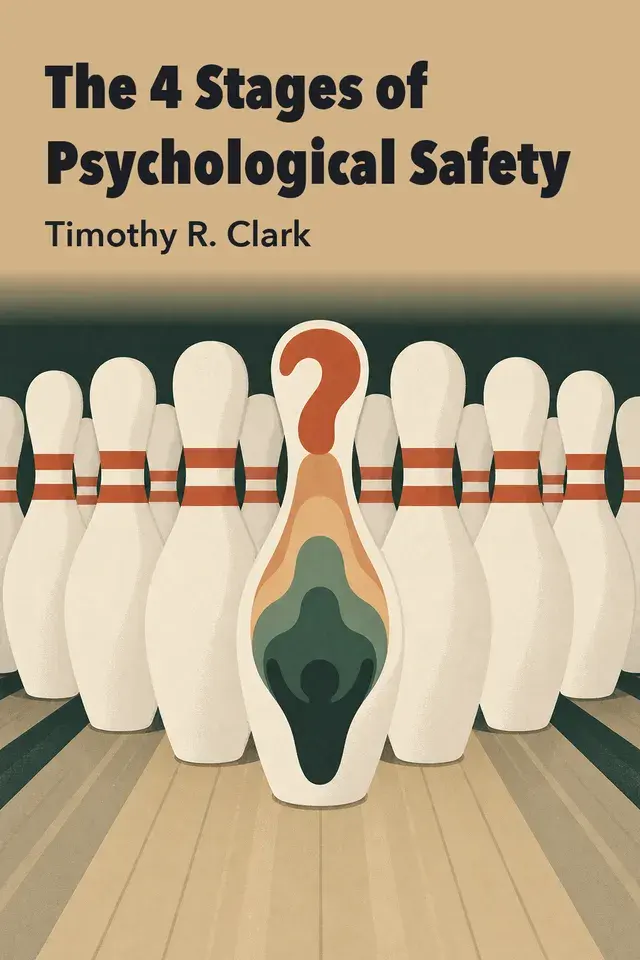
The framework’s bowling-lane image previews both the direction of travel and its limits. The lane represents the balance of respect and permission needed for people to belong, learn, contribute, and challenge. One gutter is paternalism: respect offered with little room to act. The other is exploitation: permission to contribute without respect for the people doing the work. These are brief boundary markers here; the book gives their ethical limits fuller attention later.
Clark’s organizing question is what the setting makes possible. The Geneva Steel meeting shows why leaders must look beyond whether people speak. Silence can reflect the costs attached to speaking, while participation depends on the respect and permission a group offers. The four stages give leaders a way to notice where that permission opens up, and where it stops.
Chapter 2 of 7 · 9 min · Audio & textIn the app
Belonging Without a Performance Test
Inclusion safety begins with a simple recognition: a person belongs to the human community and deserves basic respect. Timothy R.
Chapter 3 of 7 · 9 min · Audio & textIn the app
Making Learning Safe
Learning asks people to become visible before they know whether they will succeed. A student raises a hand, an employee admits uncertainty, or a colleague tests an unfinished idea.
Chapter 4 of 7 · 10 min · Audio & textIn the app
Autonomy Earned Through Contribution
Learning prepares people to contribute, but preparation alone does not give them responsibility for meaningful work. Contributor safety begins when a team lets someone move from practice into performance.
Chapter 5 of 7 · 6 min · Audio & textIn the app
The Social Risk of Speaking Up
Once a person can contribute, a harder question remains: can they challenge what the group has accepted? Clark calls this challenger safety.
Chapter 6 of 7 · 8 min · Audio & textIn the app
From Questions to Shared Innovation
Innovation, as Clark describes it, is the effort to make something better by joining things that are not usually connected. The ingredients can be existing knowledge combined with other knowledge, something familiar joined to something new, or new things connected in an unfamiliar way.
Chapter 7 of 7 · 6 min · Audio & textIn the app
Respect, Permission, and the Limits of Safety
The four stages lead to an ethical question: how should leaders treat people while setting limits and expecting results? Clark’s answer joins two things: respect for human worth and permission to belong, learn, contribute, and challenge.
Chapter 1 of 7 · 5 min · Audio & text: Participation as a Leadership Climate
Wiseley supports reading and listening to summaries in the app.
Continue in WiseleyAbout Timothy R. Clark

Timothy R. Clark is the author of “The 4 Stages of Psychological Safety”. The book explores how people move from belonging to learning, contributing, and challenging established practice.
Explore more books by Timothy R. Clark