What you'll learn
Key ideas from The 12 Traits of the Greats
These ideas compress the book's argument without treating the author's view as settled fact. Use them as an orientation before reading the full work or listening in Wiseley.
Taking responsibility focuses attention on choices and responses a person can influence, even when circumstances remain beyond control.
Martin distinguishes grounded confidence from self-deception through honest assessment of ability and experience.
Mentors, peers, and reciprocal help contribute advice, encouragement, opportunity, and support through setbacks.
A clear purpose helps distinguish effort that advances a chosen aim from activity that merely fills the day.
Alternating a modest plan, action, feedback, and revision balances direction with learning by doing.
Integrity develops through repeated choices, including private decisions and commitments that are inconvenient to keep.
Wisdom is knowledge applied in ways that change behavior and outcomes.
Generosity can begin with the resources at hand, including time, talent, knowledge, practical help, and money.
Inside The 12 Traits of the Greats
Read the first chapter in full here. The other 11 continue in the Wiseley app.
Chapter 1 of 12 · 5 min · Audio & text
Greatness Begins With Ownership
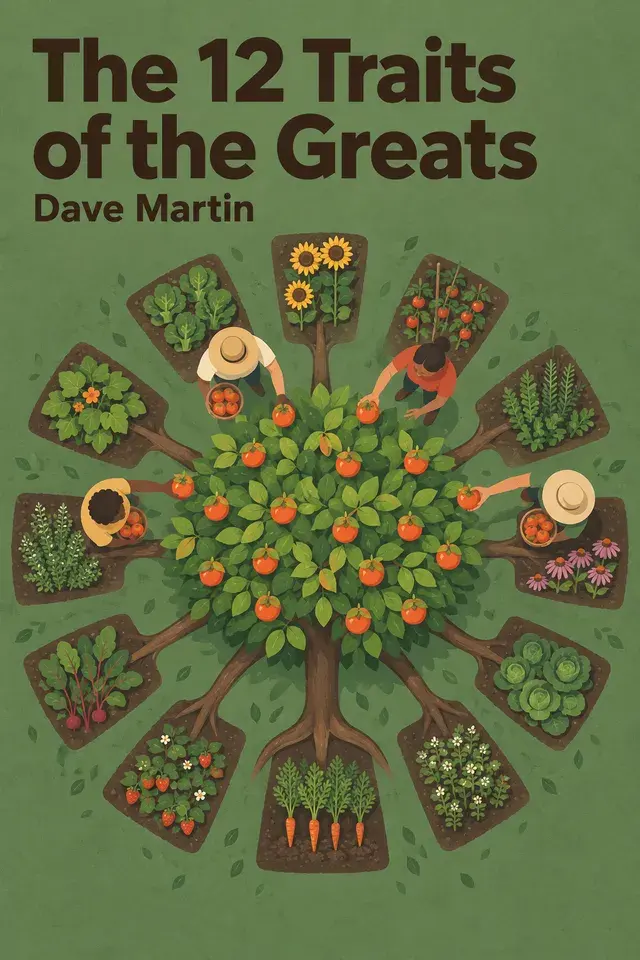
The 12 Traits of the Greats, by Dave Martin.
What makes someone great? Dave Martin’s answer starts with character and the effect a person has on others, rather than performance or public recognition alone. He points to Winston Churchill, whose wartime leadership helped sustain hope and secure support from other nations despite earlier setbacks. But greatness does not require fame. Teachers, salespeople, parents, and church ushers can shape lives and communities through work that may go largely unseen. The standard is influence rooted in how a person lives, not how widely their name is known.
This definition makes greatness both uncommon and attainable in Martin’s account. He describes it as an enduring quality that can change the lives around us, and argues that people can cultivate their potential over time. The book’s opening also recognizes that people do not begin with equal advantages or environments. Its examples are meant to show that a difficult start need not settle a person’s future, not that everyone faces the same barriers or has the same opportunities.
From this standard, Martin turns to responsibility. He presents willingness to take ownership of one’s life as a foundational quality: people must consider their own decisions and behavior, rather than locating every problem in circumstances or someone else’s actions. Blame can shift attention away from the part a person may be able to address. Accepting responsibility, in the author’s argument, restores some authority to act. It does not mean a person caused everything that happened or controls every outcome.
A useful starting audit asks what choices are shaping five important areas: health, relationships, dreams, finances, and work. Health may call for attention to habits; relationships may require more care or clearer boundaries. A dream may be neglected, while finances need deliberate attention. At work, the question is whether a person takes responsibility for the tasks within their role. Martin’s point is not that all difficulties in these areas are self-inflicted. It is that, even when conditions are imperfect, choices and effort still deserve examination.
Tim Allen’s story gives this argument a human scale. Martin recounts that after his father died, Allen went through a difficult adolescence, sold drugs, and eventually went to prison. There, Allen recognized his role in his situation and decided that he could change direction. He faced anger tied to his father’s death and lost childhood, then began reading, organized talent shows, and told jokes. After his release, he did well at a talent agency and drew notice for comedy and acting. Martin says Allen turned down repeated offers from Disney because he wanted to develop his own concept; he later starred in Home Improvement. The story presents ownership as a pivot toward different actions, not as proof that one decision guarantees success.
The chapter’s central distinction is between events a person cannot command and responses they can choose. Other people’s actions, family history, and outside conditions can shape what happens. Martin nevertheless argues that a person’s response remains consequential. His account sometimes speaks broadly about the power of choice, so it should not be read as saying that every hardship results from poor decisions. The responsibility he emphasizes is for one’s available choices and responses, not for controlling the whole world.
Martin illustrates that distinction through Moses and Pharaoh. In the biblical account, both encounter the same plagues, but Moses becomes more faithful while Pharaoh grows more resistant. The different responses lead them in different directions. The example supports Martin’s claim that shared circumstances do not force identical responses. It is an illustration of his religious and moral argument, not a general formula that hardship will always produce a particular outcome.
At work, ownership means acting with care even when a person is an employee rather than the owner. Martin describes high achievers as people who take initiative, seek responsibility, and do their tasks well instead of relying on excuses. Freedom, in his framework, includes accepting the consequences of choices, favorable or unfavorable. Responsibility also does not rule out help: the author argues that others may be more willing to support someone who is already taking responsibility for their part.
Taking ownership can be uncomfortable because change carries risks, including failure, lost work, or disapproval. Martin urges readers to begin by looking honestly at what is within their influence and where they want improvement. The examples in this chapter make a case for agency, but they do not prove that every person can overcome every constraint by effort alone. Responsibility is the book’s first trait because it gives people a place to begin: with the choices and responses they can make, while recognizing that not every circumstance is theirs to control.
Chapter 2 of 12 · 5 min · Audio & textIn the app
Belief Shapes the Possible
People rarely encounter an opportunity with an empty mind. Experience and prior beliefs shape what they notice, expect, and make of events.
Chapter 3 of 12 · 6 min · Audio & textIn the app
Find and Direct Passion
Martin begins by pointing out how differently people answer a familiar question: what do you do? Some take pride in their work; others would rather not describe it.
Chapter 4 of 12 · 7 min · Audio & textIn the app
Turn Dreams Into Plans
Passion can make a future feel worth pursuing, but motivation alone does not identify the destination or the route. Dave Martin describes a progression: imagine a possibility, develop it into a vivid vision, and turn that vision into goals, an ordered plan, and work.
Chapter 5 of 12 · 6 min · Audio & textIn the app
Achieve Through Relationships
Achievement is often told as an individual story: one person has an idea, makes the decisions, and receives recognition. Martin values independence when it means resilience or principled judgment, including the courage to disagree with a misguided majority.
Chapter 6 of 12 · 6 min · Audio & textIn the app
Focus Strengths on Purpose
Once a person has chosen a destination, a different question follows: where should limited attention and effort go? Martin's answer is focus.
Chapter 7 of 12 · 6 min · Audio & textIn the app
Courage Starts With Action
Martin presents courage as the willingness to enter a situation and act when something needs doing. It is not always dramatic.
Chapter 8 of 12 · 4 min · Audio & textIn the app
Keep Going Through Setbacks
Once a goal is underway, persistence is the capacity to keep pursuing it when progress slows, disappointments accumulate, or the route becomes less clear. It adds endurance to the decision to act.
Chapter 9 of 12 · 5 min · Audio & textIn the app
Integrity Earns Durable Trust
Talent, appearance, and personality can help someone rise, but Martin argues that they cannot sustain greatness by themselves. They are qualities a person can display or imitate.
Chapter 10 of 12 · 6 min · Audio & textIn the app
Choose Change With Judgment
Change arrives whether or not we ask for it. Seasons turn, circumstances shift, and familiar ways of working can stop fitting the moment.
Chapter 11 of 12 · 5 min · Audio & textIn the app
Turn Knowledge Into Wisdom
Knowing facts and using knowledge are not the same thing. A person can collect information without changing a single decision.
Chapter 12 of 12 · 5 min · Audio & textIn the app
Make Prosperity Serve Others
Prosperity is often measured by what someone owns. Martin gives it a broader purpose: having enough to meet needs, care for dependents, pursue a calling, and help others.
Chapter 1 of 12 · 5 min · Audio & text: Greatness Begins With Ownership
Wiseley supports reading and listening to summaries in the app.
Continue in Wiseley