What you'll learn
Key ideas from SuperLife
These ideas compress the book's argument without treating the author's view as settled fact. Use them as an orientation before reading the full work or listening in Wiseley.
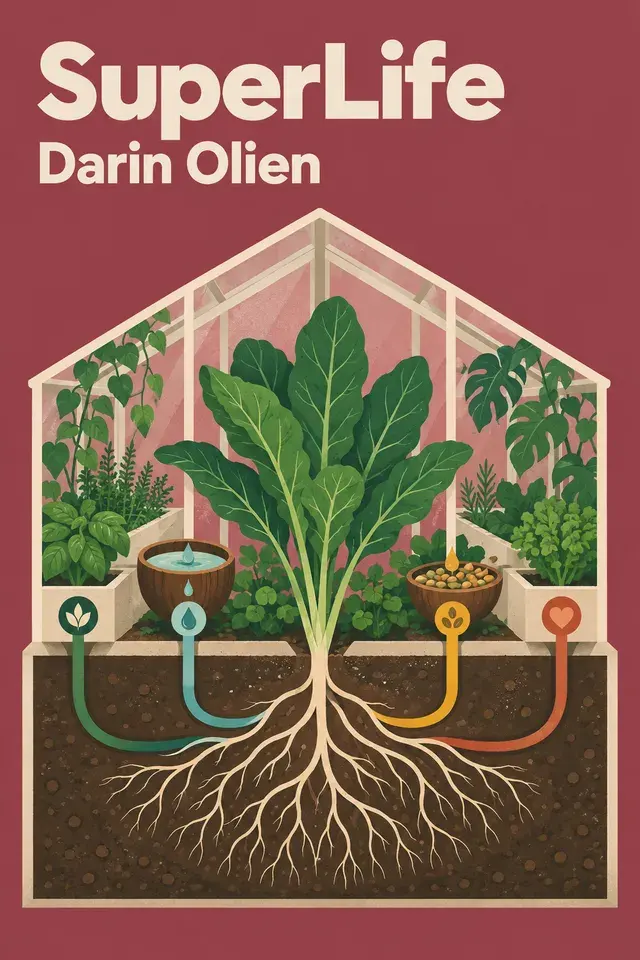
Olien organizes everyday health around five connected forces: nutrition, hydration, oxygenation, alkalization, and detoxification.
Whole foods retain fiber and interacting compounds that processing, such as juicing, can remove.
Olien’s microbiome methods center on varied fiber-rich plants, fermented foods, and caution about unnecessary antimicrobial use.
Olien presents water as a transport medium, temperature regulator, cellular environment, and support for nerve, immune, joint, and waste-handling functions.
Movement can include daily walking, brief vigorous activity, and resistance work suited to a person’s abilities.
His practical foundation links detoxification to the other four forces, whole foods and fiber, hydration, movement, and reducing avoidable exposures.
The closing program treats wellbeing as repeated choices across eating, movement, breathing, rest, nature, and social connection.
Inside SuperLife
Read the first chapter in full here. The other 12 continue in the Wiseley app.
Chapter 1 of 13 · 6 min · Audio & text
Health Through Five Connected Forces
SuperLife, by Darin Olien.
Olien’s opening premise is that health depends on conditions shared across the body, not only on what happens in one organ or at the site of a symptom. He organizes those conditions into five life forces: nutrition, hydration, oxygenation, alkalization, and detoxification. In his model, lasting change begins by supporting the environment in which the body functions.
The five forces name different parts of that environment. Nutrition concerns food and what it contains. Hydration concerns the body’s need for water. Oxygenation concerns its need for oxygen. Alkalization means attention to internal acid–alkaline balance. Detoxification includes immune function and the handling of toxins. Olien’s point is that these are connected influences, not five unrelated topics or separate cures.
That connection matters because the body’s parts share basic needs, even when medical specialties focus on them separately. A condition affecting one tissue may have a wider context than the local symptom suggests. Olien therefore asks readers to look for underlying conditions that could connect several problems, rather than treating each complaint as an isolated event. The framework shifts attention from naming what hurts to asking what supports the body as a whole.
From this perspective, symptoms may be visible signs of deeper causes. Olien argues that many smaller problems arise from a few broader conditions, and that addressing those conditions offers a way to think about prevention. He extends this argument into strong claims that illness is not inevitable and that serious diseases, including heart disease and cancer, are largely preventable. These are forceful positions in the book; the opening presents them as Olien’s argument, not as conclusions it proves.
His own teenage experience illustrates why he became interested in personal experimentation. At thirteen, he replaced much of his junk food with grapefruit and says he began to feel better. After that first improvement, he secretly stopped taking his hyperactivity pills and says he felt even better. He later abandoned the grapefruit diet and returned to a typical eating routine. Since the diet change replaced several foods at once, the initial improvement cannot establish that grapefruit itself caused it; the later medication change is a separate part of the story. The episode shows how a personal observation can prompt questions, but it is not proof that one food can explain or fix a health problem.
Olien describes his approach as ongoing self-observation. He reads research and expert advice, tries changes, keeps what seems helpful, and moves on when it does not. He writes from the perspective of a non-scientist, so the framework is also an invitation to consider his ideas as an account shaped by study and experience, rather than as scientific proof. The grapefruit story makes that distinction concrete: noticing a change is a starting point for inquiry, not a way to isolate its cause.
The book gives everyday choices substantial influence over health, and Olien presents taking responsibility for the body as both a burden and a source of agency. That emphasis does not establish that a person controls every health outcome. His broad claims about prevention should be understood as part of his outlook, not as a guarantee that illness can always be avoided. The practical value of the model is that it points to conditions people can consider, while leaving room for limits in what an individual can know or change.
As a working checklist, the five forces direct attention to nourishment, water, oxygen, internal acid–alkaline balance, and the body’s handling of waste and toxins. Each question opens onto a distinct subject, but the answers belong together. Looking at only one force would miss the framework’s main idea: bodily function depends on interacting conditions.
This model gives the rest of the book its structure. Later discussions of food, water, movement, and detoxification develop different parts of the argument, while the five forces connect them. The opening thesis is simple: support the conditions in which the body works, and health becomes a question of the whole internal environment, not merely the symptom in front of you.
Chapter 2 of 13 · 11 min · Audio & textIn the app
Choosing Food for Everyday Nourishment
In practice, Olien’s food standard is simple: choose a wide range of whole, fresh foods, with plants at the center. He names vegetables, fruit, beans, nuts, seeds, grains, sprouts, and healthy fats, and recommends eating much of this food raw.
Chapter 3 of 13 · 6 min · Audio & textIn the app
The Gut as a Living Ecosystem
The gut, in Olien’s account, is more than a place where food passes through. It is a changing community of microbes that participates in digestion and other bodily processes.
Chapter 4 of 13 · 7 min · Audio & textIn the app
Water Beyond Thirst
Thirst is an obvious prompt to drink, but Darin Olien asks readers to think about water earlier and more broadly. In his account, it is more than a drink that relieves thirst; it is a working medium throughout the body.
Chapter 5 of 13 · 6 min · Audio & textIn the app
Movement Built into Daily Life
Olien’s starting point is the way convenience has changed ordinary life. For much of human history, he argues, meeting daily needs involved walking, running, carrying, building, and other physical effort.
Chapter 6 of 13 · 6 min · Audio & textIn the app
Oxygen and Cellular Balance
Oxygen is easy to take for granted because breathing happens without deliberate planning. Olien describes it as a basic requirement: it passes from the lungs into the blood, then hemoglobin carries it to cells.
Chapter 7 of 13 · 6 min · Audio & textIn the app
Superfoods With Purpose and Limits
Olien presents superfoods as foods to address a particular need, rather than cures or compensation for otherwise inadequate meals. In his framework, they sit between ordinary eating and isolated supplements or medicines: concentrated nutrients that may help when someone has a specific reason to seek them.
Chapter 8 of 13 · 13 min · Audio & textIn the app
Acid Balance, Protein, and Fat
Olien’s argument about acidity begins with balance. He says the body works best in a slightly alkaline state overall, but he does not claim every part of the body should have the same pH.
Chapter 9 of 13 · 6 min · Audio & textIn the app
The Burden of Nutritional Stress
Olien calls repeated exposure to substances the body cannot use as nourishment “nutritional stress.” In his model, the body needs water, oxygen, fats, amino acids, and other nutrients.
Chapter 10 of 13 · 7 min · Audio & textIn the app
The Body’s Ongoing Detox Work
Olien treats detoxification as work the body is doing all the time, not as a special cleanse. It is the ongoing process of clearing metabolic waste and substances the body cannot use.
Chapter 11 of 13 · 9 min · Audio & textIn the app
Health Habits Across Generations
Olien calls reliance on treatment without changing underlying habits the Big Fix Syndrome. He argues that chronic care can keep people functioning while leaving poor diet or other contributors untouched.
Chapter 12 of 13 · 9 min · Audio & textIn the app
Choosing Food and Turning Principles Into Meals
Olien’s practical food guidance begins with a simple idea: eating should nourish the body and be enjoyable. He pairs two rules: eat foods you love, and learn to love foods that are good for you.
Chapter 13 of 13 · 6 min · Audio & textIn the app
A Daily Practice for Wellbeing
At the end of SuperLife, Darin Olien turns from explaining health to describing how it might fit into an ordinary day. His final list gathers eating, movement, breathing, rest, time outdoors, and connection with other people.
Chapter 1 of 13 · 6 min · Audio & text: Health Through Five Connected Forces
Wiseley supports reading and listening to summaries in the app.
Continue in WiseleyAbout Darin Olien

Darin Olien is an American author and podcast host. “SuperLife” explores how everyday choices shape health through nutrition, hydration, oxygenation, alkalization, and detoxification.
Explore more books by Darin Olien