What you'll learn
Key ideas from Strange Case of Dr Jekyll and Mr Hyde
These ideas compress the book's argument without treating the author's view as settled fact. Use them as an orientation before reading the full work or listening in Wiseley.
Hyde’s trampling of a child and use of Jekyll’s genuine cheque establish a connection without revealing why Jekyll paid.
Carew’s witnessed murder and the cane Utterson gave Jekyll make Hyde’s violence a public crime with a troubling link to Jekyll.
The search finds Hyde dead in Jekyll’s clothing, while Jekyll remains absent and his fate unresolved.
Lanyon witnesses Hyde become Jekyll, yet the visible transformation gives him no satisfying explanation.
Hyde’s anonymity lets Jekyll indulge, while assigning guilt to Hyde gives Jekyll’s conscience an excuse to sleep.
Jekyll’s transformations grow harder to reverse and may overtake him during sleep or as the medicine wears off.
The dwindling original salt and failed replacement leave Jekyll persuaded that an unknown impurity made the first draught work, with Hyde’s fate undecided.
Inside Strange Case of Dr Jekyll and Mr Hyde
Read the first chapter in full here. The other 5 continue in the Wiseley app.
Chapter 1 of 6 · 8 min · Audio & text
The Door Behind Respectability
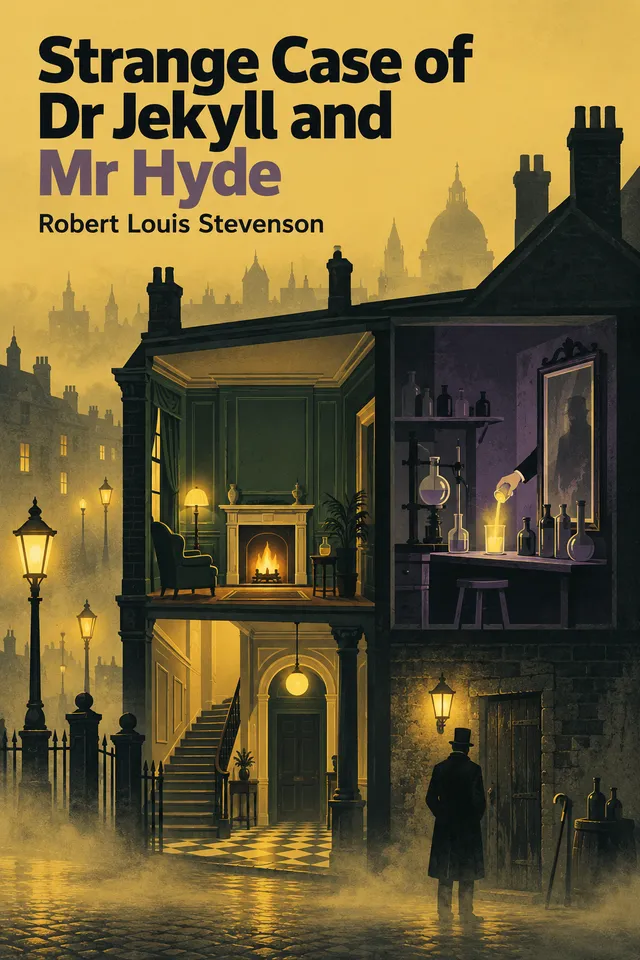
Strange Case of Dr Jekyll and Mr Hyde, by Robert Louis Stevenson.
Gabriel Utterson is reserved in manner and strict with himself, but his restraint is not indifference. He is tolerant of other people’s faults and quietly helps friends whose lives are going badly. His Sunday walks with his distant relative Richard Enfield are almost silent, yet both men keep making time for them. This measured, observant lawyer gives the opening mystery a steady point of view: he notices what can be established, then tries to keep his fears from passing for proof.
On one of their walks, they pass a battered, neglected door set in an otherwise prosperous street. Enfield says he has seen a small man use it. The sight brings back an incident that still troubles him.
Enfield once saw the man, Edward Hyde, trample a young girl underfoot and continue on. The child was frightened but not seriously hurt. Enfield, her family, and the doctor who attended her were furious. They held Hyde there and threatened to make the scene a public disgrace unless he paid the family. Hyde agreed. He used a key to enter through the neglected door, then returned with gold and a cheque signed by the well-known, highly respected Dr. Jekyll.
Enfield had suspected the cheque might be forged. The bank confirmed that it was genuine. That establishes a striking fact: Hyde used Jekyll’s name to settle the matter. It does not establish why Jekyll’s cheque was available or why he paid. Enfield’s blackmail theory is only a guess, and he admits it does not explain everything. He calls the place “Black Mail House,” but the label gives the uncertainty a name rather than resolving it.
Enfield has inspected the building. Hyde seems to be its only regular visitor. The windows are shut but clean, and smoke from a chimney suggests someone may live inside, though the closely packed buildings make that uncertain. Enfield avoids prying into other people’s affairs because one inquiry can set consequences in motion far beyond the original event. He nevertheless answers Utterson’s questions, then regrets having spoken and asks that they not discuss it again. His hesitation makes the door feel like more than a strange setting, but it still tells them nothing about what happens inside.
Utterson already knows Hyde’s name from Jekyll’s handwritten will. He had disliked its terms before hearing Enfield’s story. The will leaves Jekyll’s possessions to Hyde if Jekyll dies, and gives Hyde Jekyll’s place if Jekyll disappears or is absent without explanation for more than three calendar months. Now the name in the document belongs to the man who trampled a child and used Jekyll’s cheque. The connection is concrete; its meaning is not. Utterson fears that Jekyll is exposed to disgrace, but the will itself does not say why Hyde has been granted such unusual standing.
Seeking information, Utterson visits Dr. Lanyon, a long-standing friend of both men. Lanyon has never heard of Hyde. He says that his friendship with Jekyll faded after Jekyll turned to scientific ideas Lanyon considered fanciful and unsound. He angrily dismisses those ideas, but does not explain what they were. Utterson hopes the friends’ estrangement is only a scientific disagreement. It offers no answer about Hyde, and leaves another private division around Jekyll unexplained.
The story begins to occupy Utterson’s imagination. At night he dreams of Hyde trampling the child and entering a sleeping man’s room to command him. These are not new observations; they are his mind giving form to the fear raised by Enfield’s account. Wanting to see the man for himself, Utterson waits by the door at different hours.
When Hyde finally appears, Utterson finds him small, pale, plainly dressed, and difficult to describe. His smile displeases, his voice is hoarse and broken, and his manner shifts between timidity and boldness. Yet Utterson cannot name a particular deformity that would account for the revulsion Hyde inspires. Hyde’s effect on those who meet him is plain; its cause remains uncertain. Utterson’s thought that some hidden moral foulness shows in Hyde’s face is an interpretation, not an explanation.
Utterson steps out, touches Hyde’s shoulder, and identifies him. Hyde recoils with a sharp intake of breath, but his fear lasts only a moment; without looking Utterson in the face, he answers coolly. After Utterson introduces himself and asks to be admitted, Hyde says Jekyll is away and asks how Utterson knew him. Utterson then asks to see Hyde’s face. Hyde hesitates, then turns to face him defiantly. He gives Utterson his address in Soho, reacts angrily when Utterson mentions Jekyll, and disappears inside through the door. The encounter confirms that Hyde has direct access there and reacts strongly to Jekyll’s name. It does not tell Utterson what binds them.
Jekyll’s servant, Poole, supplies another concrete detail: Hyde has a key, the household is expected to obey him, and he mostly comes and goes by the laboratory rather than through the main part of the house. Private access now joins the cheque and the will as evidence of an unusual connection. Utterson imagines that Jekyll may be paying for an old sin or concealed disgrace. He also fears Hyde might creep to Jekyll’s bedside, and worries that, if Hyde suspects the will exists, he may grow impatient to inherit. These possibilities explain Utterson’s alarm, but none is confirmed. Reflecting on his own past, Utterson remembers misdeeds and near-misdeeds of his own. That awareness makes him fearful and humbled, rather than certain that Jekyll’s secret must have one simple cause.
Weeks later, Utterson raises Hyde and the will with Jekyll after dinner. Jekyll calls his position strange and painful, says talk cannot mend it, and assures Utterson that he can be rid of Hyde whenever he chooses. Utterson replies that he has no doubt Jekyll is right. Jekyll then says he has a great interest in Hyde and asks Utterson to protect Hyde’s rights if Jekyll dies. Utterson agrees for Jekyll’s sake, while making clear that he does not like Hyde.
By then, the clues point in several directions without settling into an explanation. Hyde’s violence is witnessed; the cheque is genuine; the will gives him a claim on Jekyll’s property; and he has a key and unusual standing in Jekyll’s household. Jekyll’s assurance does not explain his request that Hyde’s rights be protected. Enfield’s blackmail conjecture and Utterson’s fears of disgrace, intrusion, or inheritance remain unconfirmed. The mystery grows because the link is unmistakable before its meaning is.
Chapter 2 of 6 · 6 min · Audio & textIn the app
Violence, Letters, and Disbelief
Suspicion changes character when a maid witnesses Hyde kill an elderly, white-haired man later identified as Sir Danvers Carew. She sees Hyde meet him, begin with impatience, and then erupt into rage.
Chapter 3 of 6 · 6 min · Audio & textIn the app
The Last Night’s Evidence
A week later, Poole goes to Utterson in visible distress. Poole reports that Jekyll has shut himself in the cabinet again, and says he can no longer bear the silence and fear in the house.
Chapter 4 of 6 · 6 min · Audio & textIn the app
Lanyon’s Witness and Its Cost
Lanyon’s account turns a strange request into a firsthand report of Jekyll’s transformation. He receives a registered letter from his old friend and scientific colleague, though they rarely correspond and had dined together the night before.
Chapter 5 of 6 · 10 min · Audio & textIn the app
The Freedom Jekyll Invents
Jekyll’s confession turns the mystery inward. Born with talent and good prospects, he sought the esteem of people he admired.
Chapter 6 of 6 · 5 min · Audio & textIn the app
When Hyde Takes Control
Jekyll’s account now follows a change he can no longer reliably choose. The returns to his own identity become harder, while Hyde appears with less warning.
Chapter 1 of 6 · 8 min · Audio & text: The Door Behind Respectability
Wiseley supports reading and listening to summaries in the app.
Continue in WiseleyWhat Strange Case of Dr Jekyll and Mr Hyde is about
Robert Louis Stevenson’s novella follows Gabriel Utterson as he investigates the disturbing connection between respected Dr. Jekyll and violent Mr. Hyde. Through witness accounts, documents, and Jekyll’s confession, it examines divided desire, secrecy, habit, and responsibility. The summary traces how shifting evidence turns the mystery into a study of self-command and self-knowledge.