What you'll learn
Key ideas from Start with Why
These ideas compress the book's argument without treating the author's view as settled fact. Use them as an orientation before reading the full work or listening in Wiseley.
Repeat purchases record transactions; loyalty describes staying with a company despite better alternatives and often without researching competitors.
The Golden Circle places purpose, cause, or belief at the center, followed by the methods that express it and the products that make it tangible.
Authenticity emerges when an organization’s words and actions consistently express what it genuinely believes.
Trust grows when an organization demonstrates shared values, and it cannot be guaranteed by promises, procedures, or rational arguments.
Belief-aligned early adopters and authentic influencers help an innovation cross the chasm from personal conviction to trusted mass adoption.
The Celery Test shows that a clear WHY filters advice and decisions, allowing an organization to scale judgment without copying another company.
Passion attracts early believers, but scale depends on HOW-level systems that carry purpose beyond the founder.
Succession preserves an organization’s WHY when the next leader carries the founding cause instead of merely managing its existing WHAT.
How Start with Why builds its case
Follow how the book develops its argument. Each note is a brief orientation, not a replacement for the chapter.
Inspiration Beyond Authority
Authority can make people obey, but it cannot by itself make them choose to follow. Simon Sinek begins by separating a leadership position from leadership itself.
From Assumptions to Intention
Decisions often feel more certain than the information beneath them. We rarely respond to reality in a direct way.
Manipulation’s Immediate Payoff
When markets mature, obvious differences between offerings begin to disappear. Competitors can often provide similar price, quality, service, and features, while novel advantages are quickly copied.
From Novelty to Loyalty
The critique now turns to peer pressure and novelty, two ways organizations borrow confidence or attention. The author’s concern is not that these tactics never work.
The Golden Circle
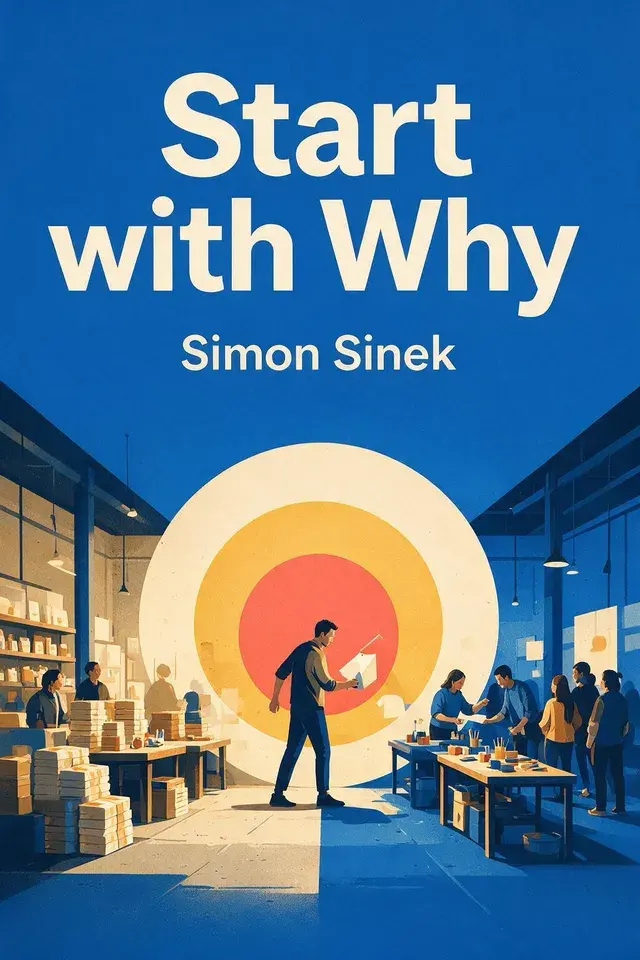
The Golden Circle is Simon Sinek’s model for understanding why some organizations create lasting influence while others struggle to hold attention. He presents it as three concentric questions: WHY, HOW, and WHAT.
Why Decisions Feel Right
People often choose before they can fully explain why, then search for reasons that sound rational. Simon Sinek connects this to the Golden Circle: WHY, HOW, and WHAT.
Making Purpose Operational
The Golden Circle becomes useful only when it governs ordinary choices. In Sinek’s model, WHY is the belief or cause at the center.
Trust, Culture, and Fit
Trust is not a conclusion people reach after checking every box. In the book’s argument, it is an earned feeling.
Purpose That Mobilizes Work
Purpose becomes practical when it changes who joins an organization, how people understand their work, and what they are willing to risk together. Sinek argues that skills and experience matter, but they should follow belief and cultural fit.
From Adoption to Movement
An innovation can be excellent and still fail to spread. Simon Sinek explains that adoption depends not only on quality, but on how different people decide what is worth trying, trusting, and identifying with.
Vision Needs Builders
An inspiring vision is only the beginning. It can give people a reason to gather, but it cannot build the structure that makes change durable.
Make Belief Tangible
Beliefs become useful to an organization when other people can recognize them. They must take visible form in stories, symbols, products, services, and repeated choices.
Scaling Without Losing Why
Growth can make an organization more successful on paper while making its purpose harder to recognize. Sinek describes three connected layers.
Succession Without Substitution
Succession is where an organization's WHY is tested. A founder may be the visible embodiment of a cause, so replacing that person with a highly competent operator can preserve the WHAT while weakening the reason behind it.
Rediscovering the Original Why
Apple’s story gives Sinek a way to make the idea of WHY concrete. He does not attribute the company’s innovation mainly to superior industry knowledge or special access to talent.
Compete with Your Better Self
Near the end of Start with Why, Simon Sinek introduces a runner named Ben Comen, whose example gives the book’s closing idea a human shape. Ben is the slowest member of his cross-country team.