What you'll learn
Key ideas from Starry Messenger
These ideas compress the book's argument without treating the author's view as settled fact. Use them as an orientation before reading the full work or listening in Wiseley.
Reliable knowledge is built by tested hypotheses, independent replication, scrutiny, and confidence proportionate to converging evidence.
The overview effect makes Earth appear borderless and fragile, while the Soweto darkness shows that a planetary view can also expose unequal access to power and resources.
A relative risk becomes meaningful only after its baseline is translated into absolute terms and variation across studies is acknowledged.
Dietary choices become clearer when health, environmental impact, animal welfare, taste, and habit are treated as distinct objectives.
Categories organize continuous variation, but useful boundaries are not automatically natural or absolute.
Institutions can turn demographic categories into unequal rights, even when the same data is needed to detect discrimination.
Eyewitness confidence, courtroom framing, and persuasive advocacy can distort interpretation, so observations require corroboration and careful separation from conclusions.
Curiosity and stewardship connect finite lives to protecting the conditions for future people and future discovery.
Inside Starry Messenger
Read the first chapter in full here. The other 9 continue in the Wiseley app.
Chapter 1 of 10 · 7 min · Audio & text
Learning to Trust Tested Knowledge
Starry Messenger, by Neil deGrasse Tyson.
Many beliefs feel self-evident because they are familiar, emotionally satisfying, or repeated by people we trust. Starry Messenger opens with a question beneath those beliefs: how can we correct an intuition or conviction that feels obvious? Tyson’s answer is a discipline of exposure. Identify what kind of claim is being made, ask what observation or experiment could test it, and then ask whether independent results converge. Confidence should track the strength and consistency of evidence, not the force of desire, authority, or repetition.
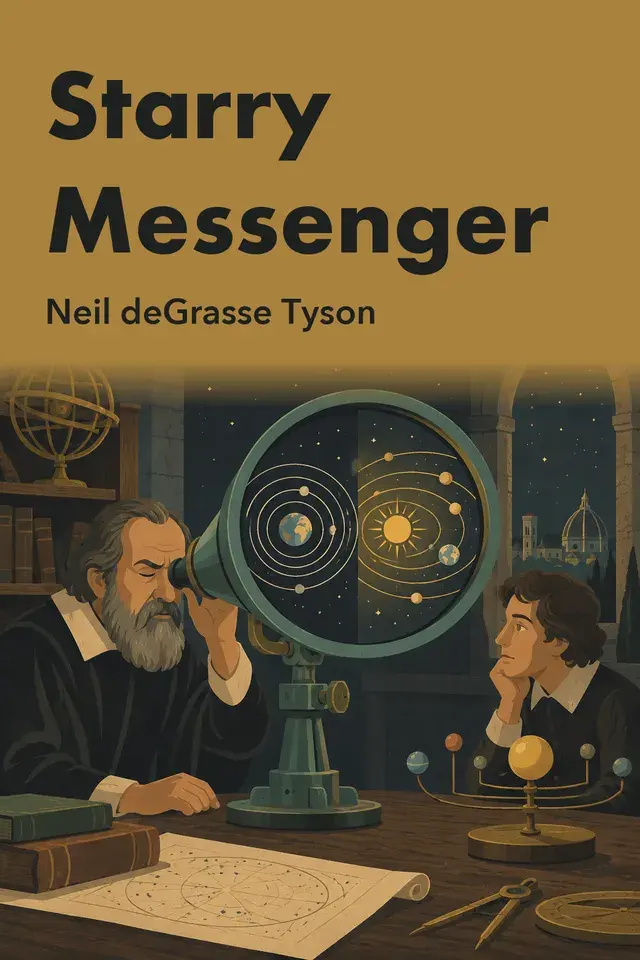
Galileo’s telescope provides the founding example. In the year sixteen ten, his observations of the Sun, Moon, stars, planets, and Milky Way revealed a universe unlike inherited assumptions. The instrument did not create a new reality. It exposed the weakness of unaided perception, including the belief that Earth was the center of all motion. Self-correction begins when tools are allowed to challenge what our eyes and traditions report.
Science becomes trustworthy not because scientists never err, but because its practices make error visible and costly. Hypotheses are tested against observations and experiments. Published work meets peer criticism, replication, and further scrutiny in conferences and journals. A single paper, impressive credential, or dramatic headline does not settle a frontier question. Checks may take years, and research may produce no confirmed phenomenon at all. That uncertainty is not a defect. It is the honest status of a claim that has not yet survived enough independent tests.
Scientific consensus must also be distinguished from conformity. At the frontier, disagreement is normal and useful. Ideas are challenged regardless of a researcher’s seniority, and an unpopular proposal can gain acceptance when repeated observation and experiment support it. Ideas that fail scrutiny are discarded. Irreproducible work damages professional standing, while deliberate fabrication can end a career through science’s own internal standards. The method depends on organized skepticism rather than on everyone agreeing at the beginning.
This standard clarifies different kinds of truth. An objective finding is independent of belief, authority, location, or repetition, and can be checked with appropriate tools. Repeated, consistent experiments make such findings reliable within their established domain. A personal truth is a deeply held conviction. It may be sincere and meaningful, but sincerity is not evidence-based proof, and a private conviction cannot legitimately be imposed on dissenters. Tyson also describes political truths: assertions that become emotionally powerful and seemingly unquestionable through relentless repetition. Repetition can manufacture confidence, but it cannot turn an assertion into an objective fact.
The practical sequence is therefore simple. First identify the kind of claim. Then ask what would count as a test. Finally check whether independent results converge. Evidence can inform a personal or political conviction without settling every value judgment. But for an objective claim, the crucial question is whether it has survived attempts to show it false. This habit separates what someone wants to be true from what has endured serious examination.
Scientific refinement does not mean that earlier knowledge becomes worthless. Newtonian laws remain useful under ordinary conditions, while modern physics reveals deeper layers and broader limits. The newer account encloses the older one as a reliable approximation within its proper domain. Equations such as F equals m a and E equals m c squared express patterns that reach far beyond any one human viewpoint. Tyson treats this relationship between tested truth and elegance as part of science’s beauty: simple forms can encode immense regularities without becoming magical explanations.
That is an aesthetic argument, not a scientific law. Tyson suggests that understanding can deepen wonder rather than drain it away. Knowing how sunlight, photons, atmospheric refraction, and visual processing produce a sunset does not make the sunset less beautiful. Cosmic images, planetary landscapes, mathematical relationships, chemical transformations, and the diversity of life can become more compelling when their underlying structure is known. Beauty standards in human culture may change, but Tyson presents the beauty of truthful and authentic nature as something that knowledge can reveal more fully.
The same perspective makes beauty less sentimental. Nature can sustain life and destroy it. Earth is a haven, but it is also shaped by extinction, disease, storms, and impacts. The Shoemaker-Levy Nine comet illustrates the tension. Tidal forces split the comet, and its fragments struck Jupiter with scars larger than Earth. People could observe the spectacle from a safe distance, where its destruction had no human consequences. If the fragments had struck Earth, the result would have been an extinction-level event. Cosmic beauty and lethal danger can occupy the same event because nature is indifferent to human welfare.
Recognizing that indifference does not produce a complete moral system. It does, however, clarify responsibility. With no evident cosmic rescuer, humans must protect one another through medicine, shelter, and future systems for deflecting dangerous asteroids. Cosmic perspective widens the frame around human quarrels and exposes the limits of our viewpoint without guaranteeing agreement. For Tyson, the universe’s deepest beauty may be its knowability at all. Reliable knowledge is therefore less a store of infallible answers than a method for correcting ourselves: use instruments when perception fails, test claims, invite scrutiny, and keep confidence proportional to evidence.
Chapter 2 of 10 · 10 min · Audio & textIn the app
Exploration Changes the View Home
After establishing why tested knowledge must correct intuition, Tyson asks what exploration changes for people who stay home. Critics call space exploration an expensive luxury and ask why hunger, poverty, education, unrest, or war should not be solved first.
Chapter 3 of 10 · 6 min · Audio & textIn the app
Disagreement Without Tribal Certainty
Disagreement becomes less destructive when we separate two questions: What is happening, and what should we do about it? The first is empirical.
Chapter 4 of 10 · 8 min · Audio & textIn the app
Making Uncertainty Count in Decisions
Tyson begins with a practical difficulty: people calculate risk constantly, but the human brain is not naturally good at probability. Pattern detection once helped our ancestors respond to ambiguous signals.
Chapter 5 of 10 · 7 min · Audio & textIn the app
Drawing the Circle of Moral Concern
People often talk about eating as though one label—meatarian, vegetarian, or vegan—settles the question. Tyson asks us to separate the motives hidden inside those labels.
Chapter 6 of 10 · 7 min · Audio & textIn the app
When Categories Hide Human Variation
Tyson's classification argument begins with a practical truth: people need categories to communicate about a world too varied to describe from scratch. We sort storms, colors, matter, and people into named groups.
Chapter 7 of 10 · 9 min · Audio & textIn the app
How Difference Becomes Inherited Hierarchy
Once a category enters an institution, it can do more than describe people. It can determine who receives rights, opportunities, and recognition.
Chapter 8 of 10 · 9 min · Audio & textIn the app
Justice Requires More Than Persuasion
Tyson opens with legal questions that become stranger in space: if a human kills an alien, is that murder, and who owns lunar minerals or comet water? These are not a space-law survey.
Chapter 9 of 10 · 7 min · Audio & textIn the app
Rethinking Bodies, Abilities, and Intelligence
People often treat the human body as nature’s reference design. Tyson asks readers to question that instinct.
Chapter 10 of 10 · 5 min · Audio & textIn the app
Finite Lives and Shared Responsibility
After the book’s arguments about knowledge, judgment, and civilization, Tyson’s coda returns to the scale of one lifetime. Its claim is not that mortality affects everyone identically.
Chapter 1 of 10 · 7 min · Audio & text: Learning to Trust Tested Knowledge
Wiseley supports reading and listening to summaries in the app.
Continue in WiseleyWhat Starry Messenger is about
How can viewing humanity from a cosmic perspective change everyday judgment? Neil deGrasse Tyson applies scientific reasoning to conflict, risk, food, identity, justice, and mortality. The book offers ways to question inherited assumptions, compare evidence, and consider shared responsibilities while acknowledging the limits of data in resolving moral choices.
About Neil deGrasse Tyson
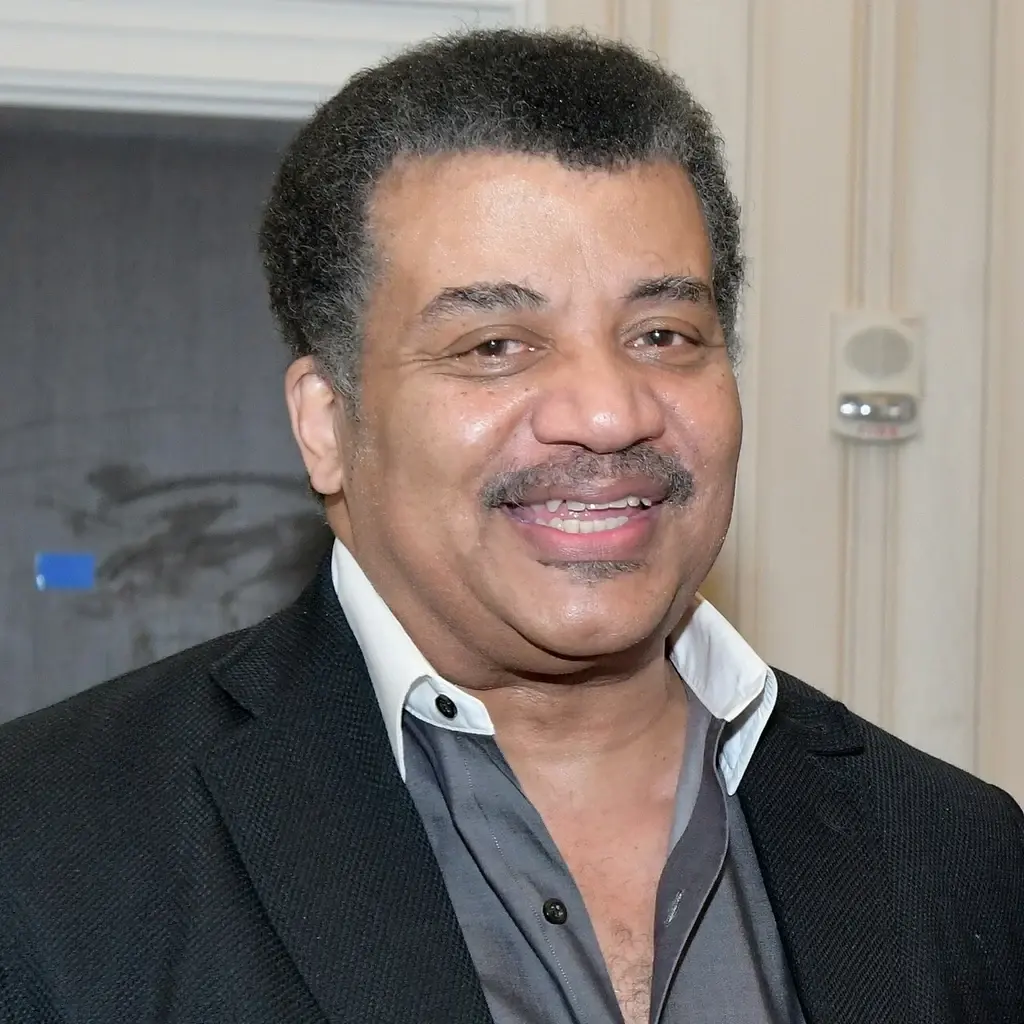
Neil deGrasse Tyson is an American astrophysicist. “Astrophysics for People in a Hurry” explores central ideas about the universe, from cosmic origins to the matter around us.
Explore more books by Neil deGrasse Tyson