What you'll learn
Key ideas from Spiritual Partnership
These ideas compress the book's argument without treating the author's view as settled fact. Use them as an orientation before reading the full work or listening in Wiseley.
The shift toward multisensory awareness is uneven and does not guarantee virtue; growth still depends on deliberate choices.
Love accepts another person without requiring a return; need makes connection conditional on safety, worth, or belonging.
Bodily sensations and emotions can help make frightened patterns visible before they direct behavior.
Spiritual partnership gives mutual spiritual growth a shared purpose while leaving each person responsible for their own inner change.
The imagined scale represents a person's sense of superiority or inferiority; equality means equal preciousness at the soul level, not sameness of traits or status.
Compassion is attentive care without hidden agendas, and it includes care for oneself.
A spiritual partner helps someone examine distress while leaving their interpretation and choices in their own hands.
Inside Spiritual Partnership
Read the first chapter in full here. The other 9 continue in the Wiseley app.
Chapter 1 of 10 · 7 min · Audio & text
A Shift in Human Awareness
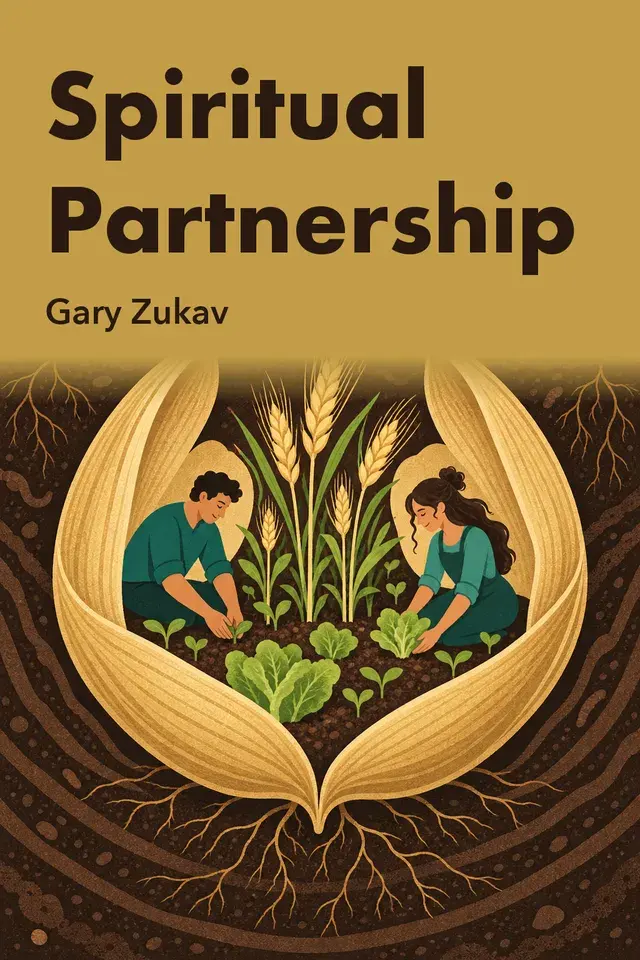
Spiritual Partnership, by Gary Zukav.
Gary Zukav begins with a contrast between five-sensory and multisensory ways of experiencing life. Five-sensory consciousness takes sight, hearing, touch, smell, and taste as the limits of what can be known. The intellect sorts and analyzes this information, helping people work with the physical world and meet practical needs. Zukav associates this orientation with survival and external power: trying to control circumstances or people to reach a desired result. He regards this approach as once useful, but increasingly destructive when control becomes the main measure of power.
Multisensory awareness, in his account, adds another way of perceiving without replacing the five senses. He says it can reveal nonphysical qualities such as wisdom, compassion, intelligence, purpose, and connection. People may experience ordinary events as more meaningful, notice intuition or unexpected coincidences, or feel less separate from others and the wider Universe. These are spiritual claims within Zukav’s framework. He argues that the intellect, accustomed to physical evidence, cannot fully explain such perceptions. He compares the added awareness to color enriching a black-and-white picture: the familiar world remains, but it may be experienced differently.
Zukav calls the expansion of perception the Gift. It is emerging across humanity, he says, without requiring each person to make it happen. But perceiving more does not automatically change how someone behaves. A person may recognize that anger pushes others away and still act angrily. The Gift can make consequences or new possibilities visible; it does not ensure that anyone will use what they notice.
That choice is the Work. Zukav describes it as changing the inner sources of destructive emotions, thoughts, and compulsive behavior, while cultivating qualities that support constructive action. He connects this effort with aligning personality with the soul, whose intentions he names as harmony, cooperation, sharing, and reverence for Life. The Work takes deliberate choices and, he says, is difficult and gradual. Expanded perception can open the way, but each person must decide whether to change and practice doing so.
To explain why those choices matter, Zukav proposes three spiritual laws. The Universal Law of Creation says that people create their experiences through choices, with intention—the reason behind an action—playing a central role. In this view, what someone does matters, but so does why they do it. The law shifts attention from an action’s visible form to the motive that gives it direction.
The Universal Law of Cause and Effect extends familiar physical cause and effect to nonphysical causes. Zukav argues that intention is one such cause, even when it cannot be seen or measured through the senses. He connects this law with the Golden Rule and karma, and says that unrecognized intentions can lead to consequences that surprise people. His third principle, the Universal Law of Attraction, holds that like energy draws like energy. He says anger or greed attracts corresponding experiences, while loving intentions draw a more loving world. These laws belong to his spiritual account of how choices shape experience.
A farmer makes the link between intention and consequence easier to picture. Imagine planting one kind of seed while expecting a different crop. When the harvest comes, the farmer may wonder why barley grew instead of lettuce. If he does not know which seeds he planted, the result seems hard to explain. For Zukav, intentions are like the seeds and consequences like the harvest: knowing what one chose helps make the result more understandable. The example does not make every outcome predictable; it illustrates why awareness of one’s choices matters.
Zukav also uses a personal story about moving from a city to a rural valley. He recalls being curt with people because he assumed strangers were replaceable. In a smaller community, he had fewer neighbors and began to see that friendship depended on changing how he treated them. He extends that lesson through his spiritual view of people as companions across eternity: if others are long-term neighbors, kindness need not wait until a practical need arises. The story shows how an assumption about other people can shape both conduct and the experience of an encounter.
His historical account applies the same framework to settlement and domination. In his telling, Vikings came to North America seeking plunder, Columbus sought a trade route, and European colonialists sought land and riches, taking what they desired by force and impoverishing the people they encountered. Zukav says they achieved what they intended, but did not foresee that their drive to dominate would destroy Native cultures and the environment. He also describes American settlers, once oppressed themselves, becoming oppressors as they moved across North America. In his account, industrialization and wider exploitation intensified environmental damage and threatened the continent’s ability to support its population. He uses these events to illustrate a consciousness focused on domination and immediate gain. The historical and metaphysical interpretation is his; the point he draws is that choices can have effects beyond what their makers intend.
Zukav presents the transition toward multisensory awareness as underway but uneven. Some people find new meaning in ordinary events or notice changing values; others feel frightened by unfamiliar experiences or deny them. He expects old and new ways of seeing to overlap for generations. Nor does expanded awareness compel virtue: people can perceive more and still choose control or continue familiar behavior. In his account, growth depends on what follows the Gift—the deliberate choices of the Work. Awareness may reveal connections and consequences beyond the senses, but people remain responsible for how they respond.
Chapter 2 of 10 · 8 min · Audio & textIn the app
When Need Masquerades as Love
People often use the word love for strong attachment. Gary Zukav asks what affection demands from the other person.
Chapter 3 of 10 · 9 min · Audio & textIn the app
Practicing Authentic Power
A painful reaction can seem like a direct answer to an irritating person or an unfair situation. But when the same anger, jealousy, or sense of rejection returns in another relationship, job, or place, the author treats that recurrence as a clue.
Chapter 4 of 10 · 6 min · Audio & textIn the app
Relationships with a Growth Purpose
A relationship can be loving and important without having spiritual growth as its main purpose. Gary Zukav draws this distinction by asking what holds people together and what they hope the connection will do.
Chapter 5 of 10 · 7 min · Audio & textIn the app
Equality Under Pressure
A spiritual partnership, in Gary Zukav’s account, asks each person to take responsibility for their own growth. That becomes difficult when two people activate each other’s fear.
Chapter 6 of 10 · 6 min · Audio & textIn the app
Roles, Secrets, and Trust
People enter many roles: parent, teacher, businessperson, partner, grandparent. In Gary Zukav’s account, a role can shape what someone notices, thinks, feels, and intends.
Chapter 7 of 10 · 7 min · Audio & textIn the app
Courage, Integrity, and Compassion
Commitment to love, in Gary Zukav’s account, is not a claim that fear has disappeared. Fearful and loving parts of a person may both be active.
Chapter 8 of 10 · 10 min · Audio & textIn the app
Turning Guidelines into Daily Practice
The guidelines are meant to help people make choices in real situations, not to prescribe one correct response for every encounter. The author presents them as ideas to test through experience and keep open to revision.
Chapter 9 of 10 · 6 min · Audio & textIn the app
Helping Without Taking Over
When someone is in pain, it is natural to offer comfort, advice, or a quick way to improve the situation. In a spiritual partnership, support has another purpose: helping the person notice what is happening within them and decide how to respond.
Chapter 10 of 10 · 8 min · Audio & textIn the app
From Intimacy to Collective Change
Zukav extends spiritual partnership beyond the couple. He argues that the ways people respond to one another at home, at work, and in public life can help shape more cooperative relationships.
Chapter 1 of 10 · 7 min · Audio & text: A Shift in Human Awareness
Wiseley supports reading and listening to summaries in the app.
Continue in WiseleyWhat Spiritual Partnership is about
Gary Zukav frames spiritual partnership as an equal relationship devoted to spiritual growth. He connects it to a proposed shift beyond five-sensory awareness and to practical work: noticing fear, examining intention, and choosing loving responses while each person remains responsible for their own change. Examples extend from couple conflict to parenting and work.
About Gary Zukav

Gary Zukav is an American author. “Spiritual Partnership” explores spiritual partnership as an equal relationship devoted to spiritual growth.
Explore more books by Gary Zukav