What you'll learn
Key ideas from Sovereign Self
These ideas compress the book's argument without treating the author's view as settled fact. Use them as an orientation before reading the full work or listening in Wiseley.
Sovereignty is recognition of an already whole Atman, not the manufacture of a better identity from changing circumstances.
Attachment becomes bondage when an outcome is made the condition for inner peace and blocked desire narrows judgment.
A pause before action reveals whether a goal is chosen freely, revised ethically, or obeyed under pressure.
Witnessing allows feelings to be fully felt while loosening identification, so discernment can guide participation instead of reactive control.
Mithya does not erase suffering; nondual understanding should increase gratitude, service, protection, and ethical discernment in the shared world.
Nonviolence includes clear boundaries, protective action, and ethical consequences when repeated requests fail.
Acceptance ends futile resistance without denying problems, tolerating abuse, or abandoning practical action.
Progress appears as less frequent, shorter, and less intense delusion, with more tranquility, responsibility, and freedom to choose.
Inside Sovereign Self
Read the first chapter in full here. The other 14 continue in the Wiseley app.
Chapter 1 of 15 · 8 min · Audio & text
The Self Beneath Borrowed Identities
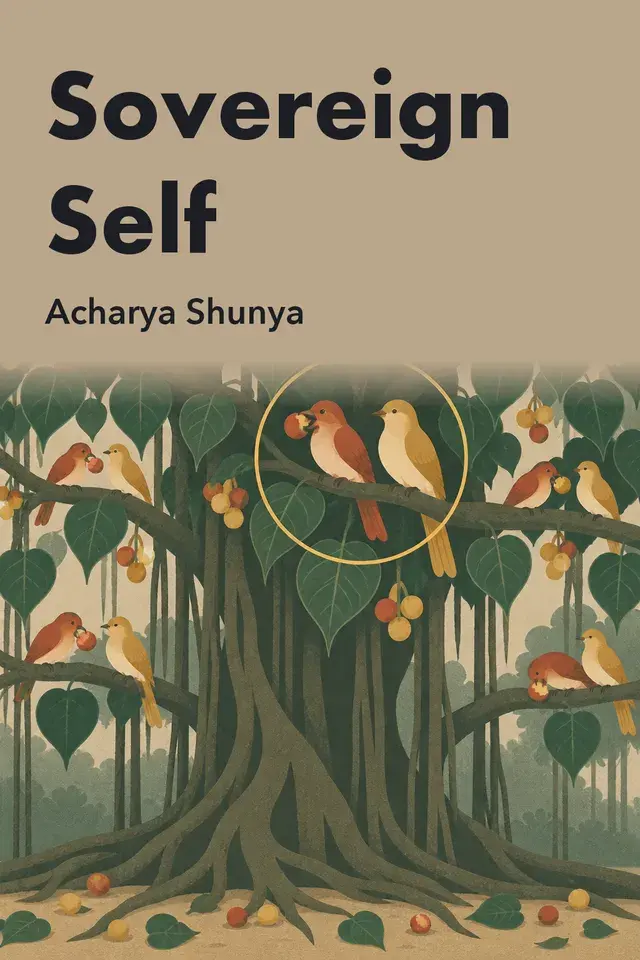
Sovereign Self, by Acharya Shunya.
Sovereignty, in Acharya Shunya’s sense, is not the power to arrange every circumstance. It is inner freedom: the ability to live from an authority deeper than fear, craving, social approval, or changing conditions. The body, mind, relationships, work, and roles may remain much as they are. What changes is the identity from which a person meets them. Shunya’s central premise is that the Self is already whole. A person does not need to manufacture a new, superior self beneath the borrowed identities gathered from experience.
Her starting point is the Vedic idea of Atman, or the Self. Atman is described as boundless, self-aware consciousness that animates the body and mind without being confined by either. Brahman is the name for that same underlying consciousness when understood as pervading the universe. In this interpretation, Atman and Brahman are not ultimately separate. Shunya also presents Atman as eternal and imperishable, continuing beyond bodily death. These are claims within her Vedic and Upanishadic framework, not conclusions independently established by the passages themselves. The body, mind, intellect, and ego are instruments or expressions through which consciousness appears, but they do not exhaust what a person is.
Maya explains why this deeper identity is so easy to miss. Shunya describes maya as spiritual forgetfulness with two functions. Concealment veils what is truly present: the Self’s fullness, peace, and awareness. Projection then makes something limited appear to be the whole truth. Body, mental states, relationships, roles, and social expectations begin to seem like the final definition of a person. The classic image is a rope mistaken for a snake. The snake is not actually there, yet the fear is real while the mistake is believed. In the same way, a projected identity can produce genuine loneliness, fear, inadequacy, and powerlessness. The problem is not simply that appearances change. It is that changing appearances are mistaken for the deepest reality.
Within maya, ahamkara, or ego, is the maker of the I-thought. Shunya uses ego in a specialized Vedic sense, not merely to mean arrogance or vanity. The thought I am gathers memories, preferences, strengths, wounds, beliefs, and social labels into a continuing identity. This constructed persona is called the jiva. It feels separate and unique, yet it borrows consciousness, intelligence, and power from the Self while forgetting their source. Because its worth depends on praise, criticism, success, and failure, the jiva keeps trying to control what cannot be fully controlled.
That does not mean the ego should be hated, denied, or bypassed. Shunya says the traditional path educates the ego step by step. A purified ego can become like a clean mirror that reflects the Self. Acceptance means seeing the ego’s conditioning without shame and without treating its fears as ultimate truth. It also means refusing to use spiritual language to hide unresolved wounds, emotional avoidance, poor boundaries, or unfinished psychological work. Recognizing the Self does not remove the need for honesty, maturity, or responsible care of the person through whom that recognition must appear.
This distinction also clarifies Shunya’s account of happiness. She calls the Self’s intrinsic bliss ananda. It is not a temporary mood produced by an object, achievement, relationship, or pleasant sensation. External happiness rises and falls because circumstances, desires, and mental conditions change. Ananda, by contrast, is presented as inherent in the Self and capable of being present even when a person is moving through sorrow. A distressed mind may not consciously experience that underlying bliss, just as clouds can obscure the sun without destroying it. Sovereignty therefore does not mean never feeling sadness. It means not concluding that changing sadness defines one’s whole nature.
The banyan-seed teaching gives this invisible grounding a concrete form. A father asks his son to examine a banyan fruit, then one of its seeds. When the seed is opened, nothing perceptible seems to remain. Yet from that apparently empty seed, a great tree can emerge. Shunya uses the image to suggest that an unseen reality can be the source and support of visible life. The Self is not presented as an object that ordinary senses can locate. Its invisibility is part of the teaching’s point: what grounds experience may not itself appear as another experience. The story illustrates Shunya’s Vedic claim; it is an analogy for contemplation, not independent proof of metaphysical immortality.
The image of two birds adds another distinction. One bird eats the tree’s sweet and bitter fruits, while the other watches quietly. The fruit-eating bird represents the jiva, participating in pleasure, pain, gain, loss, memory, and choice. The witnessing bird represents the Self as awareness of those changing experiences. The point is not to become numb or to abandon participation. A person can feel, act, and fulfill responsibilities while also recognizing that every feeling and role is known by awareness and therefore is not the whole of awareness.
A brief adaptation of Shunya’s One Truth contemplation gathers these ideas. In a quiet pause, notice that the body, thoughts, emotions, roles, and circumstances continually change. Then ask what makes all those changes known. Let the inquiry turn toward the Vedic conclusion that the one constant truth is the Self: whole, free, and inwardly sufficient. This is not an instruction to reject the personality or repeat a slogan mechanically. It is a way to distinguish the enduring ground from the identities borrowed for daily life.
That distinction explains the purpose of the path that follows. Study, contemplation, ethical practice, and mental purification do not create Atman. They prepare the mind to recognize what Shunya says has never been absent. Sovereignty begins when the person stops asking a changing persona to become whole and starts recognizing the wholeness beneath it.
Chapter 2 of 15 · 8 min · Audio & textIn the app
How Attachment Authors Inner Suffering
Shunya distinguishes jagat, the shared objective world, from samsara, the subjective world each person constructs through thoughts and beliefs. The same event can therefore produce different inner worlds.
Chapter 3 of 15 · 9 min · Audio & textIn the app
Choosing Desires Without Becoming Their Servant
After showing how attachment turns a preference into dependence, Shunya asks whether desire itself should be rejected. Her answer is no.
Chapter 4 of 15 · 6 min · Audio & textIn the app
Learning Without Surrendering Your Judgment
Shunya places a qualified living teacher inside the path for a specific reason: self-ignorance can make a seeker mistake a familiar mental pattern for truth. In her Vedic account, a guru has realized the Self and can answer questions, correct reasoning, and point the student toward the inner guru, the Self.
Chapter 5 of 15 · 8 min · Audio & textIn the app
Witnessing Experience Without Suppressing It
Shunya makes witnessing the practical bridge between recognizing the Self and living from that recognition. In her Vedic and Advaita account, experience is the seen, while awareness is the seer.
Chapter 6 of 15 · 8 min · Audio & textIn the app
Cultivating Clarity Before You Act
Before deciding what to do, Shunya asks us to notice the quality of mind doing the deciding. She calls the needed pause viveka, or moment-by-moment discernment before action or reaction.
Chapter 7 of 15 · 8 min · Audio & textIn the app
Belonging Without Possession or Dependence
Building on its earlier diagnosis of attachment, Shunya brings together two forms of detachment. Viyoga is an inward separation from mistaken identification with roles, people, possessions, and outcomes.
Chapter 8 of 15 · 6 min · Audio & textIn the app
Replacing Thought Patterns With Deliberate Choices
Shunya introduces shama as the management, or housekeeping, of thought. The higher mind—the faculty of discernment—guides the lower mind, where habitual thoughts and reactions arise.
Chapter 9 of 15 · 9 min · Audio & textIn the app
Feeling Fully Through Anger and Grief
Emotional sovereignty is not the ability to stay calm at all times. It is the ability to feel honestly without surrendering the power to choose.
Chapter 10 of 15 · 8 min · Audio & textIn the app
Recognizing Unity While Respecting the World
Advaita means “not two.” In Acharya Shunya’s Vedic presentation, it is the vision that one universal consciousness appears through many bodies and minds.
Chapter 11 of 15 · 10 min · Audio & textIn the app
Making Ethics a Daily Discipline
For Shunya, dharma is where sovereignty becomes visible: inner freedom expressed through ordinary choices made from humane values rather than compulsion, imitation, or approval-seeking. The Vedic map names four aims: security, artha; pleasure, kama; virtue, dharma; and liberation, moksha.
Chapter 12 of 15 · 6 min · Audio & textIn the app
Living Your Nature With Integrity
Shunya distinguishes universal dharma from personal swadharma. Dharma sets values such as truth, nonviolence, kindness, and responsibility.
Chapter 13 of 15 · 7 min · Audio & textIn the app
Firm Boundaries and Compassionate Speech
Conflict reveals whether power comes from fear-driven ego or from the Self. The author calls the latter atmashakti, or soul power.
Chapter 14 of 15 · 7 min · Audio & textIn the app
Acceptance That Preserves Your Agency
Equanimity, or samatvam, is not the absence of feeling. In Acharya Shunya’s account, it is the capacity to acknowledge a condition, feel its impact, and still choose a response aligned with dharma.
Chapter 15 of 15 · 7 min · Audio & textIn the app
Preparing for Freedom in Ordinary Life
Shunya presents moksha as something more lasting than a spiritual high. Meditation, contemplation, or a crisis may briefly loosen samsaric patterns and reveal inner freedom.
Chapter 1 of 15 · 8 min · Audio & text: The Self Beneath Borrowed Identities
Wiseley supports reading and listening to summaries in the app.
Continue in WiseleyWhat Sovereign Self is about
What does inner freedom mean when relationships, desires, and circumstances keep changing? Acharya Shunya’s Vedic account locates sovereignty in the enduring Self. It connects that spiritual vision with practices for examining thoughts, meeting grief, choosing ethical actions, and maintaining compassionate boundaries in everyday life.
About Acharya Shunya

Acharya Shunya is the author of “Sovereign Self”. The book explores how Vedic teachings locate inner freedom in an enduring Self rather than in changing circumstances.
Explore more books by Acharya Shunya