What you'll learn
Key ideas from Smoke Gets in Your Eyes
These ideas compress the book's argument without treating the author's view as settled fact. Use them as an orientation before reading the full work or listening in Wiseley.
A replaced goldfish delayed Doughty’s understanding of death; witnessing a child’s fall made mortality real and difficult to set aside.
Hospitals and transport systems can hide death from public view, while rituals bring loss into shared space.
Civil War transport needs gave embalming practical value, while professional promotion helped turn a situational service into an expected custom.
Modern funeral customs can keep bodily change out of sight, leaving decay unfamiliar and death harder to imagine.
Historical family care and Muslim Ghusl show that relatives can have active roles in washing and shrouding the dead.
Doughty’s good death is personal and includes preparation, awareness, limited suffering, and acceptance.
Doughty leaves the redwoods and chooses to live after recognizing her suicidal intent and considering the uncertainty her death would leave loved ones.
Inside Smoke Gets in Your Eyes
Read the first chapter in full here. The other 7 continue in the Wiseley app.
Chapter 1 of 8 · 8 min · Audio & text
Learning to Work with Death
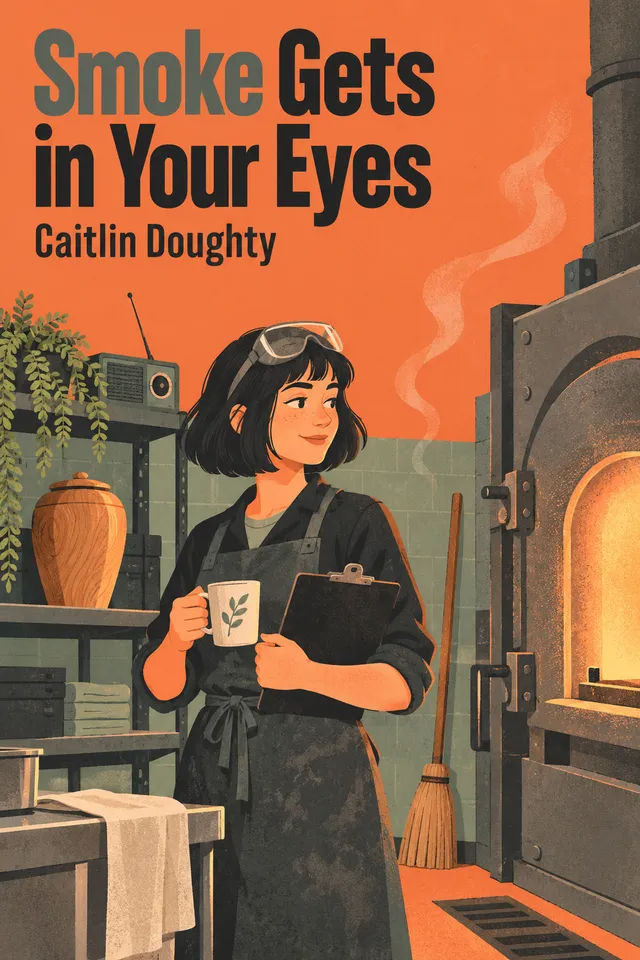
Smoke Gets in Your Eyes, by Caitlin Doughty.
For much of her childhood, Caitlin Doughty encountered death at a safe distance. Cartoons and horror films let her fast-forward through frightening scenes. Even her first lesson about a dead creature came with a substitute. When her goldfish Superfly became ill and stopped swimming, her mother thought it had died and planned to tell her later. Her father flushed the fish and replaced it with a similar one. The new fish swam, and the family called it Superfly the Second. For a while, death seemed something a family might outwit.
At eight, Doughty saw an event she could not rewind. At a shopping mall during Halloween, she called for her father from an upper floor and saw a little girl fall about thirty feet onto a counter. The girl’s mother screamed. Doughty could not find her father in the crowd. She does not describe gore, and she never learned whether the girl survived. What stayed with her was the sound of the impact and the knowledge that the event was real.
That night, Doughty stayed awake until dawn thinking that she and everyone else would die. Her parents found her huddled under blankets the next morning and took her for pancakes, but the family did not discuss what had happened. The sound returned in her memory, and death seemed suddenly present everywhere. She became afraid that ordinary events could signal her own death and developed small rituals she believed might keep it away. As she grew older, the rituals and recurring sound faded. She says she then relied on denial, rather than feeling that the fear had been resolved.
Years later, after studying medieval history and reading academic papers about mortality, Doughty wanted to encounter actual bodies. She applied to funeral homes for months before Westwind hired her. She hoped working with the dead might reach the frightened child she had been. After securing the job, she began imagining a funeral home called La Belle Mort, or Beautiful Death, where children and families could engage with death in a setting she pictured as safe and beautiful. This was an aspiration in her notebook, not a remedy she had tested. Her first lessons came through ordinary work, and the bodies did not fit an idealized image.
On her first day as a crematory operator, Doughty was asked to shave Byron, a man in his seventies, before his family saw him. She was twenty-three and had never shaved anyone. She had imagined trained professionals doing this work, so holding a razor to a dead stranger’s face felt like a test she was not ready to take. She tried to think of Byron as matter, but could not keep the person out of view. She felt the task as both intimate and unsettling, wanted to quit, and completed the shave.
Afterward, Byron’s wife and daughter came to view him. The preparation and rose-colored light made his face look more serene. His wife explained that he had been a fastidious accountant, but lung cancer had made him too ill to shave himself. The shave had been a practical task for Doughty, but it helped restore a familiar detail for the family. Her work was already connecting the body's physical condition with the person mourners remembered.
When the family left, Mike cremated Byron. About two hours later, Doughty raked out the glowing remains and found his skull intact. It was warm and crumbled when she turned it. The recognizable man she had shaved was no longer there; now she confronted what remained of his body. The change was not an idea in a book or a frightening scene on a screen. It was a physical result of work she had helped carry out.
Westwind’s routine made that work a sequence of practical steps. Doughty began by starting the retorts, checking cremation permits, and finding the corresponding bodies in refrigerated storage. Workers moved a body to the retort, loaded it, closed the chamber, adjusted airflow, ignited the burners, and monitored temperature and progress. The container and soft tissue burned; bone remained. Once the chamber had cooled, workers raked out the remains, removed metal objects, and put the bone fragments through a machine that reduced them to the powder families received as cremated remains. For Doughty, completing these steps meant handling a body at close range, then taking responsibility for what came out of the machine.
The work was not solemn reflection all day. Doughty had expected time to read and think, but ordinary concerns soon took over: lunch, cleaning, and the feeling that she could not get fully clean. Ash and soot settled around the crematory and on the workers. Routine did not make the bodies unreal. It made attention to sequence, equipment, and the material left behind part of the job.
On her second day, Doughty met Padma, a woman in her early thirties who had been killed by a rare genetic disease. Her body was kept at Stanford University Hospital for months so doctors could study the disease that killed her. Her body later arrived at Westwind. Her skin had blackened, and mold covered her face. The sight confronted Doughty with a different physical reality from Byron’s cremation. A cremation reduced recognizable features through heat; Padma’s body showed the changes of decomposition. Doughty thought of literary images that make death seem pale and beautiful, and saw how much they leave out. Her response was not that every body could be made serene. It was that the work required her to meet each body as it was.
Funeral work also brought Doughty into homes where families were still beside the dead. A house call required two workers. For her first one, she went with Chris to collect Mrs. Adams, a woman in her late forties who had died of breast cancer. At the house, at least forty people had gathered around her. Doughty worried that they would distrust two white funeral workers arriving in an unmarked van, and she was unsure how to introduce herself to the family.
Chris asked whether this was Mrs. Adams, and a man stepped forward and introduced himself as Mr. Adams. When Doughty asked if he was her husband, he corrected her: “I am her husband. Not were her husband.” Chris then introduced himself and Doughty and asked if they were ready to take her. The family stayed and watched as the workers positioned the gurney, slid a sheet beneath her, lifted her onto it, covered her, and secured her for transport. Chris’s calm instructions helped Doughty follow the procedure and gave the relatives a way to understand what was happening. As the gurney was wheeled out, Mrs. Adams’s son, who was Doughty’s age, asked to lay a flower on it. Doughty told him his mother must have been amazing, then recognized she had no basis for saying so. Her awkwardness showed how little experience she had with grief; the family’s presence showed that a removal could be more than a technical task.
These encounters did not erase Doughty’s fear or prove her imagined funeral home could make death safe. They gave her a way to approach mortality through concrete work: preparing a face for family, explaining and carrying out a removal, tending a machine, and processing what remained. The work asked for practical skill and attention, while keeping the dead person’s family and physical reality close. For Doughty, learning to work with death began when an abstract fear became a body that had to be cared for.
Chapter 2 of 8 · 10 min · Audio & textIn the app
Rituals Make Loss Visible
Death can happen in the middle of ordinary life, yet the systems around it often carry the dead out of sight. Caitlin Doughty traces how dying in the United States moved from the home toward hospitals, where doctors and rules of hygiene took charge of the final hours.
Chapter 3 of 8 · 9 min · Audio & textIn the app
The Business of Looking Natural
A funeral custom can seem inevitable simply because it is familiar. Doughty traces embalming and the modern American funeral to particular historical needs, then to businesses that made those practices appear proper and necessary.
Chapter 4 of 8 · 8 min · Audio & textIn the app
What Happens to a Body
Funeral care meets bodies at moments when their appearance and substance are changing. Preparation can make some changes less visible, but it cannot restore a body to an earlier state.
Chapter 5 of 8 · 7 min · Audio & textIn the app
Decay, Love, and Return
Doughty’s argument begins with the body’s ordinary changes after death. They are not a sign that something has gone wrong.
Chapter 6 of 8 · 9 min · Audio & textIn the app
Families Can Care for the Dead
Families often enter death care at a moment when they have little experience and may not know what choices are available. Doughty argues that clear information can give them room to decide how they want to care for someone and say goodbye.
Chapter 7 of 8 · 8 min · Audio & textIn the app
Preparing for a Good Death
Preparing for death means thinking ahead about the care we would want when we may no longer be able to speak for ourselves. Caitlin Doughty makes this a personal practice, shaped by values and by the care a person can actually receive.
Chapter 8 of 8 · 7 min · Audio & textIn the app
Reimagining Death and Its Meaning
A humane relationship with death depends partly on whether people have real choices about caring for the dead. Doughty’s proposals range from making funeral spaces more welcoming to allowing forms of disposition that current rules may prevent.
Chapter 1 of 8 · 8 min · Audio & text: Learning to Work with Death
Wiseley supports reading and listening to summaries in the app.
Continue in Wiseley