What you'll learn
Key ideas from Sleep Drink Breathe
These ideas compress the book's argument without treating the author's view as settled fact. Use them as an orientation before reading the full work or listening in Wiseley.
The book frames sleep, hydration, and breathing as adjustable daily foundations for broader wellness.
Sleep drive builds during waking hours, while the circadian clock helps time when the body is ready for sleep.
Sleep duration and perceived restoration answer different questions, so a useful baseline considers both.
A steady wake time anchors bedtime planning, while chronotype and daily obligations shape a workable schedule.
Hydration needs vary with the person, activity, environment, diet, and health; a formula is only a starting estimate.
Breathing automatically exchanges oxygen and carbon dioxide, while its speed, depth, and timing can be consciously adjusted.
Calming, alertness, appetite, and sleep use distinct breathing patterns, with choices shaped by the purpose and setting.
The three-week plan coordinates sleep, hydration, and breathing through five chronotype-aware daily check-ins.
Inside Sleep Drink Breathe
Read the first chapter in full here. The other 10 continue in the Wiseley app.
Chapter 1 of 11 · 4 min · Audio & text
The Wellness Dominoes
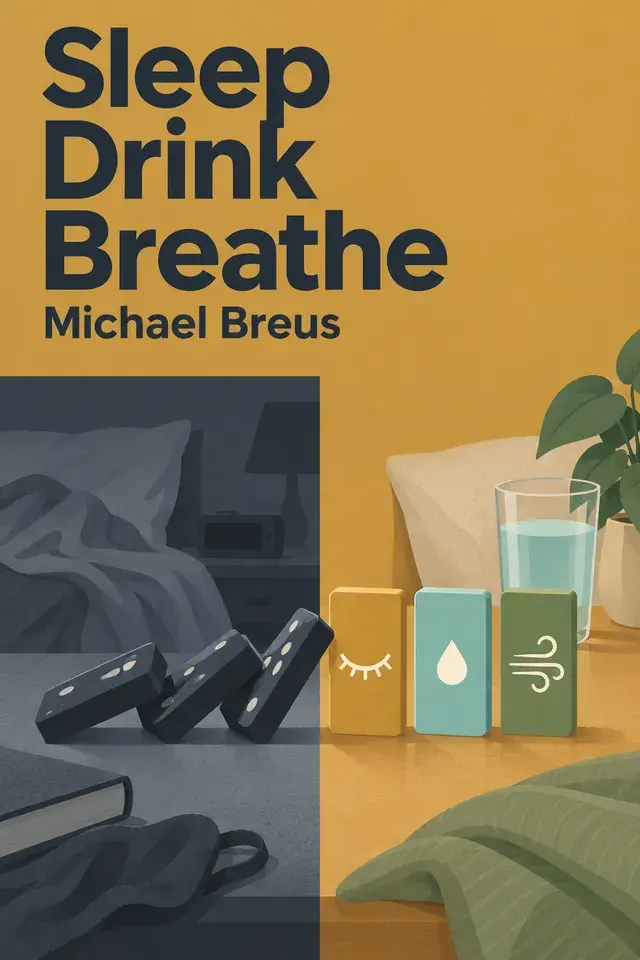
Sleep Drink Breathe, by Michael Breus.
Wellness advice can make health feel like a set of competing projects. One message promotes a new technique, another a device, supplement, or costly program, and each promises a major change. The author argues that this churn can leave people confused or overwhelmed. He points to efforts that do not last: a month of disliked green juice, a cold plunge tried once, supplements left unused, an exercise bike serving as a clothes rack, and expensive meal kits. These examples illustrate why elaborate plans may be hard to maintain, particularly when everyday foundations are neglected.
His response is to return to sleeping, drinking for hydration, and breathing. These ordinary actions happen automatically, but the author distinguishes simply doing them from doing them well. He treats them as adjustable daily behaviors and the starting point for broader wellness work. This puts them before specialized systems or new purchases: first understand the basics, then consider what changes might help. The book begins with sleep, then turns to hydration and breathing.
That choice is part of a bigger idea about the body’s internal balance, or homeostasis. The author sees sleep, hydration, and breathing not as unrelated tasks, but as everyday behaviors that can influence one another. A difficulty in a basic routine can ripple into other problems; a healthier pattern may create room for further useful changes. His domino metaphor describes this chain: one small shift can help move another. The metaphor gives the book its organizing model; later chapters fill in the details of each behavior.
The author reports seeing this pattern across many patients: when they establish a healthy sleep routine, they are more energized throughout the day and make better choices about almost everything, including food and exercise. This shows the sort of spillover he means: a change in one daily behavior may support decisions elsewhere. The example illustrates the model without making that sequence a formula for every reader.
From there, the book asks readers to learn what each behavior involves and check their current habits. A baseline shows where someone is starting before deciding what needs attention. The author describes low- or no-cost assessments as an accessible first step. Assessment is followed by troubleshooting, so readers can look for what makes a behavior difficult and consider adjustments without shame. Recommendations follow from that groundwork, instead of asking everyone to begin with the same ideal routine.
The order leaves room for useful tools, including technology recommendations, but puts them after understanding and assessment. The opening objection is not to every product; it is to letting a constant stream of programs distract from foundational routines. Readers first get a way to understand the behaviors and notice what may need attention.
The planned three-week program carries the same pacing into practice. It introduces a few changes at a time, with the aim of building habits until they become more automatic. The gradual schedule answers the book’s concern that drastic, complicated plans can be hard to sustain. The opening contribution is a manageable route through the coming material: learn the basics, see where current habits stand, troubleshoot, and practice small changes over time.
Chapter 2 of 11 · 7 min · Audio & textIn the app
Sleep Drive, Clock, and Repair
Sleep does not arrive simply because someone feels tired. The book describes two processes that work together: sleep drive, which builds during waking hours, and the body's roughly twenty-four-hour sleep rhythm, which helps time sleepiness and alertness.
Chapter 3 of 11 · 6 min · Audio & textIn the app
Assess Sleep Without Obsession
A useful sleep baseline is a picture of your usual pattern, not a grade for each morning. It combines two different questions: how long you sleep and how restorative that sleep seems.
Chapter 4 of 11 · 7 min · Audio & textIn the app
Sleep Traps and Clinical Signals
Sleep trouble can continue even after someone recognizes a pattern. A schedule that conflicts with the body’s timing may shorten or fragment sleep; weekend catch-up can shift that timing again; and anxious efforts to sleep can add more wakefulness.
Chapter 5 of 11 · 8 min · Audio & textIn the app
Make Restorative Sleep Repeatable
Sleep principles become useful when they shape an ordinary week. A steady wake time gives the schedule an anchor; a bedtime and evening routine can then be planned around it.
Chapter 6 of 11 · 7 min · Audio & textIn the app
Hydration Signals and Limits
Hydration can seem straightforward: drink, feel better, pass urine. Yet the body does not report its fluid status through one dependable signal.
Chapter 7 of 11 · 10 min · Audio & textIn the app
Build a Reliable Hydration Practice
A reliable hydration practice has to avoid two opposite mistakes: routinely drinking too little and assuming that more is always better. The author identifies six common problems: forgetting to drink, deliberately limiting fluids, drinking too much, sleeping too little, mistaking bloating for a sign to drink less, and drinking unfiltered tap water.
Chapter 8 of 11 · 6 min · Audio & textIn the app
Breathing Basics and Self Checks
Breathing happens automatically, including while we sleep, yet we can also change its pace, depth, and timing for a while. Each cycle brings oxygen in and carries carbon dioxide out.
Chapter 9 of 11 · 7 min · Audio & textIn the app
Repair Everyday Breathing Habits
Breathing is constant and mostly automatic, which makes it easy to take for granted. The author argues that automatic breathing can still settle into patterns: shallow, high in the chest, too fast, mouth-led, or briefly held without awareness.
Chapter 10 of 11 · 9 min · Audio & textIn the app
Train Breath for Specific Needs
Once you can notice your breathing habits, the next step is to practice changes that serve a particular need. Michael Breus lays out six: use the nose when possible, train the diaphragm and rib muscles, sit or stand tall, clear excess phlegm, choose a technique for the moment, and get blood moving.
Chapter 11 of 11 · 10 min · Audio & textIn the app
Coordinate Three Systems Daily
Sleep, hydration, and breathing can affect one another. The book’s closing plan brings their separate practices into one three-week routine, with five daily check-ins.
Chapter 1 of 11 · 4 min · Audio & text: The Wellness Dominoes
Wiseley supports reading and listening to summaries in the app.
Continue in WiseleyAbout Michael Breus

Michael Breus is an American clinical psychologist and sleep specialist. “Sleep Drink Breathe” explores sleep, hydration, and breathing as everyday systems that shape one another.
Explore more books by Michael Breus