What you'll learn
Key ideas from Seculosity
These ideas compress the book's argument without treating the author's view as settled fact. Use them as an orientation before reading the full work or listening in Wiseley.
Seculosity describes reliance on ordinary pursuits for enoughness; those pursuits may be good without having to certify a person’s worth.
Performancism makes results feel like verdicts on identity, so a setback can threaten more than a grade or record.
Present-focused love values a child as a person, rather than as a future record of achievements.
Useful work matters without needing to serve as the measure of a life.
Politics affects real lives, but it cannot guarantee complete belonging or the ability to live wholly by its ideals.
Christian communities reproduce seculosity when personal holiness or social change becomes a condition for acceptance.
Transformation can follow acceptance as a fruit of grace, but it cannot serve as the price of being accepted.
Inside Seculosity
Read the first chapter in full here. The other 10 continue in the Wiseley app.
Chapter 1 of 11 · 6 min · Audio & text
The Hunger to Be Enough
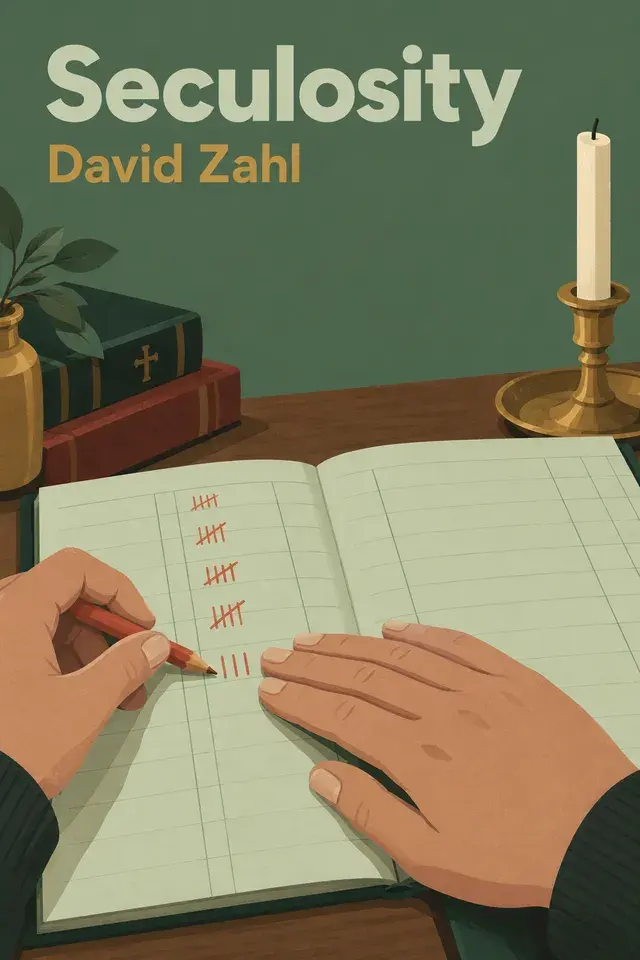
Seculosity, by David Zahl.
Sherry once described San Francisco as a place with little conventional religion, yet an intense religious atmosphere. Raised in a strict religious household, she recognized the anxiety and shame of piety beyond church walls. Her observation gives David Zahl a starting point: familiar religious practice may decline while the human search for meaning and reassurance continues in other forms.
The word religion can name explicit beliefs and practices: worship, clergy, and belief in God. Zahl calls this capital-R Religion. By those conventional measures, he says, religion has receded in many places. But religion can also mean the story or lens that orders a person’s priorities, or what that person leans on to feel whole, manage guilt, and believe life matters. This is small-r religion: a justifying story, the thing someone relies on to feel okay and enough.
That distinction shifts attention from what people say they believe to what they expect to secure their worth. A pursuit, conviction, or priority may become a source of reassurance. Seculosity names the persistent search for enoughness when ordinary pursuits are asked to provide the justification and security people seek from religion. Zahl’s point is not that every commitment is secretly religious. The question is what role it plays in a person’s life.
Enoughness is the felt sense of being sufficiently successful, worthy, lovable, or good. People can set standards in many parts of life and hope that meeting them will bring value, vindication, or love. Yet reaching a benchmark rarely settles the matter. A standard can move, or a new one can take its place. Even a personal and flexible standard may weigh heavily because it is hard to know when it has been met. The inner accountant keeps recording what is missing.
This search is closely tied to righteousness: the desire to be right, good, or justified. Zahl draws on the idea that people are deeply concerned with righteousness, not only because a particular faith teaches it. Standards help people understand who they are and where they belong. They can also become a way of proving that one deserves approval. Looking at the standard a person is trying to satisfy can help explain behavior that otherwise seems puzzling, including efforts to win approval or to present oneself as the wronged party.
The same longing can turn standards into weapons. Imagine two people who both care deeply about doing what is right but disagree about which standard should guide them. If each treats their own judgment as proof of goodness, a disagreement can become a verdict on the other person’s character. When the other seems to block what one sees as righteousness, even small differences may take on the shape of a battle between good and evil. It becomes easier to excuse harshness toward someone cast as an enemy.
That is how people who think of themselves as good can act cruelly and feel justified. Zahl connects this pattern to Pharisaism: outward signs of righteousness can take precedence over the purpose they were meant to serve. He also notes that religious and secular settings can both foster self-justification. Without an external judge, a person may still carry an internal one, measuring failures and raising the standard. Achievement can bring more pressure rather than final peace.
Yet the standards that divide people point to a shared human need. People may disagree sharply about what goodness requires, but many are trying to find a secure basis for worth, belonging, and a meaningful life. This common longing can bring people together and support concern for others. It can also create in-groups and out-groups when each group’s particular way of seeking righteousness becomes a reason to dismiss or dehumanize people outside it. Recognizing a shared need does not erase real differences; it can make those differences easier to understand with compassion.
Zahl uses the term seculosity for this religious impulse directed toward earthly pursuits. “Secular” here describes a setting where belief in God is not assumed; it does not mean irreligious or materialistic. Seculosity can coexist with explicit religious devotion, and identifying as religious does not make anyone immune to the same search for justification. Zahl acknowledges that calling both spiritual and material hopes religion can blur important differences. His term names a particular pattern: relying on ordinary things for enoughness or salvation.
Those ordinary things can be good in themselves. The concern is not that people care about them, but that they are asked to deliver a final verdict on a person’s worth. A useful question to carry forward is: am I enjoying this pursuit as a good, or asking it to certify that I am enough? That question keeps the pursuit and the burden placed on it distinct, and gives the book a lens for examining the different forms this search can take.
Chapter 2 of 11 · 7 min · Audio & textIn the app
When Performance Becomes Piety
A full schedule can signal more than a set of obligations. It can tell other people, and the person living it, that this life matters.
Chapter 3 of 11 · 8 min · Audio & textIn the app
Romance Under Ultimate Pressure
Weddings often describe a couple as perfect or right for one another. Even when God is mentioned, romance itself can seem to hold the ceremony’s center.
Chapter 4 of 11 · 7 min · Audio & textIn the app
Parenting Without a Perfect Score
Parenting can become a performance test when a child’s progress is expected to prove that the parent is doing well. Advice and achievement then carry a weight beyond the immediate question of how to care for a child.
Chapter 5 of 11 · 8 min · Audio & textIn the app
The Promise of Being Optimized
A phone can bring information and connection close, yet call us away from the people beside us. David Zahl begins with the story of Jean-Louis Forain, one of the first people in Paris to own a telephone, who became the device’s servant, summoned whenever it rang.
Chapter 6 of 11 · 6 min · Audio & textIn the app
Work, Worth, and Unearned Grace
Work is necessary, and it can be absorbing, creative, and meaningful. It gives people things they need and lets them contribute to the lives of others.
Chapter 7 of 11 · 7 min · Audio & textIn the app
Rest Beyond Self-Improvement
The productivity logic described in work does not stop when the workday ends. It can take over the hours called leisure.
Chapter 8 of 11 · 6 min · Audio & textIn the app
Food Beyond Moral Scorekeeping
Food is one of the most ordinary parts of a day, yet it can carry unusual weight. People may hide a fast-food purchase, apologize for eating, or call a meal a “cheat.”
Chapter 9 of 11 · 8 min · Audio & textIn the app
Politics as a Place of Salvation
A joke from Seinfeld once seemed like an exaggeration: Elaine ends a relationship because her boyfriend holds the wrong view on abortion. Zahl uses the joke to show how political disagreement has gained force in ordinary relationships.
Chapter 10 of 11 · 9 min · Audio & textIn the app
When Faith Becomes Another Law
Zahl turns the book’s lens toward the church and asks whether explicitly Christian efforts can reproduce the same pressure found elsewhere: the demand to prove that a life is good enough. His criticism is not a judgment on every Christian or every congregation.
Chapter 11 of 11 · 8 min · Audio & textIn the app
Grace for People Who Fail
The book’s closing argument turns on a distinction: change may be good, but it cannot be the price of being accepted. When people are told they must transform to become worthy, faith becomes another demand to prove themselves.
Chapter 1 of 11 · 6 min · Audio & text: The Hunger to Be Enough
Wiseley supports reading and listening to summaries in the app.
Continue in WiseleyWhat Seculosity is about
Seculosity asks why secular pursuits can take on the demands of religion. David Zahl traces how busyness, romance, parenting, technology, work, leisure, food, and politics promise worth or rescue yet intensify anxiety when made ultimate. The book considers Christian grace as a way to receive enoughness without earning it.