What you'll learn
Key ideas from Right Kind of Wrong
These ideas compress the book's argument without treating the author's view as settled fact. Use them as an orientation before reading the full work or listening in Wiseley.
Intelligent, basic, and complex failures point to different causes and learning needs, rather than treating every failure as the same kind of event.
An intelligent failure tests an uncertain idea in new territory while pursuing a worthwhile goal and limiting avoidable harm.
Attentive checklists curb haste and memory slips; maintenance prevents damage, training reduces accidents, and failure-proofing lowers known risks.
Complex failures grow when routine actions, external events, and missed warnings interact over time; one apparent mistake rarely explains the full chain.
Stop—Challenge—Choose makes pausing, testing an interpretation, and choosing a useful response into a learnable practice.
Vigilance fits the stakes: experimentation can be bounded where risks are limited, while serious potential harm calls for careful protection.
Leaders align candor with accountability by naming uncertainty, stakes, and the standards that still apply.
Inside Right Kind of Wrong
Read the first chapter in full here. The other 9 continue in the Wiseley app.
Chapter 1 of 10 · 7 min · Audio & text
Why Failure Feels Dangerous
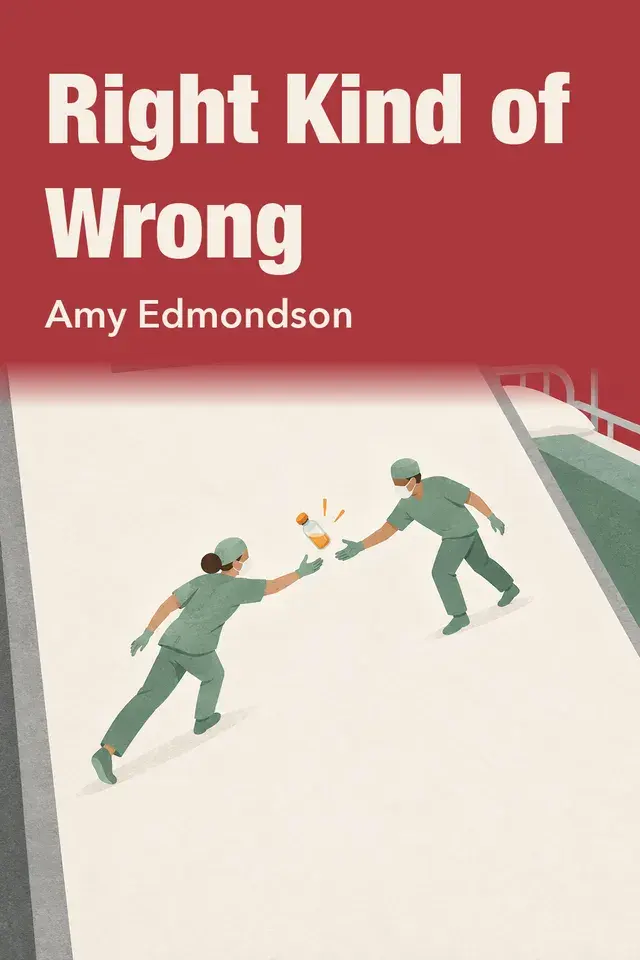
Right Kind of Wrong, by Amy Edmondson.
Learning from failure sounds straightforward, but people do not naturally turn toward it. When something goes wrong, they may delay examining it, soften the account, deny it, or blame circumstances and other people. Shame and embarrassment make disclosure costly: a mistake can seem like evidence of incompetence, and criticism can feel like a threat to one’s standing. Avoidance may protect someone briefly, but it can also block learning and make people less willing to take on challenges where they might develop.
Part of the difficulty is that failure covers different things. A failure is an outcome that falls short of a desired result. An error is an unintended departure from a specified standard. A violation is a deliberate departure from a rule. These distinctions matter because not every disappointing outcome signals the same problem. Nor does the size of a failure tell us how much it can teach. A costly failure may yield information that could not otherwise be gained; a small failure is not automatically useful. The question is not simply how bad the result was, but what kind of failure occurred and what can be learned from it.
Edmondson makes the stakes tangible with early attempts to repair children’s hearts using experimental procedures. Some patients died. The possibility of medical progress does not erase those losses, and the tragedy should not be treated as acceptable just because it might produce knowledge. The example shows why failure’s consequences deserve serious attention, while also raising the question of whether an outcome can teach something important.
The book begins to separate failures into three broad kinds. Intelligent failures arise in uncertain new territory, where people are trying to learn what works. Basic failures are mistakes in more familiar work, where preventable errors are possible. Complex failures involve multiple causes that can interact. These categories are not a complete test for judging any one event. They establish that “failure” is not one uniform experience, and that learning from an experiment differs from preventing a mistake.
The central puzzle began in Edmondson’s doctoral research. Studying teams in two hospitals, she expected better teamwork to mean fewer medication errors. Instead, the initial results showed a statistically significant association in the opposite direction: teams rated as better had more detected errors. Edmondson felt ashamed and feared telling her adviser. The result looked like a failure of her own research, not yet like a clue about how teams work.
She later considered another explanation. Perhaps the stronger teams were not making more mistakes; perhaps their communication helped them notice, admit, correct, and report mistakes more readily. If people fear being blamed, they may hide errors. A team can then appear to have fewer errors because fewer are reported, not because fewer occurred. In that case, the recorded error rate reflects both what happens and what people feel able to say about it.
That interpretation remained uncertain and drew skepticism because it challenged the aim of measuring actual error rates. Further evidence made it plausible. A research assistant who did not know the teams’ error rates, ratings, or Edmondson’s hypothesis observed and interviewed hospital units. He independently described some as open about mistakes and others as punitive; his assessment of openness closely tracked the detected error rates. A survey question about whether mistakes would be held against someone also correlated with higher detected rates. These clues did not establish the true number of errors in each unit. They suggested that less open teams might have had errors that remained unseen.
A NASA simulator study offered a related example of teamwork changing the number of errors a group could catch. Researchers tested twenty two-person cockpit crews. The fatigued crews had worked together over multiple shifts, while the rested crews were unfamiliar with one another. Fatigued individuals made more errors than rested individuals, but the fatigued crews who had worked together made fewer errors as teams than the rested, unfamiliar crews. Crew members apparently caught and corrected one another’s mistakes. The finding helped fuel crew resource management: individual fallibility did not disappear, but the team could compensate when people worked together effectively.
Edmondson uses the term psychological safety for a team climate in which people can speak up, ask for help, and discuss mistakes without expecting interpersonal punishment. It is a quality of the group, shaped by how its members respond to one another, not a fixed personality trait. Such a climate makes it easier to disclose a problem, hear an uncomfortable concern, and catch or correct an error. It can also support thoughtful experimentation where answers are not already known.
Psychological safety does not mean lowering standards or excusing poor work. Candor and accountability can coexist: people can be expected to meet standards and still be able to report a concern or admit an error. In fact, high expectations without room to speak up can make problems harder to surface. A psychologically safe team is not necessarily a comfortable one; candid discussion can be difficult. The point is that people can discuss both preventable harm and useful learning openly. Failing well begins by distinguishing between them—and making honest conversation possible.
Chapter 2 of 10 · 8 min · Audio & textIn the app
Designing Intelligent Failures
Permission to experiment is not permission to act carelessly. Amy Edmondson’s idea of an intelligent failure is more disciplined: it is an uncertain attempt in new territory, aimed at a worthwhile goal, informed by what is already known, and designed to limit harm while yielding useful information.
Chapter 3 of 10 · 9 min · Audio & textIn the app
Curiosity Converts Setbacks
An unsuccessful attempt is not automatically a lesson. It becomes one when people examine what happened and let the evidence shape their next move.
Chapter 4 of 10 · 9 min · Audio & textIn the app
Preventing Basic Failures
Basic failures happen in familiar territory, where useful knowledge or safeguards already exist but are not used. An error is an unintended mistake; it becomes a failure when it brings an unwanted result and goes uncaught or uncorrected.
Chapter 5 of 10 · 11 min · Audio & textIn the app
Reading Complex Failure
Complex failure is not simply a large mistake. It develops when several causes combine in a setting people know, where routines and experience can create confidence.
Chapter 6 of 10 · 8 min · Audio & textIn the app
From Shame to Learning
A setback can threaten more than a plan. It can threaten our picture of ourselves as capable, sensible, or right.
Chapter 7 of 10 · 8 min · Audio & textIn the app
Match Response to Context
To respond well to a possible failure, first read the situation. Pause long enough to ask two questions: how much is known, and what could an error cost?
Chapter 8 of 10 · 11 min · Audio & textIn the app
See and Shape Systems
Outcomes often carry no single person’s intention. A good person can be caught in arrangements that push reasonable choices toward poor results.
Chapter 9 of 10 · 8 min · Audio & textIn the app
Practicing Fallible Living
Living well does not require becoming immune to failure. It begins with accepting that we are fallible, then using judgment about what to prevent, what to learn from, and how to respond when something goes wrong.
Chapter 10 of 10 · 8 min · Audio & textIn the app
Leading a Learning Culture
Leaders who want an organization to learn from failure have to hold two ideas together: people need room to speak candidly, and work still needs clear standards. If only successes are safe to report, leaders lose information.
Chapter 1 of 10 · 7 min · Audio & text: Why Failure Feels Dangerous
Wiseley supports reading and listening to summaries in the app.
Continue in WiseleyAbout Amy Edmondson

Amy Edmondson is an American scholar of leadership, teaming, and organizational learning. “Right Kind of Wrong” explores how people and teams can learn from setbacks without excusing preventable harm.
Explore more books by Amy Edmondson