What you'll learn
Key ideas from Rewire
These ideas compress the book's argument without treating the author's view as settled fact. Use them as an orientation before reading the full work or listening in Wiseley.
Repeated experience strengthens familiar neural pathways, while pathways can also weaken over time.
Chronic stress can narrow attention, strengthen familiar reactions, and make decision-making and behavior change harder.
Calming down, observing a thought, and considering another interpretation can loosen an automatic negative response.
Recurring responses become easier to examine when their environmental, social, sensory, and time-based cues are mapped.
Motivation fades, so plans for predictable obstacles can keep a new response available during difficult moments.
Separating performance from identity makes room to treat setbacks as information about a task or approach rather than a verdict on personal worth.
Self-trust grows through achievable, value-aligned commitments and attention to accomplishments.
Inside Rewire
Read the first chapter in full here. The other 11 continue in the Wiseley app.
Chapter 1 of 12 · 6 min · Audio & text
The Brain Learns Its Patterns
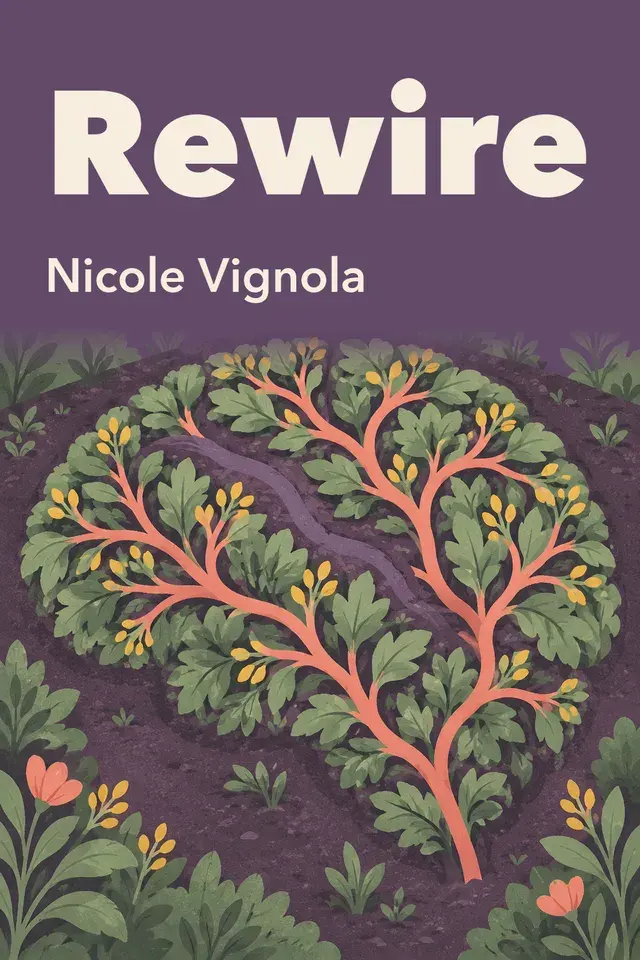
Rewire, by Nicole Vignola.
The brain carries traces of a life lived: what a person experiences, notices, and repeats helps shape how they think and respond. Vignola calls the brain’s capacity to adapt neuroplasticity. In her account, neurons pass messages across small gaps called synapses. With repeated use, connections can strengthen and familiar routes become easier to travel. Connections can also weaken. This means experience can reinforce an established response, while the brain’s ability to change leaves room for different patterns to develop.
A well-used route can make a thought or action feel automatic. The response may arrive before a person has stopped to choose it, because the brain favors familiar shortcuts that save effort. That automatic quality does not prove the response is inborn or unchangeable. Vignola’s example is that she learned to cry when angry. A reaction can be learned through experience, become a familiar way of responding, and still be open to change.
Learning begins well before people can explain what they are learning. Vignola describes childhood as a time when experience readily shapes a child’s developing brain maps: their internal representations of themselves, other people, and the world. Children absorb cues from their surroundings and from watching others. Some lessons are useful, such as learning to move away from a hot stove. Other lessons may be unhelpful, such as absorbing a limiting label or a pattern of conflict. Neither kind needs to be taught as a formal rule to leave an impression.
This early learning is not the same as saying that childhood exposure guarantees mastery. Vignola contrasts a child hearing French recordings in the background with an adult trying to learn the language. The child might pick up some of it without focused study, but would not necessarily become fluent. An adult, she says, generally has to direct attention to the words and make a conscious effort. Childhood offers particular conditions for absorbing experience; it does not make every later attempt futile.
Some capacities do have developmental limits. Vignola describes critical periods as windows in which particular kinds of development are especially possible. She gives sight as an example of a capacity that may not develop later if it was not established during its critical period. That qualification matters: plasticity does not mean every ability can be acquired at any age. At the same time, she identifies many skills and behaviors—including habits, creativity, dancing, and playing guitar—as capable of development beyond childhood. The limits on some capacities do not make all learning subject to the same limit.
For adults, changing a familiar response often calls for deliberate attention and repetition. The brain’s shortcuts help routine actions run without much thought, but this also means a new action can be easy to forget while the old one remains familiar. Vignola describes attention as selective: information judged relevant becomes more noticeable, while other input stays in the background. Applying attention to a desired skill or response gives it more opportunity to be practised. Repetition can then make the newer route more available and, over time, more automatic.
Vignola uses Gene McGehee’s daily school-meeting routine to illustrate how deeply a repeated response can be learned. McGehee had dementia, and his memory reset every fifteen minutes. Each day, he went outside without understanding why; when the children got off their school bus, they ran over to greet him. They had been visiting him for three years, though he thought each meeting was the first. Vignola interprets the routine as an ingrained pattern that continued without his consciously remembering its history or purpose. The example suggests that repetition can shape behavior in ways that do not depend on a person recalling each earlier occasion.
There is no single timetable for a new habit. Vignola gives a broad range of eighteen to two hundred and fifty-four days for habit formation, with around sixty-six days as an average for behavior to become automatic. The spread is a reminder that change does not follow a fixed deadline. A week may be too brief to make a new response feel familiar, and the pace will vary from person to person. The figures describe variation, not a guarantee about any individual.
Vignola emphasizes that people differ, including in how neurodivergent and neurotypical brains work. She says neurodivergent people can make new habits and adopt healthier patterns of thinking in ways that serve them, if they wish to change, rather than to fit into a neurotypical world. Her account of neuroplasticity makes room for both the persistence of learned patterns and the possibility of revising many of them. Attention and repetition can help build new responses, while developmental limits and individual differences remain real.
Chapter 2 of 12 · 11 min · Audio & textIn the app
Stress, Emotion, and Attention
Stress has a poor reputation, but Vignola argues that it is not one uniformly harmful state. She distinguishes alert stress, acute stress, and maladaptive stress.
Chapter 3 of 12 · 7 min · Audio & textIn the app
Interrupting the Negative Loop
A difficult moment can take up more room in the mind than several good ones. Vignola calls this negativity bias: people tend to notice and remember adverse events, and to give them extra weight when judging a situation.
Chapter 4 of 12 · 6 min · Audio & textIn the app
Stories That Shape Perception
A self-story can begin as a thought about one moment and gradually become a rule about who you are. “I’m not good enough,” “I’m shy,” or “I can’t do that” may be repeated until it feels less like an opinion and more like a fact.
Chapter 5 of 12 · 8 min · Audio & textIn the app
Adapting Through Grief and Loss
Loss can make ordinary life feel unfamiliar before a person has found words for what changed. Grief may follow a death, a breakup, a friendship ending, a lost opportunity, or the future someone expected to have.
Chapter 6 of 12 · 7 min · Audio & textIn the app
A Toolkit for Changing Responses
Vignola’s NeuroToolkit turns the book’s account of learned patterns into a procedure for changing one recurring response. The aim is to notice what sets the pattern off, understand what follows, and practise a different response.
Chapter 7 of 12 · 7 min · Audio & textIn the app
Cues, Rehearsal, and Space
A new response is easier to practise when the surroundings bring it to mind. The inputs that fill a day can shape what receives attention, including the media a person sees and the first routine after waking.
Chapter 8 of 12 · 7 min · Audio & textIn the app
Preparing for Fear and Setbacks
A new habit can feel exciting at first, when motivation is fresh. Later, the novelty may fade, and familiar responses can return, especially when you are tired or distracted.
Chapter 9 of 12 · 7 min · Audio & textIn the app
Connection, Learning, and Identity
Resilience is not built by individual effort alone. Vignola adds two supports that can shape how a difficult moment feels: relationships that offer care and perspective, and a way of viewing ability as something that can develop.
Chapter 10 of 12 · 9 min · Audio & textIn the app
Movement and the Changing Brain
Movement is presented as a brain-health practice, not punishment for eating or simply a way to change weight. The book’s claim is that physical activity affects the body’s signals to the brain and may support the brain’s capacity to adapt.
Chapter 11 of 12 · 9 min · Audio & textIn the app
Sleep, Reward, and Motivation
Vignola treats sleep as part of how learning and change take hold. New information is fragile, and she says sleep helps encode and consolidate it so it can be recalled later.
Chapter 12 of 12 · 9 min · Audio & textIn the app
Self-Trust and Chosen Agency
Vignola presents self-trust as something built through experience. Each time you make a realistic promise to yourself and keep it, you gain evidence that you can rely on your own choices.
Chapter 1 of 12 · 6 min · Audio & text: The Brain Learns Its Patterns
Wiseley supports reading and listening to summaries in the app.
Continue in WiseleyAbout Nicole Vignola

Nicole Vignola is the author of “Rewire”. The book explores how experience and repeated thoughts shape habits and emotional responses and how those patterns can change.
Explore more books by Nicole Vignola