What you'll learn
Key ideas from Remember
These ideas compress the book's argument without treating the author's view as settled fact. Use them as an orientation before reading the full work or listening in Wiseley.
Remembering depends on encoding, consolidation, storage, and retrieval, and a breakdown at any stage can prevent a durable, consciously accessible memory.
Distributed study and self-testing are presented as stronger supports for long-term factual retention than cramming or rereading alone.
Autobiographical memory is a selective life story, not a complete record, preserving experiences that carry meaning, novelty, emotion, or rehearsal.
Retrieval rebuilds an event from incomplete traces, and reconsolidation can save the rebuilt version.
Forgetting reduces interference by clearing obsolete routine details, leaving attention available for current information and action.
Sleep supports attention, consolidates facts and skills, and may help clear metabolic debris; a full night generally outperforms a short nap.
Normal aging weakens processing speed, attention, working memory, and free recall unevenly, while recognition and accumulated knowledge can remain comparatively strong.
Genova’s grandmother illustrates that profound memory loss can coexist with surviving love and connection, without defining a person’s worth.
Inside Remember
Read the first chapter in full here. The other 8 continue in the Wiseley app.
Chapter 1 of 9 · 9 min · Audio & text
How Experience Becomes Memory
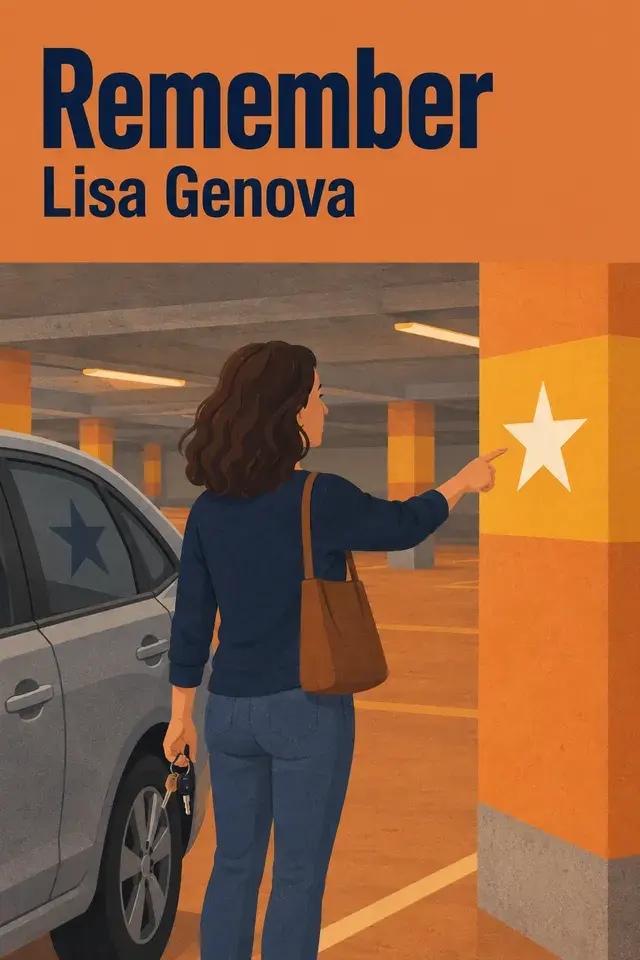
Remember, by Lisa Genova.
When something slips your mind, it is tempting to call the whole experience forgetting. Genova offers a more useful vocabulary: a durable memory depends on four distinct processes—encoding, consolidation, storage, and retrieval. The same blank can arise because information was never formed, did not become stable, or cannot currently be accessed. For a consciously retrievable long-term memory, all four processes must work together. The sequence begins before memory exists, with selective attention.
Encoding converts attended parts of an experience into a neural form. Seeing, hearing, or otherwise encountering something is not enough. The senses receive more information than the brain can preserve, so attention selects what receives further processing. Meaning, novelty, emotion, and consequence tend to attract it, while routine details often do not. Attention is therefore necessary for memory, but it is only the entrance.
Genova’s parking-garage lapse makes this distinction concrete. While rushing, she failed to consciously register where she parked. Later, the empty search felt like a retrieval failure. The more basic problem, however, was absent encoding: no location-memory had been created. The brain could not retrieve a detail that had never been selected and recorded. A missing car therefore does not automatically indicate amnesia, dementia, or a damaged memory system.
After encoding comes consolidation. The attended details begin as separate aspects of experience: sights, sounds, words, facts, place, time, meaning, and emotion. Genova describes the hippocampus as helping bind these elements into an associated, retrievable pattern. It is useful to picture it as a weaver connecting the strands of an experience, while remembering that the precise neural binding process is not fully settled. Consolidation takes time. Attention starts the process, but significance, emotion, repetition, or later processing can affect whether an experience becomes durable. Even something attended to may not survive.
Storage is the maintenance of that linked pattern through lasting changes in the brain. Long-term memory is not kept in one central vault, and finished memories do not remain entirely in the hippocampus. Their components are distributed across the regions that participated in the original experience. A remembered meal may involve separate systems for its appearance, sounds, tastes, facts, and feelings. The hippocampus helps make those parts available as one episode, but the memory’s contents are spread across the brain.
Retrieval reactivates the associated pattern. It is less like opening a complete recording than following a cue into a network of connected details. A place-name, sound, smell, image, or fact can activate related sights, emotions, and knowledge. This cue-driven process can make an inaccessible memory available, but not every missing memory is waiting to be unlocked. Some traces were never encoded, some were not fully consolidated, and some may no longer be available. Retrieval is also reconstructive: the mind rebuilds an experience from activated associations rather than replaying a fixed file.
Henry Molaison shows why these stages must be separated. To treat his seizures, surgeons removed both hippocampi. His seizures improved, and his personality, intelligence, language, perception, and motor abilities remained intact. Yet he could not form new consciously held long-term memories for the rest of his life. New people, words, songs, stories, and recent events would not persist in the ordinary way. His case might suggest that comprehension itself had been lost, but it had not.
Molaison could understand speech, complete a sentence, follow a direction, and repeat a short phone number or list while it was still present. He could hold a small amount of information for a few seconds. If an instruction remained active, he could act on it; after a short delay, he might not remember the instruction, the action, or the person who gave it. This preserved immediate ability alongside profound amnesia reveals a different system: working memory.
Working memory is the brief holding space for whatever is currently attended. The prefrontal cortex supports this present-moment system. It keeps sights, sounds, language, and other information available long enough for conversation, reading, calculation, and action. A visual scratchpad can hold what is seen, while a phonological loop briefly preserves heard words as an inner echo. Without rehearsal or further processing, these contents usually fade or are displaced within roughly fifteen to thirty seconds. Genova gives a rough capacity estimate of about seven plus or minus two units, but it is not a fixed quota. Word length, distraction, rehearsal, and meaningful grouping change what a person can manage.
Chunking shows how grouping changes practical capacity. Eighteen unrelated letters are difficult to hold one by one. Arrange the same letters as MY NAME IS LISA GENOVA, however, and they become five meaningful chunks: MY, NAME, IS, LISA, and GENOVA. The number of individual letters has not changed. What changes is the structure available to working memory. A meaningful unit is easier to rehearse and less demanding than a string of disconnected pieces. Chunking helps the temporary system work more efficiently, but it does not turn working memory into permanent storage.
That distinction also gives a simple way to handle the parking problem. After leaving a car, pause instead of relying on a later search. Direct attention to where it is, consciously describe the location in a brief phrase, and repeat that phrase while walking away. The location is first held in working memory, then has a better chance of receiving the processing needed for consolidation. Later, that description or a matching feature can serve as a retrieval cue. The pause cannot guarantee a lasting memory, but it changes the starting conditions: the location has at least been noticed.
The causal lesson is straightforward. If a detail was never attended to, the lapse may be an encoding failure. If it was attended to but did not become stable, consolidation may have been interrupted. If the pattern was stored but a useful cue is missing, retrieval may be the obstacle. Working memory explains how information can guide us now without becoming part of the durable past. Remembering is not a single act of keeping or losing; it is a chain that begins with noticing.
Chapter 2 of 9 · 9 min · Audio & textIn the app
Learning Skills and Lasting Knowledge
Memory does not learn everything in the same way. Long-term memory includes procedures, facts, and events.
Chapter 3 of 9 · 6 min · Audio & textIn the app
The Life We Remember
Autobiographical memory is the remembered history of your own life, tied to particular places and times. It is not a complete diary.
Chapter 4 of 9 · 8 min · Audio & textIn the app
Why Certainty Can Mislead
Memory can be easy to access and still be wrong. That distinction qualifies the retention techniques discussed earlier.
Chapter 5 of 9 · 9 min · Audio & textIn the app
Finding Words and Keeping Intentions
Memory failure is not one thing. A tip-of-the-tongue episode is a blocked attempt to retrieve information that is already stored.
Chapter 6 of 9 · 6 min · Audio & textIn the app
The Uses of Forgetting
Forgetfulness is not simply memory failing at its job. A useful memory system must preserve what matters, allow some material to weaken, and keep irrelevant details from competing for attention.
Chapter 7 of 9 · 8 min · Audio & textIn the app
Context Stress and Rest
Memory depends not only on what is learned, but on the conditions of encoding, consolidation, and retrieval. Context supplies cues, stress shifts attention and bodily resources, and sleep supports attention before learning and stabilization afterward.
Chapter 8 of 9 · 7 min · Audio & textIn the app
Aging Memory and Disease
Memory does not age as one thing. Forgetting is normal at every age; it can follow weak attention, missing cues, routine, lack of practice, poor sleep, stress, or time.
Chapter 9 of 9 · 9 min · Audio & textIn the app
Caring for Memory and Personhood
Once ordinary aging has been distinguished from Alzheimer’s disease, the practical question becomes what can be changed. Genova’s answer is neither fatalism nor certainty.
Chapter 1 of 9 · 9 min · Audio & text: How Experience Becomes Memory
Wiseley supports reading and listening to summaries in the app.
Continue in WiseleyAbout Lisa Genova

Lisa Genova is an American neuroscientist and novelist. “Remember” explores how memory forms, changes, and fails, and how ordinary forgetting differs from Alzheimer’s disease.
Explore more books by Lisa Genova