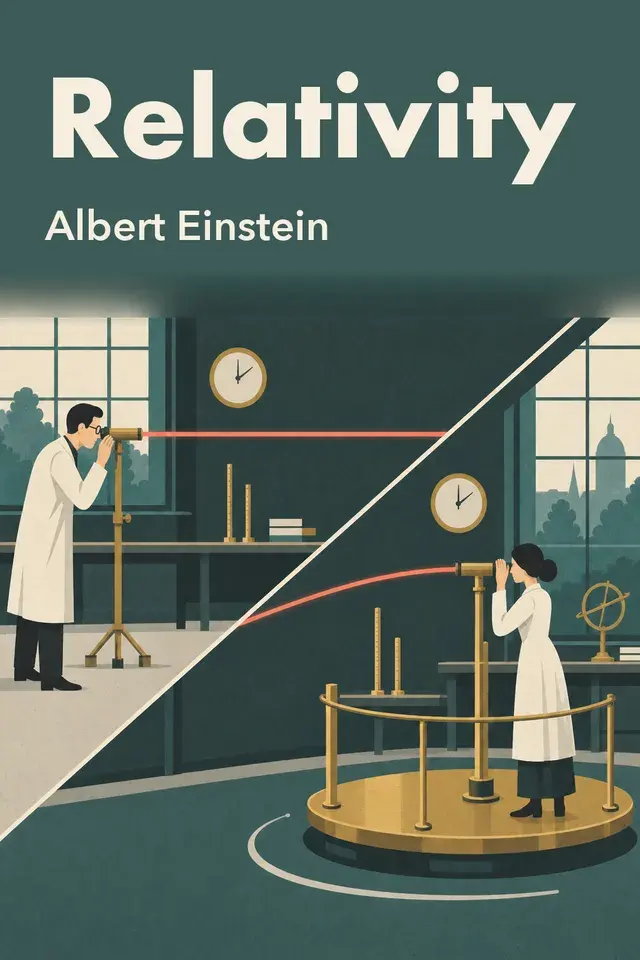
What you'll learn
Key ideas from Relativity
These ideas compress the book's argument without treating the author's view as settled fact. Use them as an orientation before reading the full work or listening in Wiseley.
The light-speed law and classical velocity addition cannot both apply unchanged across inertial systems.
Observers in relative motion can disagree about whether distant lightning strikes were simultaneous and which happened first.
Mass measures energy through E equals mc squared, while classical mechanics remains accurate at low speeds.
In an upward accelerating chest, floor pressure and falling objects are consistent with an observer describing a constant gravitational field.
A straight light ray in a Galilean frame appears curved from an accelerated frame, leading to the prediction of curved light paths in gravitational fields.
Relativity predicts Mercury’s perihelion advance of 43 arcseconds per century; the unexplained observed residual is close to it within a few seconds.
In the account’s model, nonzero average matter density rules out quasi-Euclidean infinite space and points toward finite curved geometry.
Allowing the cosmic radius to change lets the original field equations describe expansion; Hubble’s nebular redshifts support it, while age and finitude remain open.
Inside Relativity
Read the first chapter in full here. The other 7 continue in the Wiseley app.
Chapter 1 of 8 · 4 min · Audio & text
Making Geometry Physical
Relativity, by Albert Einstein.
Geometry begins as a logical system, but its conclusions do not automatically describe the world. In pure Euclidean geometry, a proposition is correct when it follows from axioms by accepted reasoning. Logic can test the deduction; it cannot establish that the axioms describe physical objects. For geometry to speak about nature, its points, lines, and distances must be connected to things that can be handled or measured. Einstein proposes treating distances between marks on a practically rigid body as unchanged when the body is moved. Euclidean propositions then become claims about possible relations among rigid bodies, which experience can test. Even straightness can be tied to an operation: among three points on a rigid body, choose the middle point so the sum of its distances to the other two is shortest. This physical interpretation rests on limited experience, not proof by logic alone.
A rigid body also supplies a standard for length. To measure an interval, lay a standard rod along it repeatedly. If it does not contain a whole number of rod lengths, use divisions on the rod for a finer measure. The operation gives a concrete meaning to length and shows why physical geometry depends on stable standards.
Position also needs a body of reference. An everyday place name shows the idea: Trafalgar Square identifies a point on Earth. For a numerical description, choose three mutually perpendicular planes and specify a point by its perpendicular distances from them. These coordinates record measurements relative to the planes; they are not physical locations by themselves. In practice, the planes need not be erected. Measurements can be found indirectly, while their meaning remains tied to physical procedures. A cloud, for example, can be specified by the ground point below it and the height of a pole that would reach it. Observers at different positions can infer that height optically without raising the pole.
When coordinates change over time, they express motion relative to the chosen system. A body's trajectory is the path it follows relative to a body of reference or its coordinate system. Take a stone released from a train window as the train moves steadily. A passenger marks positions against the moving train and sees the stone fall along a straight path. On the embankment, the stone keeps the train's forward motion as it falls. Its changing horizontal position combined with its downward position traces a parabola. These paths describe one motion from two reference bodies; neither is an independent trajectory that exists apart from a system of positions. Without stating the reference, asking for the stone's path is incomplete.
Classical mechanics must also say when the body occupies each point. Classical time serves as a common measure of change: in the simple illustration, observers use identical clocks and note the stone's position at each tick. A motion is therefore more than a curve through space; it pairs positions with the times when the body is there.
The coordinate systems used in Newtonian mechanics are called Galilean. In such a system, the law of inertia says that a body sufficiently far from other bodies remains at rest or moves uniformly in a straight line. The law helps identify suitable systems; a set of axes alone does not qualify unless inertia holds there. Newtonian mechanics is valid in these Galilean systems. The fixed stars approximately satisfy the inertial condition. Relative to Earth, they appear to trace immense circles over an astronomical day, so mechanics uses systems in which they do not make those circles. The opening point is practical: physical descriptions gain meaning from stated standards, measured positions, times, and reference systems.
Chapter 2 of 8 · 5 min · Audio & textIn the app
When Light Challenges Motion
Einstein now applies the relativity principle to a sharper question: what happens when the phenomenon is light? The restricted principle concerns coordinate systems moving uniformly in straight translation relative to one another, without rotation.
Chapter 3 of 8 · 5 min · Audio & textIn the app
How Clocks Define Time
The earlier difficulty came from combining constant light speed with the classical assumption that time intervals and rigid lengths do not depend on a system’s motion. Einstein’s next step is to ask what a distant time measurement actually means.
Chapter 4 of 8 · 7 min · Audio & textIn the app
What Special Relativity Explains
The Lorentz transformation changes how velocities combine. Classically, if a body moves at speed w in a system that itself moves at speed v, their speeds add: the total is v plus w.
Chapter 5 of 8 · 5 min · Audio & textIn the app
From Inertial Frames to Gravity
In the preceding account, the special principle gives the same form to natural laws in frames moving uniformly and in straight lines, with rotation excluded. That principle leaves out frames that accelerate.
Chapter 6 of 8 · 8 min · Audio & textIn the app
Gravity Changes Space and Time
A process described from an accelerated frame can have a different path from the same process described in a Galilean frame. For ordinary bodies, a straight, uniform path in the latter appears accelerated in the former.
Chapter 7 of 8 · 8 min · Audio & textIn the app
A New Gravitational Law
With the geometric framework in place, the next task is to state a gravitational law that keeps its form in every Gaussian coordinate system. Einstein begins with a gravity-free Galilean domain whose familiar laws are known from special relativity.
Chapter 8 of 8 · 6 min · Audio & textIn the app
The Shape and Expansion of Space
Einstein’s cosmological discussion begins with a problem in Newtonian gravity. If stars fill infinite space at roughly constant average density, the mass inside a sphere grows with its volume.
Chapter 1 of 8 · 4 min · Audio & text: Making Geometry Physical
Wiseley supports reading and listening to summaries in the app.
Continue in WiseleyAbout Albert Einstein
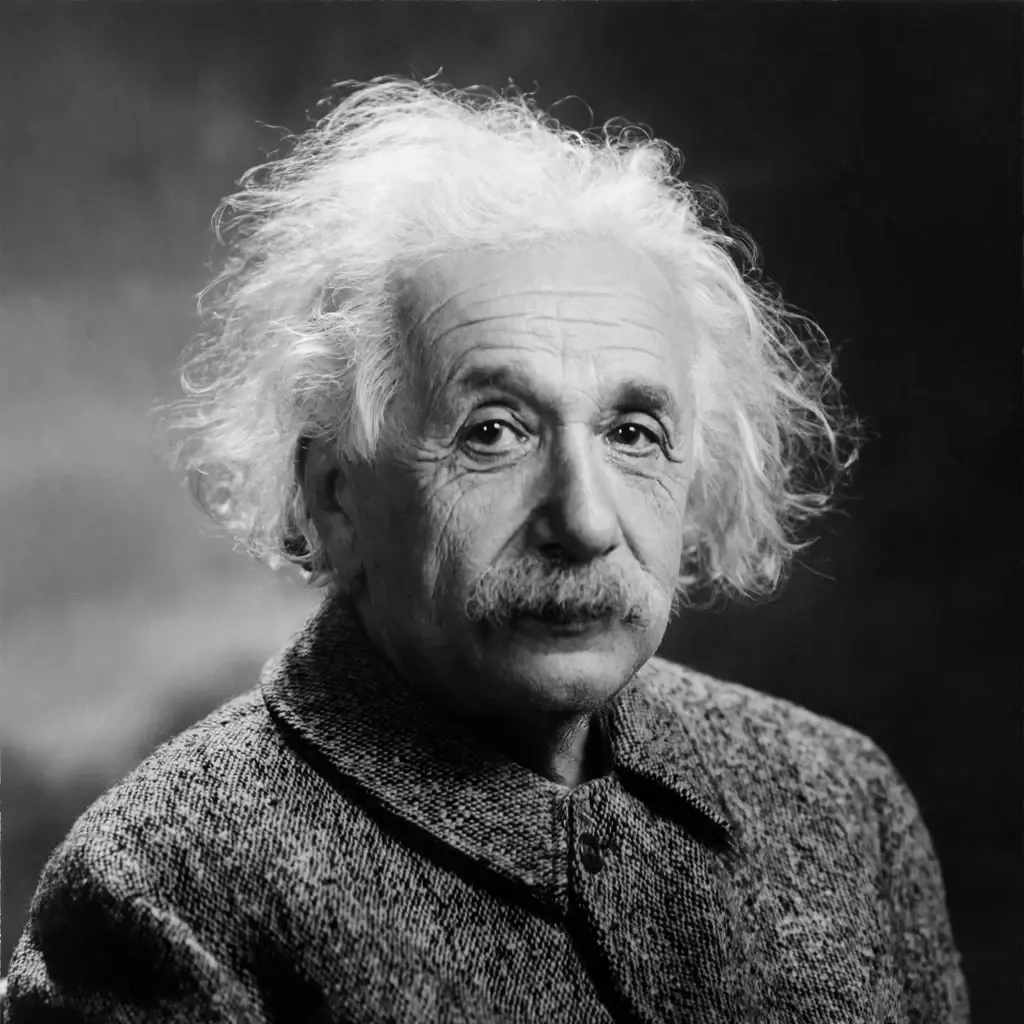
Albert Einstein was a German-born theoretical physicist. “Relativity” explores how space, time, and gravity are measured when observers move relative to one another.
Explore more books by Albert Einstein