What you'll learn
Key ideas from Reclaim Your Brain
These ideas compress the book's argument without treating the author's view as settled fact. Use them as an orientation before reading the full work or listening in Wiseley.
Brain balance means the prefrontal cortex can guide limbic activity while feelings and impulses still inform experience.
Cognitive distortions turn partial evidence, isolated events, feelings, or rigid rules into overly certain judgments.
Mindfulness is deliberate, nonjudgmental attention to present experience that can create a pause before an automatic response.
Considering each person’s actions, motives, perspective, and values can reveal fair requests, clearer limits, and more reciprocal ways to relate.
Attention can suffer from too little or too much stimulation, and a person’s useful range may shift from day to day.
Change planning combines self-monitoring, balanced reasons, personal strengths, SMARTER goals, and accountability.
When reasonable approaches stall, a broader medical assessment may help identify contributors that self-management cannot resolve.
Inside Reclaim Your Brain
Read the first chapter in full here. The other 12 continue in the Wiseley app.
Chapter 1 of 13 · 7 min · Audio & text
How Brain Regulation Shapes Experience
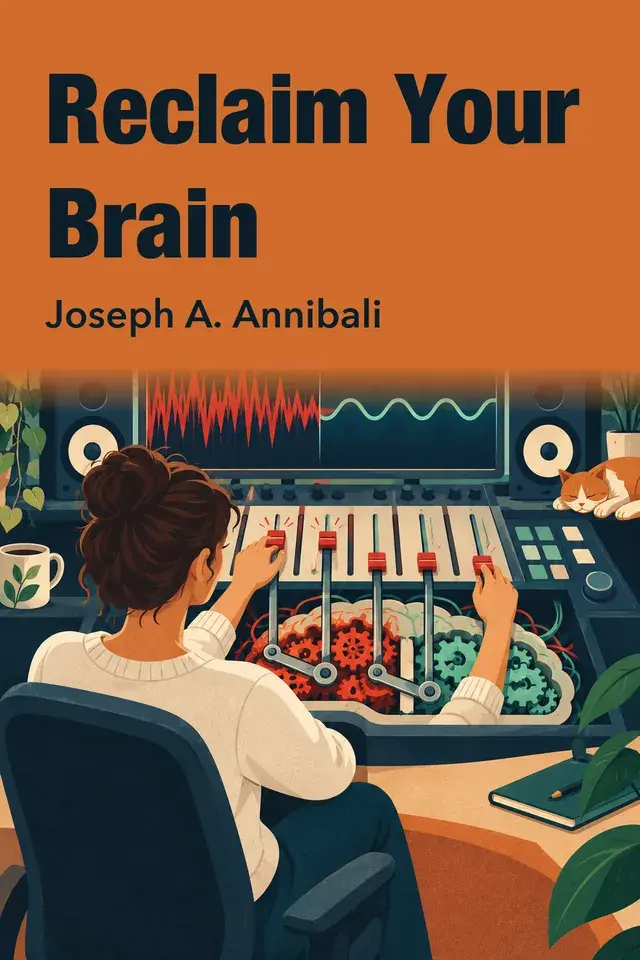
Reclaim Your Brain, by Joseph A. Annibali.
When demands pile up, thought can feel as if it is running on its own. Joseph Annibali calls this kind of overloaded, revved-up experience a “busy brain.” He uses it to introduce a model of how the brain regulates attention, emotion, and behavior. In this model, difficulty is not simply a matter of willpower: the brain’s systems may be working out of balance.
Annibali describes the prefrontal cortex, or PFC, as an executive control center. It helps direct attention, plan, make decisions, and guide behavior toward goals. Beneath the cortex, he describes the limbic system as more closely tied to emotion and arousal. His model gives the PFC a role in regulating limbic activity, much as a guide helps keep a powerful engine on course.
Balance does not mean shutting down emotion. Feelings and impulses can offer useful information, and the PFC can help a person consider them while still choosing a response. But either system can dominate. If limbic activity overwhelms the PFC, fear, agitation, or impulse may crowd out planning. If the PFC is too controlling, a person may become ruled by thought and control while losing touch with feeling. Annibali presents many busy-brain experiences as a weak PFC response to a stronger limbic system, while emphasizing that this is not the only possible pattern.
Josh, a college student struggling at school, describes his thoughts as an out-of-control freight train. The image conveys mental activity that feels difficult to slow or steer. In Annibali’s account, this kind of agitation can make it harder to focus and keep up with ordinary responsibilities. The example shows how a person’s difficulties may reflect more than a lack of effort, without assigning a diagnosis from the experience alone.
Sierra’s story shows how overload can build. She is already carrying work, caregiving, and household responsibilities when the task of completing a tax return adds pressure. Annibali describes her limbic system as already revved up; the additional demand disrupts the balance further, and she begins having panic attacks. The example connects accumulating stress with changes in emotion and behavior, while leaving room for individual differences in what triggers that response.
The book’s answer includes both mind management and care for the brain. Annibali argues that the brain can change: circuits and pathways are not fixed, and experience and practice can support new patterns of thinking, reacting, and behaving. He points to approaches such as mindfulness, revising negative self-stories, and lifestyle changes as ways people may help steady their responses. He also discusses options such as neurofeedback and nutritional supplements, and supports medication when appropriate. These are possibilities, not a single plan for everyone; he acknowledges that people respond differently and that some approaches may be insufficient on their own.
That qualification matters when a physical problem is contributing. Annibali says significant brain injury may need to be treated before mind-management strategies can work effectively. He describes SPECT imaging as an optional tool he used with some patients to look for brain-activity patterns or possible injury. It is not a test that readers need in order to use the book, and a scan alone is not a diagnosis. His broader point is that persistent difficulty can sometimes call for attention to underlying contributors, not just more effort with mental strategies.
Bill’s case illustrates why Annibali makes that distinction. Bill was a bright Yale student with severe, persistent depression. Antidepressants, psychotherapy, and help examining negative beliefs brought only moderate improvement; his harsh negativity and depressive dips continued. Because he was not recovering as hoped, Annibali proposed SPECT imaging. It showed significant damage in Bill’s left temporal lobe, a region the book associates with memory, emotion, and other functions. Bill and his parents did not recall a specific head injury, though he had played soccer. Annibali treated the soccer history as a possible clue, not a confirmed cause.
Annibali interpreted the damage as a contributor to Bill’s depression and treated him with Lamictal. Over several months, Bill improved and was nearly free of depression; he later returned to Yale, graduated, and went on to law school. The author presents this as one person’s clinical course, not evidence that the same scan or medication is right for everyone. For Bill, learning that a brain injury might be involved also helped his family understand his difficulties as more than a failure of effort or character.
The foreword offers a separate program outcome. Daniel Amen reports that 80 percent of 170 active and retired NFL players in the clinic’s program showed high improvement, particularly in mood, memory, sleep, and brain function. That is the foreword’s reported result, and the passage gives no study details to establish it as general proof or a prediction for other groups.
Together, these examples introduce the book’s organizing idea: a poorly regulated brain can disrupt thought, mood, and daily life, yet patterns can change with practice and appropriate care. The framework is a starting point, not a complete diagnosis. Mental strategies may help, but when an injury or another contributor is present, that problem may also need attention.
Chapter 2 of 13 · 7 min · Audio & textIn the app
Recognizing and Interrupting Negativity
Negative thoughts can serve as caution. Paying attention to a small problem may prevent it from growing.
Chapter 3 of 13 · 7 min · Audio & textIn the app
Rewriting Personal Stories
A painful self-judgment can remain even after the circumstances that shaped it have changed. Carl’s attention and work improved after he received help for ADHD, but he still described himself as a loser and incompetent.
Chapter 4 of 13 · 8 min · Audio & textIn the app
Practicing Presence Under Pressure
When the mind is crowded with responsibilities, it can keep racing even while a person is doing something important. Under stress, people may breathe shallowly and feel mentally noisy, reactive, or pulled away from the person in front of them.
Chapter 5 of 13 · 9 min · Audio & textIn the app
From Power Struggles to Mutuality
Relationships can add to stress, or they can help people feel safer and more able to grow. The author connects this to brain regulation: in a relationship marked by threat, people may become guarded, suspicious, and reactive.
Chapter 6 of 13 · 8 min · Audio & textIn the app
Matching Stimulation to Attention
The book’s attention model asks how much stimulation helps a person stay alert and engaged. Stimulation includes outside input, such as noise or activity, and the thoughts, plans, and memories occupying the mind.
Chapter 7 of 13 · 8 min · Audio & textIn the app
Working with Anxiety and Arousal
Anxiety is not always a problem to eliminate. A moderate level of alertness can help someone anticipate trouble, notice danger, care for others, and prepare to act.
Chapter 8 of 13 · 9 min · Audio & textIn the app
Mood, Depression, and Daily Rhythms
Everyone feels sad at times, often in response to loss or change, and sadness can coexist with moments of happiness. The author distinguishes this from serious depression, which can spread through daily life, drain enjoyment and interest, and sometimes arrive without a clear precipitating loss.
Chapter 9 of 13 · 6 min · Audio & textIn the app
When Thinking Gets Stuck
Most people know the feeling of replaying a conversation, checking a detail again, or lying awake as a worry grows. Some checking is useful: it can support careful, organized work.
Chapter 10 of 13 · 7 min · Audio & textIn the app
Trauma, Safety, and Reconnection
Trauma can make past danger feel present after an event has ended. Annibali distinguishes sudden, extreme events, which he calls “Big T” trauma, from “Little t” trauma that accumulates through prolonged or repeated experiences.
Chapter 11 of 13 · 8 min · Audio & textIn the app
Addiction, Motivation, and Recovery
The chapter asks what a substance or behavior may do for someone before asking why it persists. A person might use something to quiet painful feelings or seek stimulation when attention and energy feel low.
Chapter 12 of 13 · 8 min · Audio & textIn the app
When Symptoms Have Physical Causes
When changes in mood, behavior, memory, or attention persist, it can be tempting to keep treating the symptom as the whole problem. Annibali argues that a physical condition in the brain or body can sometimes contribute to what looks like a psychiatric or attention difficulty.
Chapter 13 of 13 · 5 min · Audio & textIn the app
Meaning Beyond Mind and Brain
After describing ways to manage the mind and brain, the book closes by asking what makes that effort meaningful. Humans share basic drives with other primates, the author observes, but people can also seek lives shaped by something beyond those drives.
Chapter 1 of 13 · 7 min · Audio & text: How Brain Regulation Shapes Experience
Wiseley supports reading and listening to summaries in the app.
Continue in Wiseley