What you'll learn
Key ideas from Raising Securely Attached Kids
These ideas compress the book's argument without treating the author's view as settled fact. Use them as an orientation before reading the full work or listening in Wiseley.
A caregiver serves as a safe haven during distress and a secure base that supports exploration.
Cooperation gives children a voice while adults keep clear limits for health, safety, and family life.
Reflective functioning considers the child’s possible inner state and the parent’s own feelings at once.
Secure emotion training moves from noticing and naming through expression, recovery, and reconnection.
A helpful response to harm stops it, explores what is happening, expresses empathy, and teaches a safer next step.
A trusted caregiver can make it easier for a child to disclose distress and seek comfort or help.
Independence develops through supported practice, with a parent staying available while respecting a child’s pace and safety.
Inside Raising Securely Attached Kids
Read the first chapter in full here. The other 12 continue in the Wiseley app.
Chapter 1 of 13 · 9 min · Audio & text
Attachment as a Secure Foundation
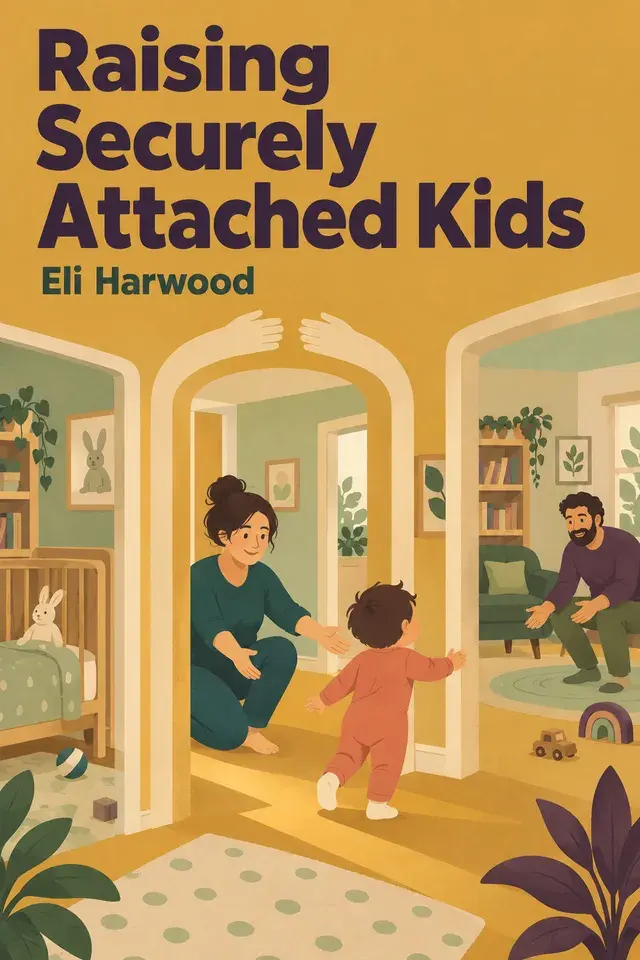
Raising Securely Attached Kids, by Eli Harwood.
Attachment is a child’s expectation about a basic question: when I need help, will my caregiver be there? Children form that expectation through repeated moments of pain, distress, connection, pride, and mistakes. When a caregiver responds with comfort and protection, the child learns that seeking support can help. The author presents this relationship as a foundation for learning and development, because children’s other experiences unfold within it.
A caregiver has two connected roles. As a safe haven, the caregiver offers shelter and comfort when a child is afraid or overwhelmed. As a secure base, the caregiver provides dependable backup that makes it easier to explore beyond the caregiver’s arms. The same relationship can support both closeness and growing independence.
The author illustrates the safe-haven role with her daughters’ fear of a bearded uncle. At family gatherings, they moved between being frightened by his facial hair and seeking their mother. She took their fear seriously and responded calmly. As they settled, their attention could shift from distress toward curiosity about him. The point is not that a beard is dangerous. It is that a caregiver’s response can help a child feel safe enough to make sense of something frightening.
Researchers describe four broad patterns in how children cope with distress. In a secure pattern, a child seeks the caregiver and can accept comfort. In an avoidant pattern, the child tends to turn away from distress or distract themselves. In a resistant pattern, the child seeks closeness but may also protest, push away, or struggle to trust reassurance. In a disorganized pattern, a child may shut down or react in confused ways when the caregiver is also a source of fear.
These patterns are ways of describing relationship experiences and coping, not diagnoses or fixed destinies. The author says patterns can change, and adults with different childhood experiences can become secure parents. The descriptions are useful as a map of what a child may have learned to expect, not as a permanent verdict about a child or family.
One research method behind this map is the Strange Situation, developed by attachment researcher Mary Ainsworth. An infant and caregiver first play; then a stranger enters, the caregiver briefly leaves the infant with the stranger, and they reunite. In episode 3, that separation lasts no more than three minutes and is cut short if the infant becomes severely distressed. The infant is later left alone before the final reunion. Researchers pay particular attention to how the infant responds when the caregiver returns: the reunion can show how the child manages stress and what support they seem to expect.
A securely attached infant may cry when the caregiver leaves, then seek them when they return and settle after reconnecting. An avoidant infant may show little outward reaction and turn to toys rather than approach the caregiver. That quiet reunion can look like independence, but a follow-up study found higher saliva stress responses among avoidant infants than among secure infants. The author interprets this contrast as a reminder that visible calm does not always mean a child feels calm inside.
A resistant infant may seek the returning caregiver, then push away or reject comfort and remain upset. A disorganized infant may show disorientation or conflicting movements, as if pulled between seeking the caregiver and seeking safety from them. These observations helped researchers describe patterns, but they are not a reason to diagnose a child from one encounter.
The original research also has limits. The early Baltimore sample was middle-class and white, and the work assumed mothers were the primary attachment figures. The author calls that sample unrepresentative. Later work replicated attachment findings across cultures and studied fathers, grandparents, and adoptive parents. Anyone who plays a significant caregiving role can be an attachment figure, and children may have several, even if they prefer one at a particular age.
A related example comes from adolescence. In two studies, securely attached teens who were in car accidents wanted their mother’s comfort over their peers’ at the time. As teens turn more toward peers, parents still matter. When a teen comes to a parent with serious trouble, the author emphasizes listening calmly and taking the teen’s feelings seriously rather than assuming that age has made comfort unnecessary.
Temperament is another part of the picture, but it is not attachment. Temperament refers to inborn differences, such as sensitivity, introversion, strong will, or sensory seeking and avoidance. Those traits can affect how much support a child needs and how demanding caregiving feels. A mismatch between a parent’s and child’s temperaments may make it harder to stay calm and responsive, but it does not mean the child’s nature has been caused by attachment. Caregivers shape how children feel about their traits through their responses and acceptance.
Attachment needs also change with development. Before birth, the relationship has a physical dimension, and the author describes talking to the baby as one way parents can begin relating to them. Newborns still need substantial closeness. Their crying communicates a need that may involve hunger, discomfort, tiredness, or simply being held. The author recognizes that families differ in support, time, work, and mental health; responsiveness means offering the most care possible within those circumstances, not following one identical routine.
As toddlers become mobile and curious, they need limits that protect them, alongside comfort when they are upset. Preschoolers may understand social expectations before they can reliably control impulses, so they need help practicing after mistakes. School-age children explore school, friendships, and interests, while still needing a safe haven and a secure base at home. In adolescence, peers take on more of the attachment role, but a parent can remain available for serious distress. In adulthood, close friends and partners may become important attachment figures, while parents can continue to offer support in a changed role.
This changing balance helps explain why comfort and exploration belong together. Young children are still developing the capacities needed to reason through distress and regulate themselves. The author describes caregivers as an outside source of help while those abilities grow. Many experiences of being soothed support the later capacity to soothe oneself. A baby who stops crying is not necessarily calm or finished processing; the overall pattern of responsiveness matters. The author also notes that a caregiver may briefly step away to regain calm, and that a short period of crying alone is not traumatic in itself.
Repeated comfort gives children experience with turning toward help and returning to steadiness. Over time, that trust can make exploration feel safer. A secure foundation does not remove every fear or make every stage easy. It gives children reason to expect that, when distress comes, someone who matters can help them find their way back to safety.
Chapter 2 of 13 · 6 min · Audio & textIn the app
From Control to Cooperation
Parenting gives adults responsibility for a child, but it does not give them control over who that child becomes. A request can turn into a contest when resistance is treated as a challenge to authority.
Chapter 3 of 13 · 9 min · Audio & textIn the app
Read the Need Behind Behavior
A child’s behavior is visible, but the feelings and needs beneath it are not. Harwood calls the effort to imagine those inner states reflective functioning.
Chapter 4 of 13 · 8 min · Audio & textIn the app
Healing the Parent’s Old Wounds
A child’s behavior can reach a parent as more than a response to the present moment. Earlier relationships may have taught the caregiver what anger, need, or distress means, and those lessons can still shape how available the parent feels.
Chapter 5 of 13 · 6 min · Audio & textIn the app
Feelings as a Path to Resilience
Harwood challenges the idea that toughness means hiding pain, never crying, and needing no one. That ideal can feel protective, especially when support is missing, but numbness is not the same as resilience.
Chapter 6 of 13 · 7 min · Audio & textIn the app
Attunement Makes Emotion Safer
Children learn what emotions mean partly by watching the people who meet them. When a child is sad, frightened, angry, or excited, a caregiver’s face, voice, and movements answer a quiet question: Is this feeling recognized?
Chapter 7 of 13 · 6 min · Audio & textIn the app
Attention, Confidence, and Empathy
A child’s bids for attention are often bids to have an experience witnessed. As children become more interactive, they look to caregivers to see whether what they notice matters to someone else.
Chapter 8 of 13 · 8 min · Audio & textIn the app
Structure That Teaches With Care
Structure is one way care becomes visible in daily life. It includes plans, routines, schedules, rules, and boundaries that help children know what to expect.
Chapter 9 of 13 · 9 min · Audio & textIn the app
Conflict as Practice and Repair
Conflict is not a sign that a family has failed. It is an inevitable part of close relationships, where people’s needs, feelings, and preferences meet.
Chapter 10 of 13 · 7 min · Audio & textIn the app
Connection as Everyday Protection
Protection begins in whether a child can turn to a caregiver when something frightening or hurtful happens. Harwood describes secure connection as more than a promise to keep danger away.
Chapter 11 of 13 · 8 min · Audio & textIn the app
Talking Through Difficult Topics
Sensitive conversations are not a single speech to get right. Children may meet difficult subjects through their own experiences, people they care about, or what they see and hear.
Chapter 12 of 13 · 6 min · Audio & textIn the app
Nudging Without Forcing
Growing independence asks parents to loosen control while staying emotionally available. Harwood describes the parent as both a refuge and support for exploration.
Chapter 13 of 13 · 6 min · Audio & textIn the app
Letting Growth Change the Bond
A child’s growth brings milestones that matter to both child and parent: starting preschool, riding a bike, having a sweetheart, graduating, or learning to drive. The author playfully calls the feelings around these moments “milefeels.”
Chapter 1 of 13 · 9 min · Audio & text: Attachment as a Secure Foundation
Wiseley supports reading and listening to summaries in the app.
Continue in WiseleyAbout Eli Harwood

Eli Harwood is the author of “Raising Securely Attached Kids”. The book explores secure attachment as a reliable source of comfort and a base from which children can explore.
Explore more books by Eli Harwood