What you'll learn
Key ideas from Radical Product Thinking
These ideas compress the book's argument without treating the author's view as settled fact. Use them as an orientation before reading the full work or listening in Wiseley.
RPT defines a product as a system for creating a desired change, so its success depends on the change it produces.
The Radical Vision Statement links a specific problem, tangible end state, and basic change mechanism to guide decisions.
A pain point is validated when users demonstrably experience it and value relief enough to exchange time, money, privacy, or another resource.
Recording vision debt makes its reason and repayment path visible, while revisiting the rubric keeps priorities responsive to changing risks.
Execution becomes hypothesis driven when experiments predict an outcome and explain how the activity is expected to create it.
Digital pollution names social costs that can accompany product growth when commercial measures leave wider effects unexamined.
Abundant information and commercial ranking can make visibility look like truth while lowering the cost of distributing persuasive falsehoods.
Product builders have a duty to consider foreseeable effects, including harms that emerge from routine decisions and unintended side effects.
Inside Radical Product Thinking
Read the first chapter in full here. The other 10 continue in the Wiseley app.
Chapter 1 of 11 · 8 min · Audio & text
Vision Before Iteration
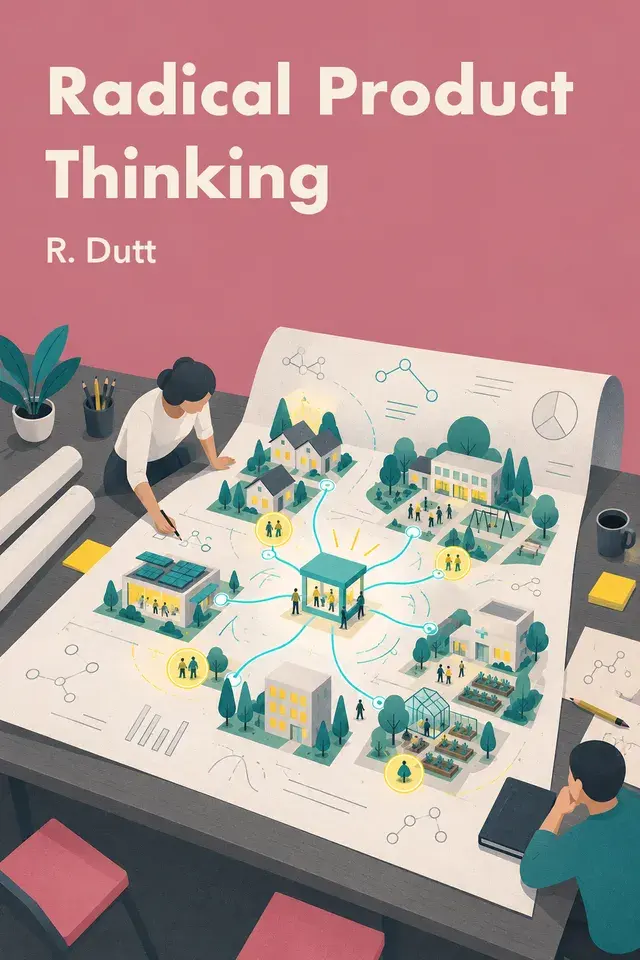
Radical Product Thinking, by R. Dutt.
Radical Product Thinking begins by changing what “product” means. A product is not only an object or an app. It can be any system through which people try to create change: a service, a government program, a nonprofit effort, or the work of a team. The useful question is therefore not just whether something was built or adopted, but what change it was meant to bring about. That intended change gives the work a reason to exist and a way to judge whether its design is serving its purpose.
This starting point separates a destination from the methods used to move toward it. In an iteration-led approach, a team makes a change, observes the response, and makes another change. That cycle can produce useful improvements. But when it is expected to supply the destination as well as the route, immediate feedback and visible measures can pull the work toward whatever seems most promising now. A product may become better at its current task without becoming a better answer to the larger problem.
The author describes this distinction as the difference between a local maximum and a global maximum. A local maximum is an improvement within a limited view: it makes the current solution, or the part of the system under consideration, work better. A global maximum is the more worthwhile outcome across the larger system and over time. The distinction is not a claim that every incremental improvement is mistaken. It asks whether the improvements are taking the work toward an outcome that matters beyond the next step.
The comparison between the Tesla Model 3 and General Motors’ Bolt makes the distinction concrete. The author presents Tesla as beginning with a destination: an electric car that was affordable without asking drivers to compromise in order to go green. That vision shaped decisions across the car. Tesla developed a smaller, more powerful motor using the Hall effect and created a demanding process for attaching magnets. Its battery, cabin, and motor cooling were treated as parts of one system. In this account, the vision connected choices that might otherwise have remained separate engineering or manufacturing problems.
The Bolt followed a different path. GM used the Spark chassis, outsourced the battery, and sought to bring an electric car with more than two hundred miles of range to market ahead of the Model 3. Given the resources available to GM, adapting an existing platform offered a practical route to a competitive car. The author calls this a local maximum: the design advanced an immediate goal, but its inherited layout and separated systems limited how far the product could be rethought as a whole. The contrast is about the direction each approach took, not simply which car had more features.
The author relies in part on engineer Sandy Munro’s assessment of the cars. Munro praised aspects of the Model 3’s electronics, wiring, driving experience, and motor, while criticizing its body. Tesla acknowledged problems with body manufacturing. That qualification matters: a strong vision does not make every design decision successful or remove the need to solve practical problems. Tesla also kept iterating, including on its manufacturing process and batteries. The difference is that these iterations were described as ways to improve the route to the chosen destination. In the author’s account, GM’s evolutionary approach did not become Tesla’s more integrated result simply by continuing to iterate longer.
The same distinction can be applied beyond a car company. The book uses Singapore to show how a stated future can organize change at national scale. After independence in 1965, Singapore faced serious disadvantages, including unemployment, housing shortages, scarce resources, and dependence on Malaysian water. Lee Kuan Yew’s experience of the failed merger with Malaysia helped shape a desired future in which Singapore could survive, trade globally, remain non-communist, and avoid racial riots. He described the country’s role as a “first-world oasis” in a third-world region and a base from which businesses could explore Asia.
That future was made more concrete through choices about how the country should work and feel: green and clean, English-speaking, efficient, incorruptible, and meritocratic. These were not just broad hopes. They served as design requirements for the system Singapore was trying to build. For example, cleanliness was pursued through education intended to persuade the majority, with enforcement directed at people who knowingly disregarded the rules. The example shows how a destination can shape both a policy and the way it is carried out.
Singapore’s public-transport experience also shows why vision-driven work must allow course correction. Privatization was intended to improve efficiency and prices through competition. But the publicly listed operator, SMRT, prioritized short-term earnings and neglected maintenance and investment. When that arrangement no longer served the transport aim, the government changed its approach: Temasek acquired SMRT, and it was delisted. The author describes the resulting transport system as among the world’s best. The point is not that one ownership model always works. It is that a method can be revised when it stops supporting the intended outcome.
This is where Lean and Agile fit into the argument. Lean encourages faster experiments and learning; Agile supports incremental development and feedback during execution. Those methods can help a team move and adapt quickly. They do not, by themselves, decide which destination is worth pursuing. RPT pairs their speed with a direction, so feedback can refine the means without silently replacing the purpose. Singapore’s discarded initiatives illustrate that iteration can change a strategy while the larger aim remains in view.
A vision, then, is useful when it can guide ordinary choices, from an integrated engineering decision to a public service or a change in operating policy. It does not freeze a product in one design, and it does not guarantee success. It gives iteration something to serve. Without that destination, improvement can remain local; with one, a team can ask whether the next change makes the system a better way to create the change it set out to make.
Chapter 2 of 11 · 8 min · Audio & textIn the app
Diagnosing Product Diseases
When an organization loses sight of the change its product is meant to create, failure rarely arrives as one dramatic mistake. It often appears as recurring decision patterns.
Chapter 3 of 11 · 9 min · Audio & textIn the app
Crafting a Radical Vision
When an organization says its vision is to grow, lead a market, or reach a revenue target, it has described what it wants for itself. Dutt’s Radical Vision Statement begins with a change in the world that matters to people.
Chapter 4 of 11 · 9 min · Audio & textIn the app
Turning Vision Into Strategy
A vision describes a change worth pursuing. Strategy explains how a product and the organization behind it can bring about that change.
Chapter 5 of 11 · 8 min · Audio & textIn the app
Priorities, Survival, and Vision Debt
Once a team has a direction, prioritization determines whether that direction shapes ordinary choices or stays on paper. Dutt proposes a shared rubric that puts two questions beside each other: How much does this work advance the product vision?
Chapter 6 of 11 · 9 min · Audio & textIn the app
Executing and Measuring for Learning
Once a team has a strategy, execution is a way to test whether that strategy creates its intended change. A product can attract users, delight them, and perform well on familiar measures while still failing to change the behavior it was meant to change.
Chapter 7 of 11 · 10 min · Audio & textIn the app
Designing a Healthier Culture
A workplace’s culture is not defined by its stated values or its perks. It is shaped by what people experience during the workday: whether their work feels worthwhile, whether they can make progress, and what drains their energy.
Chapter 8 of 11 · 9 min · Audio & textIn the app
Inequality, Attention, and Polarization
Product growth can bring benefits while also creating costs that the product’s success measures do not capture. Dutt calls this unintended social damage digital pollution.
Chapter 9 of 11 · 9 min · Audio & textIn the app
Privacy and the Information Ecosystem
Privacy and the quality of information may seem like separate concerns. One is about what a person reveals; the other is about what a person can believe.
Chapter 10 of 11 · 9 min · Audio & textIn the app
A Product Ethic for Builders
A product builder’s responsibility does not end with good intentions or with the feature they personally designed. Products can reach large numbers of people quickly, and routine choices about business models, data, or design can shape wider systems.
Chapter 11 of 11 · 8 min · Audio & textIn the app
Applying RPT Beyond Products
Radical Product Thinking can apply wherever people are trying to bring about change. Dutt uses “product” broadly: a job, a specialty, an institution, volunteer work, or a personal commitment can become a mechanism for achieving a chosen purpose.
Chapter 1 of 11 · 8 min · Audio & text: Vision Before Iteration
Wiseley supports reading and listening to summaries in the app.
Continue in WiseleyAbout Radhika Dutt

Radhika Dutt is the author of “Radical Product Thinking”. The book explores how teams can create meaningful change without letting iteration, easy metrics, or short-term pressures choose the destination.
Explore more books by Radhika Dutt