What you'll learn
Key ideas from Quantum Supremacy
These ideas compress the book's argument without treating the author's view as settled fact. Use them as an orientation before reading the full work or listening in Wiseley.
Transistor miniaturization drives silicon toward atomic constraints, motivating a different physical basis for computation.
Superposition and interference carry alternatives as probabilities until measurement produces an ordinary outcome.
Quantum advantage depends on preserving coherence long enough for controlled operations, not simply on increasing the number of physical qubits.
Shor makes factoring-based encryption a hardware-dependent concern, while larger keys, new trapdoors, quantum key distribution, and laser links remain proposed responses.
Quantum simulation becomes useful when it maps reaction stages, finds bottlenecks, and compares catalysts across a complete working system.
Mechanism-first drug design reverses trial-and-error discovery by starting from a bacterial vulnerability and testing compounds built for that function.
AlphaFold’s reported structural maps mark major classical progress, but a fold does not by itself explain function or design.
Exact simulation runs into particle counts, chaotic amplification, and enormous quantum state spaces; more qubits do not remove those resource limits.
Inside Quantum Supremacy
Read the first chapter in full here. The other 12 continue in the Wiseley app.
Chapter 1 of 13 · 6 min · Audio & text
Why Computing Needs Another Approach
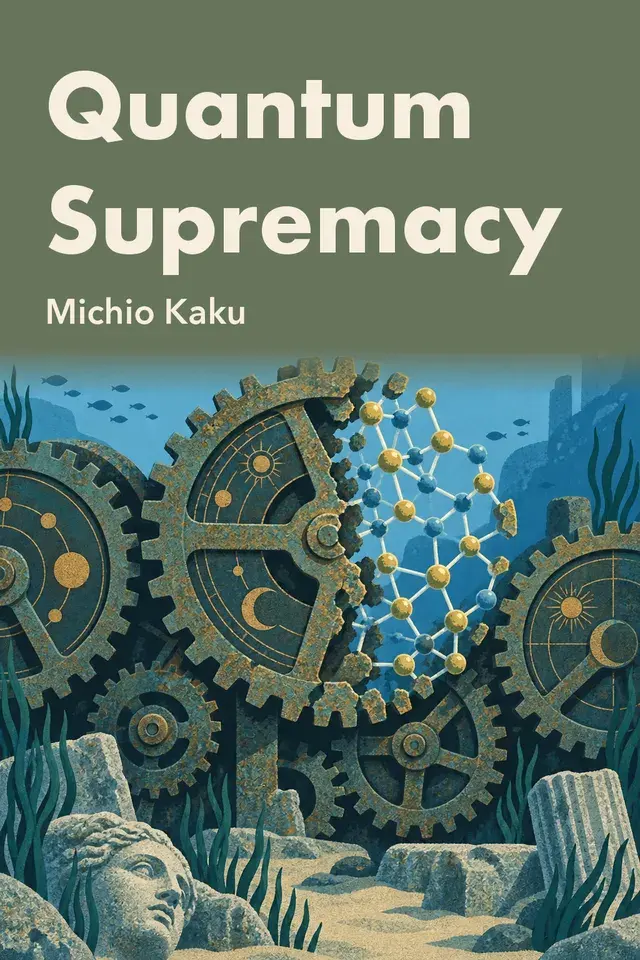
Quantum Supremacy, by Michio Kaku.
Computing, in Kaku’s account, begins with a human desire to model nature: to build a smaller system whose behavior represents a larger one. The Antikythera mechanism is his worked example. Recovered from a Mediterranean shipwreck and dated to roughly 150 to 100 BCE, it is presented as the oldest known computer. At least thirty-seven gears modeled the Sun and Moon, predicted eclipses, and represented irregularities in the Moon’s orbit. Inscriptions recorded planetary motions, and a missing section may have extended that display. Its importance lies in the method. Rather than merely observing the sky, the device simulated celestial cycles through continuous mechanical motion. Computation first appears as a way to make nature’s behavior manipulable and intelligible.
When mechanical calculation revived in the 1800s, the problems were practical: navigation, trade, finance, and mathematical tables were vulnerable to human error. Charles Babbage pursued a general mechanical computer to calculate such tasks reliably. His major machine was not completed in his lifetime, but Ada Lovelace saw what the design implied. Repeated calculations required instructions that could guide the hardware through one operation and then return it to the next. Her published procedure for generating Bernoulli numbers is presented as an early computer program. More importantly, she recognized that numbers could represent letters, musical notes, and other symbols. A machine built to manipulate quantities could therefore manipulate representations of many kinds. Hardware supplied the operations; instructions supplied the procedure and the subject.
This separation led toward programmable computing, but it also exposed a limit. Mathematicians had long hoped to derive every true statement from a complete set of axioms. The source presents Gödel’s 1931 result as showing that this ambition fails: mathematics contains true statements that cannot be proved within a given formal system. Turing recast the question as a problem about machines. His universal machine used a tape of binary cells and a small set of operations: read, write, change a symbol, move left or right, and stop. By encoding instructions in binary, it could transform inputs into outputs and perform arithmetic. Turing called a problem computable when a machine could reach a proof in finite time. The qualification matters. The limit is described relative to specified axioms and finite procedures; it is not a broader claim that no mathematical truth can ever be known.
World War II turned these abstractions into working codebreaking machinery. At Bletchley Park, the electromechanical bombe used powered rotors, drums, and relays against Enigma. Colossus was a different step: it used vacuum tubes to process binary signals electronically and is described as an early programmable digital computer. Digital systems also improved copying accuracy and allowed information to be altered through algorithms, making them more flexible than analog machines.
The next transformation came from the transistor. A semiconductor can control whether electrons flow, so a transistor’s off and on states can represent zero and one. Networks of these tiny controls became digital logic. Photolithography made it possible to print and etch vast numbers of circuits onto silicon, producing chips with about a billion transistors. The pattern became known as Moore’s law: computing power kept rising as components shrank. But Kaku argues that the trend cannot continue indefinitely. He describes transistor layers as about twenty atoms across; near five atoms, electron positions become uncertain, leakage can cause short circuits, and concentrated heat can damage the chip. At that scale, the obstacle is not simply cost or ingenuity. The material no longer behaves like a stable miniature version of the larger device.
That constraint motivates the book’s central proposal. If nature at atomic scales follows quantum behavior, then modeling nature may require machines that use a quantum physical basis rather than merely smaller silicon switches. Kaku presents quantum computing as a possible post-silicon approach to simulation: a change in what the computer represents and how it processes possibilities. The physical details are less important here than the historical pattern. Computing advances by finding a physical system that can embody a useful model.
The term quantum supremacy gives this proposal a concrete, narrower meaning. Kaku reports Google’s Sycamore completing a selected mathematical task in about two hundred seconds, compared with an estimate of ten thousand years for the fastest conventional supercomputer. The comparison is striking because it measures a decisive advantage on that particular benchmark. It does not, by itself, establish that quantum computers are universally superior, an inference drawn from the benchmark’s limited scope rather than an explicit warning in the source. Its role here is to define the claim the rest of the book will examine: quantum computing may open a new way to model nature as silicon miniaturization approaches its physical boundary.
Chapter 2 of 13 · 9 min · Audio & textIn the app
How Quantum States Carry Possibility
Quantum theory starts with a failure in the old picture of nature. Around 1900, physicists imagined a clockwork universe governed by continuous laws.
Chapter 3 of 13 · 10 min · Audio & textIn the app
Building Reliable Quantum Machines
Quantum computing’s promise becomes an engineering problem as soon as a calculation must last longer than a fleeting quantum state. The required condition is coherence: component states remain synchronized while operations are applied.
Chapter 4 of 13 · 7 min · Audio & textIn the app
Turning Life Into Molecular Questions
Quantum chemistry gives biology a virtual laboratory. Researchers can specify a molecule, alter its arrangement, calculate its interactions, and compare the predicted result with experiments.
Chapter 5 of 13 · 9 min · Audio & textIn the app
Learning Nature's Chemical Shortcuts
Photosynthesis and nitrogen fixation are two cases where nature appears to have found chemical shortcuts. They also show why a quantum explanation is only a beginning: researchers must model each stage, locate the bottleneck, and test whether a different catalyst improves the whole process.
Chapter 6 of 13 · 9 min · Audio & textIn the app
Storage and a Changing Climate
Renewable energy has a timing problem. Solar panels produce nothing at night, and wind turbines can stop when the air is still.
Chapter 7 of 13 · 7 min · Audio & textIn the app
Designing Defenses Against Infection
Modern medicine has often advanced by noticing a useful effect and explaining it afterward. Kaku uses Fleming’s accidental observation of mold killing bacteria as the emblem: penicillin emerged from an unexpected result, not a mechanism-first design.
Chapter 8 of 13 · 9 min · Audio & textIn the app
Cancer Detection and Genetic Intervention
Cancer is difficult to treat partly because it is not one disease with one failure. The book presents it as a family of disorders in which mutations, environmental triggers, and chance can disrupt cell regulation.
Chapter 9 of 13 · 9 min · Audio & textIn the app
Learning Protein Structure and Function
Biology begins with a difference between information and action. DNA can be treated as a blueprint, but proteins perform much of the body’s work, and their functions depend on the shapes into which strings of amino acids fold.
Chapter 10 of 13 · 9 min · Audio & textIn the app
Repairing the Biology of Aging
Life can maintain order without violating thermodynamics because it is not a closed system. Energy enters, allowing an organism to preserve local organization; the chapter uses sunlight as the broad example.
Chapter 11 of 13 · 8 min · Audio & textIn the app
Containing a Star on Earth
Fusion attracts attention because it reproduces the reaction that powers the Sun: hydrogen nuclei combine to form helium, and a small mass difference appears as energy. The book contrasts this with fission, where uranium or plutonium splitting leaves long-lived radioactive by-products.
Chapter 12 of 13 · 9 min · Audio & textIn the app
From Cosmic Hazards to Fundamental Laws
Cosmic applications become clearer when separated into three questions: what is there, what will it do, and what laws explain it? This observation–forecasting–theory sequence is an editorial way to organize the material, not a formal classification attributed to Kaku.
Chapter 13 of 13 · 8 min · Audio & textIn the app
What Simulation Can Ultimately Explain
Quantum computation reaches its philosophical boundary when simulating nature is taken to mean reproducing everything exactly. Kaku’s argument is narrower.
Chapter 1 of 13 · 6 min · Audio & text: Why Computing Needs Another Approach
Wiseley supports reading and listening to summaries in the app.
Continue in WiseleyWhat Quantum Supremacy is about
What could quantum computers reveal about nature that conventional machines struggle to calculate? Michio Kaku connects quantum physics to chemistry, medicine, energy, and cosmology. Follow the proposed mechanisms and research methods while distinguishing experimental achievements, engineering obstacles, and speculative futures.
About Michio Kaku
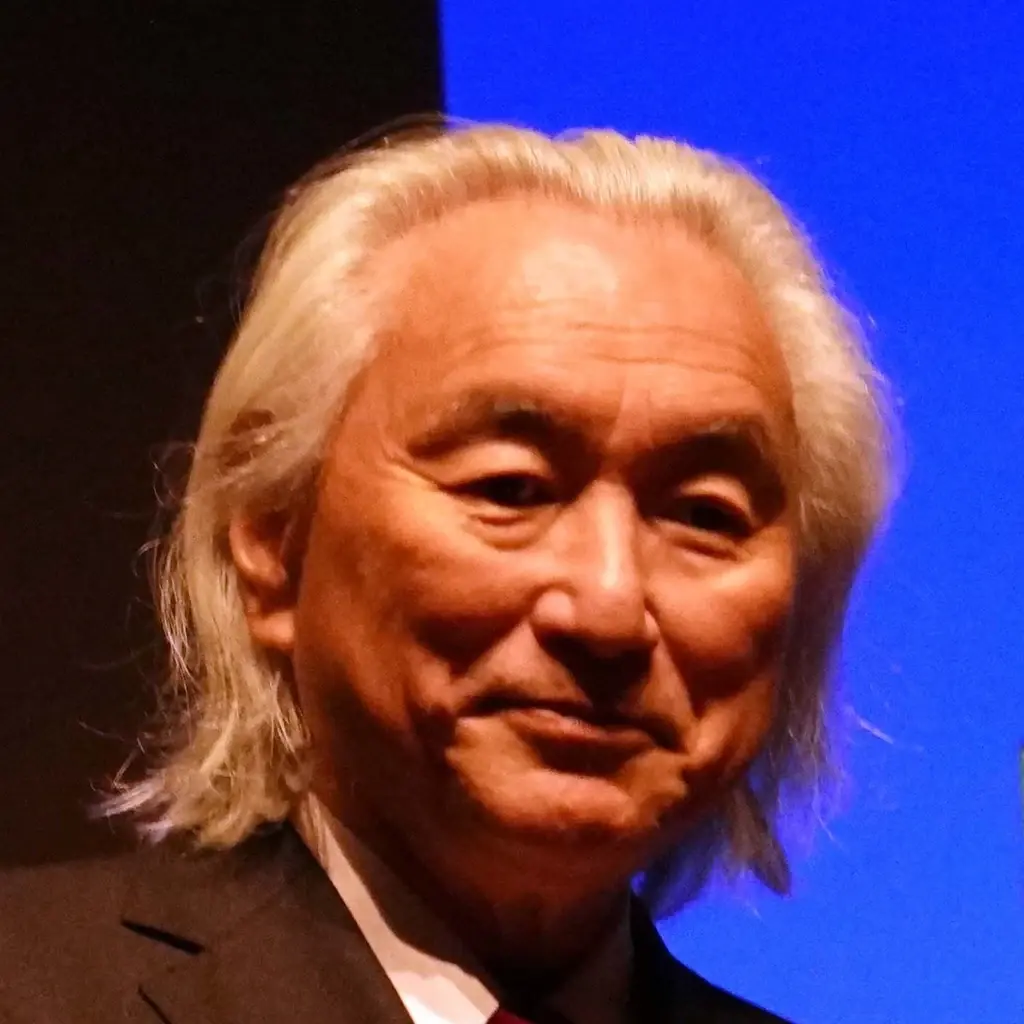
Michio Kaku is an American theoretical physicist, futurist and author. “Quantum Supremacy” explores what quantum computers could reveal about nature that conventional machines struggle to calculate.
Explore more books by Michio Kaku