What you'll learn
Key ideas from Profit Over People
These ideas compress the book's argument without treating the author's view as settled fact. Use them as an orientation before reading the full work or listening in Wiseley.
Neoliberalism presents market discipline as a general rule, while policy in practice often reflects unequal political power and state support.
Consent can coexist with coercion and restricted participation; freer political systems rely more heavily on managing public opinion.
The telecommunications agreement was expected to widen foreign access while shifting costs toward workers and ordinary subscribers.
Nicaragua’s recognized election and subsequent coercion show why ballots alone cannot establish meaningful popular choice.
In Haiti and Mexico, liberalization changed livelihoods through falling wages, food dependence, and growing hardship.
The proposed MAI gave investors broad rights without a reciprocal citizen right to sue, making exceptions and interpretation central.
Public organizing helped delay the MAI and contributed to Fast Track’s withdrawal, while leaving the wider contest unresolved.
Inside Profit Over People
Read the first chapter in full here. The other 4 continue in the Wiseley app.
Chapter 1 of 5 · 13 min · Audio & text
Who Makes the Market?
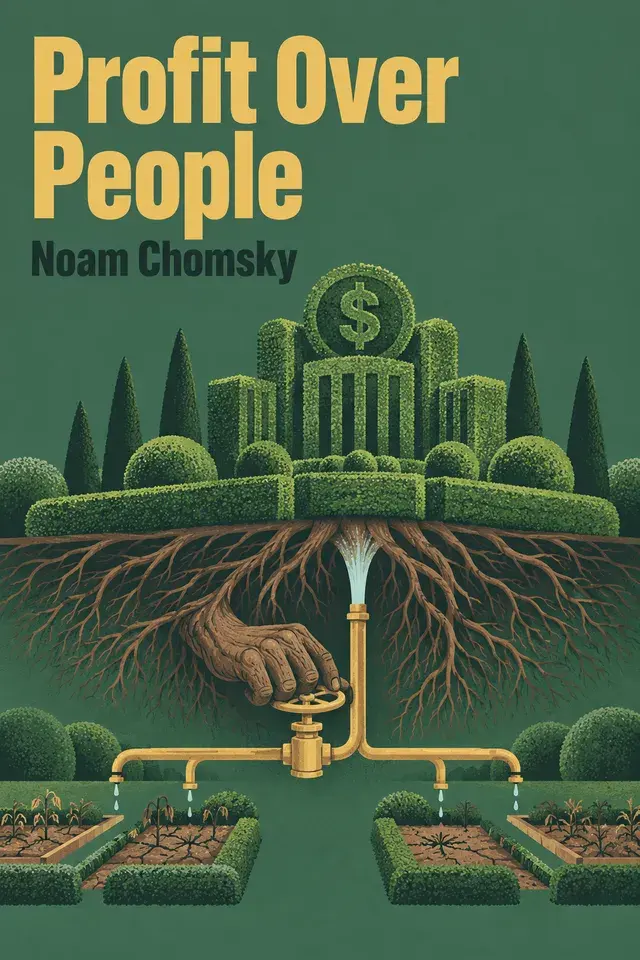
Profit Over People, by Noam Chomsky.
A market can look like a natural force: prices rise or fall, firms compete, and governments are told to stand aside. Chomsky asks us to look at the arrangements behind that picture. Who wrote the rules? Who can shape them? And whose interests do they serve? His central claim is that market outcomes reflect political choices. Those choices distribute power and support some groups while leaving others with the costs.
The word neoliberalism can suggest a new version of classical liberal thought. Chomsky argues that the policies he examines are neither new nor faithful to that tradition. They favor liberalized trade and finance, prices set by markets, low inflation, and privatization. The Washington consensus names a related package promoted by the United States and international financial institutions it largely dominates. In some countries, the package arrived through stringent structural adjustment programs. Its call for government to get out of the way can also reduce popular influence over decisions made in a democracy.
A useful way to assess such claims has four parts. First, identify who sets the rules and what power backs them. Second, compare the stated doctrine with policy in practice. Third, trace who receives the benefits and who bears the costs. Finally, ask how firm the evidence is and what it cannot establish. Chomsky warns against treating a country as if everyone in it shared one interest. A class analysis instead asks where power lies and how it is used. A policy can fail its public purpose yet serve those who designed it. But evidence of that pattern does not by itself prove every motive or explain every outcome.
The introduction by Robert McChesney connects market language to corporate influence. He describes neoliberalism as an order that gives a small group of private interests broad control over social life in pursuit of profit. Public relations and political debate can present “free-market” policies as a matter of choice and enterprise, while government is cast as wasteful or parasitic. Yet, McChesney argues, modern governments remain central to business: they subsidize corporations, advance their interests, and protect them from competition. So the relevant question is not simply whether government intervenes. It is whom that intervention supports.
McChesney also uses Chile to show why these economic claims cannot be separated from political power. He says Milton Friedman and like-minded neoliberals accepted the 1973 military overthrow of Salvador Allende’s elected government because Allende interfered with business control. After fifteen years of brutal dictatorship, electoral democracy returned under a constitution that made it harder for citizens to challenge business and military dominance. McChesney stresses that neoliberalism and fascism are distinct, despite a phrase some earlier critics used to describe fascism. In his account, neoliberalism can operate with formal elections even as meaningful participation is curtailed; fascism rejects formal democracy and mobilizes racist and nationalist movements.
The introduction describes unequal participation in the United States as another part of this setting. McChesney reports that just over a third of eligible voters turned out in the 1998 congressional elections, with poor and working-class people disproportionately among those who did not vote. In a separate example from U.S. electoral politics, he reports that the richest quarter of one percent supplied 80 percent of individual political contributions, while corporations outspent labor ten to one. These figures do not explain every election or policy. They illustrate why formal political equality may coexist with sharply unequal resources for influencing decisions.
Chomsky’s historical cases test market doctrine against policy in practice. In India, the British Permanent Settlement oppressed lower classes while creating wealthy landed proprietors aligned with continued British rule and enriching British investors. Chomsky adds that India helped finance Britain’s trade deficit and supplied a protected market, contract labor, and opium for export to China. That opium trade was imposed by force, even as England itself prohibited opium. The example asks readers to look beyond claims of development or efficiency and examine how a policy reorganized power and who gained from it.
Brazil offers another test. Chomsky describes it as a United States-backed capitalist development experiment beginning in 1945 that benefited foreign investors. Business praised the model under military rule, but the World Bank reported that two-thirds of the population lacked enough food for normal physical activity. Chomsky also points to conditions in 1989: profits had tripled from the previous year, while already low industrial wages fell another 20 percent. Brazil ranked near Albania in a United Nations human-development report. When crisis began to affect the wealthy, he says, the once-praised experiment was recast as evidence against state intervention and socialism. The shift in description itself makes it important to ask whose experience defines success.
East Asia complicates the claim that development follows one universal market recipe. Chomsky cites accounts of Japan using state-led industrial policy and introducing market mechanisms gradually as commercial prospects improved. Taiwan retained a guiding state role even as U.S. officials advertised it as a private-enterprise success story. South Korea also retained a guiding role, though its entrepreneurial state functioned differently. The lessons attributed to Joseph Stiglitz include education, health, technology transfer, industrial planning, coordination, and relative equality. Chomsky contrasts these approaches with Latin American patterns of greater inequality, capital flight, and foreign control. This comparison challenges the claim that liberalization alone explains development. It does not make East Asia a formula that other countries can simply copy.
The evidence calls for restraint as well as comparison. Chomsky cites economist Paul Krugman on the limits of development knowledge. For the United States, Krugman says, two-thirds of the rise in per-capita income is unexplained; Asian success stories also did not follow what current orthodoxy says are the keys to growth. Krugman recommends humility in policy formation and caution about sweeping generalizations. Chomsky suggests that escaping harmful experiments may be necessary for development, but says it is not enough to guarantee success. Reported numbers and studies can support comparisons, but they do not turn a complicated history into a controlled test.
The historical record of richer countries makes the contrast between doctrine and practice especially clear. Chomsky argues that Britain built strength through taxation, administration, state direction, protectionism, and force. After 150 years of protectionism, violence, and state power that had put it far ahead of competitors, Britain turned toward liberal internationalism in 1846. That turn came with significant reservations: 40 percent of British textiles continued to go to colonized India, and much the same was true of British exports generally. New England protected its textile industry with high tariffs against British imports. By contrast, British policy undermined Indian industry, including textiles, while India remained a market for British goods. Chomsky’s broader point is that powerful countries often used state support while weaker countries faced pressure to open their markets. The principle of market discipline was not applied evenly.
Public support continued after governments adopted market rhetoric. Chomsky describes United States business leaders after the Second World War as expecting another depression without state intervention. They argued that advanced industries, including aircraft, could not survive in a purely competitive economy without subsidies. The Pentagon system helped transfer costs to the public, while the language of national security made support easier to justify. Chomsky says aircraft companies such as Boeing and Airbus depended on large public subsidies. He also cites Reagan-era import relief and government programs for advanced technology, alongside rescues and loan guarantees for firms. These examples show why it matters to count public support even when policy is described as free enterprise.
The same accounting applies to costs that do not appear in a market price. Chomsky points to military spending that helped secure oil supplies and argues that estimates of trade efficiency or growth are incomplete if they leave out such support. The chapter’s claim about a subsidy to oil prices rests on one technical study cited by the author, so it should be treated with that limit in mind. Following the money and the rules means noticing both direct aid and costs shifted to the public.
Chomsky also contests the idea that these questions belong only to modern critics of capitalism. He draws on classical liberal thinkers who worried about concentrated economic power and workers’ loss of independence. Adam Smith warned that a narrow division of labor could make workers ignorant and object-like, and argued that government should address the harm. Chomsky also recalls Smith’s distinction between regulation favoring workers and regulation favoring masters. Wilhelm von Humboldt condemned wage labor controlled by others, while Alexis de Tocqueville warned that industrial progress could accompany the decline of artisans and the rise of a manufacturing aristocracy. Chomsky finds a modern expression of this tradition in independent workers’ movements and libertarian socialism.
Taken together, these cases offer a way to examine market claims without assuming that either state action or market exchange is automatically fair. Ask who makes the rules, compare the stated principle with actual policy, follow the gains and costs, and match conclusions to the strength of the evidence. The Introduction adds a final qualification: McChesney says the path to a free and humane alternative is unclear, and that upheaval will not automatically produce one. The case for scrutiny rests on the record itself: outcomes called natural or inevitable have often depended on political choices.
Chapter 2 of 5 · 12 min · Audio & textIn the app
Consent, Opinion, and Public Power
People may vote regularly and still have little say over what elected officials do, which questions receive attention, or how workplaces are run. That gap is central to Noam Chomsky’s account of consent.
Chapter 3 of 5 · 13 min · Audio & textIn the app
Selective Markets and International Rules
Chomsky’s examples range from domestic subsidies to trade rules and foreign policy. They ask who receives public support, who is expected to benefit from market opening, and when international law is treated as binding.
Chapter 4 of 5 · 12 min · Audio & textIn the app
Democracy in Material Outcomes
A vote can mark a democratic choice, but it cannot show by itself how freely people made that choice or what options remained afterward. Chomsky tests claims about democracy against coercion and the conditions people faced in Nicaragua, Haiti, and Mexico.
Chapter 5 of 5 · 10 min · Audio & textIn the app
Investor Rights and Democratic Oversight
Chomsky makes investment treaties a question of who holds decision-making power after negotiations begin. Fast Track, in his account, would let the executive negotiate agreements with little congressional oversight or public awareness.
Chapter 1 of 5 · 13 min · Audio & text: Who Makes the Market?
Wiseley supports reading and listening to summaries in the app.
Continue in WiseleyAbout Noam Chomsky
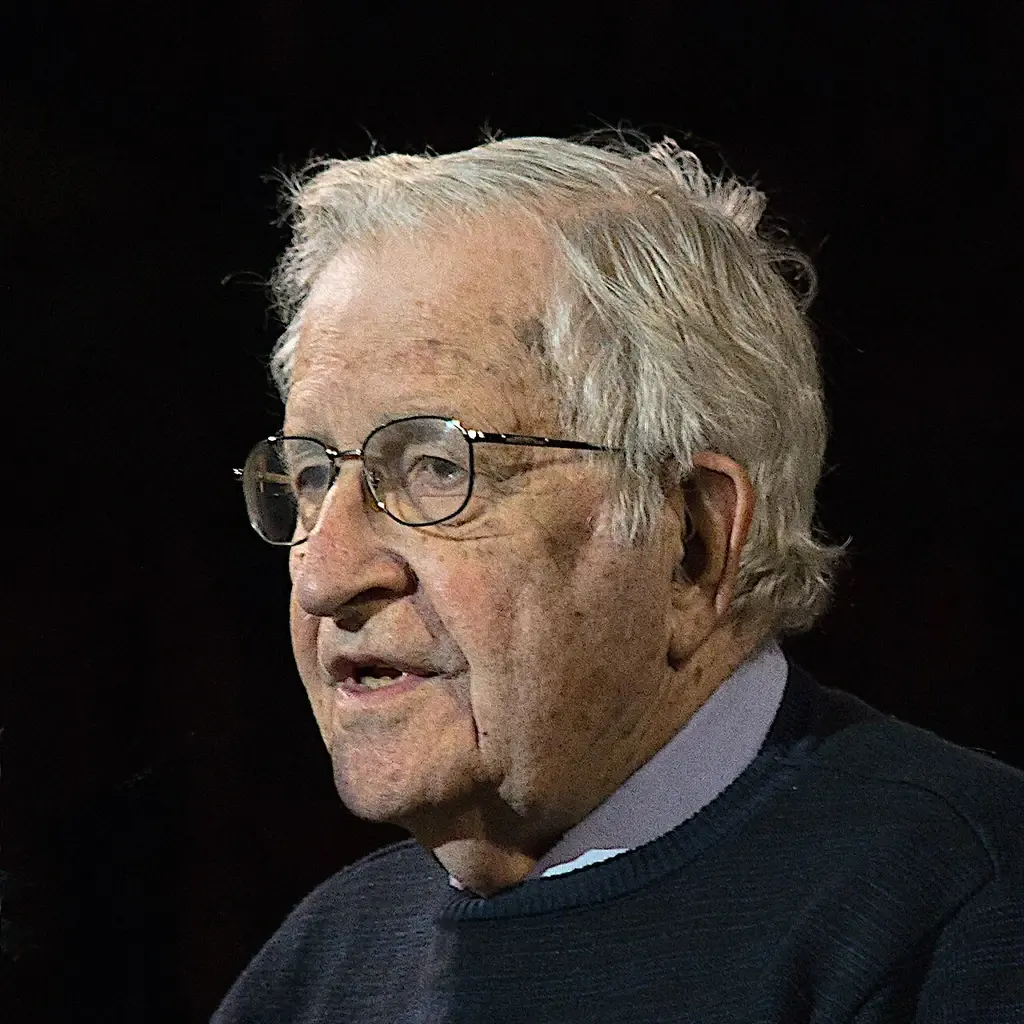
Noam Chomsky is an American linguist and activist. “Understanding Power” explores how institutions shape public knowledge, state policy, and control of economic life.
Explore more books by Noam Chomsky