What you'll learn
Key ideas from Powerful Phrases for Dealing with Difficult People
These ideas compress the book's argument without treating the author's view as settled fact. Use them as an orientation before reading the full work or listening in Wiseley.
Understanding recognizes another viewpoint without requiring agreement, while apology remains a situational repair tool rather than an automatic admission of fault.
A shared definition of the problem comes before proposing solutions because competing viewpoints must be heard and summarized.
Effective requests name a specific interaction, such as necessary email, lower volume, or more personal space, instead of attacking personality.
Reliable performance conversations separate observable impact from possible causes such as missing training, stress, inexperience, or low motivation.
Unequal authority calls for calm, fact-based requests that connect a boss’s behavior to work impact and a feasible future arrangement.
Compromise has limits at bullying, abuse, and wrongdoing; forced compliance calls for documented opposition and an appropriate response route.
Repair combines clarifying questions, a sincere apology for recognized conduct, empathy, and a specific behavioral change.
Inside Powerful Phrases for Dealing with Difficult People
Read the first chapter in full here. The other 8 continue in the Wiseley app.
Chapter 1 of 9 · 11 min · Audio & text
Make Your Words and Delivery Agree
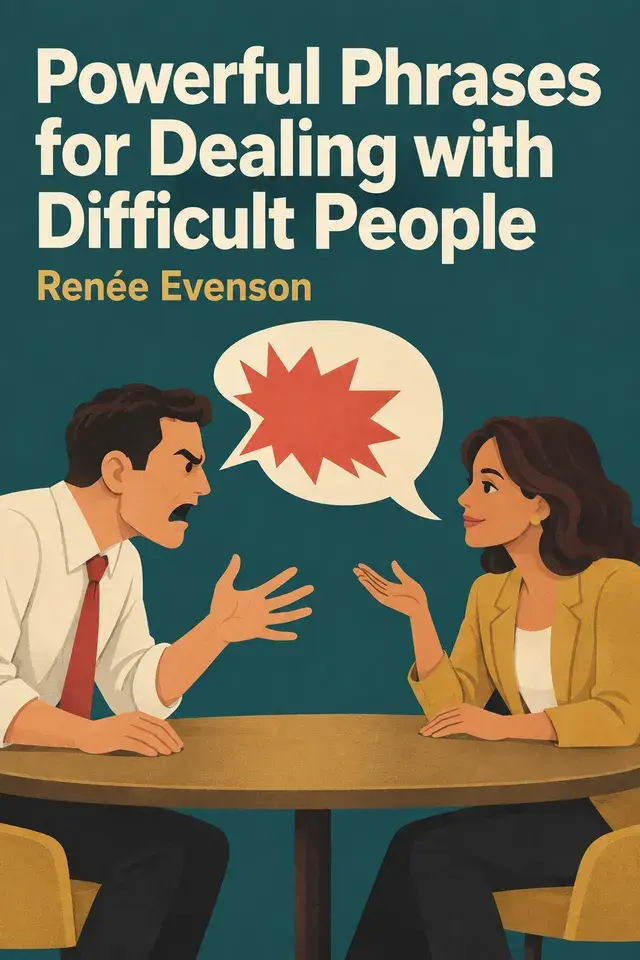
Powerful Phrases for Dealing with Difficult People, by Renée Evenson.
Conflict in this book is not something to wait out. When irritation is ignored, it can grow into bitterness and damage a working relationship. The practical alternative is a calm conversation that names the problem, hears the other person’s view, and seeks an outcome both can work with. But words alone are not the method. A respectful phrase can still sound accusatory if the speaker’s face, posture, or voice contradicts it. The core principle is congruence: state your need clearly while delivering it in a way that reduces defensiveness.
An I-statement is the usual opening. It describes what happened and how the situation affected you, rather than judging the other person’s character. This keeps attention on a specific behavior and its effect. The book warns that beginning with “you,” especially with words such as “always” or “never,” can invite a defense of character instead of a discussion of the problem. An I-statement can make constructive engagement more likely, but it does not guarantee that the other person will accept responsibility.
A phrase of understanding acknowledges that the other person may see the situation differently. It invites them to explain their intentions, feelings, or circumstances and signals that you are willing to hear more. Understanding is not agreement. It is a way to establish enough common ground for the real issue to be discussed. Sometimes, hearing the other side reveals information that was not visible at first and changes how the conflict should be approached.
An apology is another tool, but it is situational. You may apologize for your part in creating tension, for the effect of your behavior, or for the difficulty of the situation without admitting that every accusation is true. A sincere apology can lessen anger and pride, soothe hurt feelings, and reopen communication. It should not be offered automatically or more often than necessary. Its purpose is progress and repair, not self-punishment.
Compromise requires reciprocal flexibility. Each person listens with an open mind, considers the other’s perspective, asks questions, and looks for a workable middle ground. It is not unilateral surrender. Once a solution is found, a resolution phrase makes the arrangement explicit. It can confirm what everyone understands, check whether the participants can accept the outcome, and restate what will happen next. If someone still prefers another option, the goal is shared understanding of why the selected solution is best, not a pretense that everyone had the same preference.
Reconciliation provides the relationship-focused close. The speaker can express appreciation for the discussion, affirm that the working relationship matters, and communicate confidence about future cooperation. This leaves the exchange on a constructive note. It does not erase every disagreement or prove that trust has been fully restored; it simply makes the intention to work together clear.
These phrases work partly through nonverbal communication. Words carry the content of a message, while actions convey feelings behind it. When the two conflict, the listener may become confused and may judge the visible behavior more strongly than the carefully chosen sentence. The book therefore recommends practicing useful posture, expression, eye contact, and vocal control in ordinary conversations, so they are easier to manage during conflict.
Body language includes stance, posture, hand movements, gestures, and physical distance. A confident presentation is described as upright, with relaxed shoulders and a relaxed stance, natural hands, little fidgeting, and controlled gestures. A distance of roughly two to four feet is offered as a general illustration, not a rigid measurement. If the other person backs away or leans back, creating more space may be appropriate. Touch can support a message in some relationships, but unless welcomed contact is clearly appropriate, it is safer to avoid touching the other person.
Facial expressions can reveal anger or distress before the speaker intends to show them. Practice can help replace an angry scowl with an expression that appears concerned, sincere, and interested. Eye contact should be comfortable rather than an unbroken stare, with occasional shifts of gaze. A slight, sincere smile and restrained eyebrow movement may signal openness, but exaggerated smiling or eyebrow gestures can undermine the message. These are contextual clues, not reliable diagnoses of what someone feels or intends.
Tone also carries meaning. A neutral or concerned tone is a useful way to open a difficult conversation, while a softer, slower pace may help an upset person settle. Brief listening sounds can signal comprehension, whereas a questioning inflection may suggest confusion or disagreement. Assertiveness means expressing a view clearly and objectively, controlling emotion, matching actions to words, and remaining respectful while standing up for yourself. Aggression is more impulsive or careless: it disregards presentation and nonverbal signals and can make the speaker appear angry, arrogant, or bossy. Calmness does not require giving up a legitimate position. It makes the position easier to hear. If the other person is withdrawn, compassion and encouragement may help; if they are aggressive, a soft voice and attention to the emotion can de-escalate the exchange without surrendering the point.
Kate’s conflict with Emma shows the difference. During a presentation, Emma interrupts Kate again, having interrupted her in a previous meeting, and Kate loses her concentration. In the first hallway exchange, Kate treats the interruptions as a pattern of disrespect and responds with accusations. Emma answers defensively, the rebuttals escalate, and the original problem remains unresolved. The conversation also makes future cooperation harder.
In the revised discussion, Kate prepares and rehearses possible responses. She explains the effect of the interruptions through an I-statement, acknowledges that Emma may not intend disrespect, and uses a carefully chosen apology to reduce tension without taking responsibility for everything. She then invites a workable arrangement. Their compromise is reciprocal: Emma waits until Kate finishes speaking, while Kate makes sure Emma has an opportunity to contribute, including an opportunity to disagree. The resolution states those responsibilities plainly. They close with appreciation for their working relationship, and the author presents the exchange as an illustration of the full sequence, not as proof that every listener will cooperate.
Andrew and James provide a similar lesson about delivery. Their first attempt to resolve a presentation dispute fails because Andrew’s angry tone, crossed arms, and indignant glare contradict his words. James responds dismissively, and the conversation deteriorates into sarcasm and derogatory banter. That exchange threatens their ability to work cohesively and prepare the presentation. In the improved version, Andrew rehearses both his language and his body language. He maintains relaxed confidence and eye contact, watches James’s signals, and remains assertive when James is dismissive. Andrew combines understanding, an I-statement, perspective-taking, and compromise. The concrete resolution is that Andrew will speak first, but both coworkers will handle part of the presentation. James moves toward apology and agreement, and the relationship receives a positive close. The author describes future cooperation as likely, not guaranteed.
A practical rehearsal can be simple. First, describe the behavior and its effect on you, without assigning a motive or labeling the person. For example, explain that interruptions make it difficult to keep your concentration. Next, choose a respectful request that addresses the interaction, such as asking to finish a thought before taking questions. Finally, practice saying the request with calm confidence: relaxed posture, natural gestures, a steady tone, and enough eye contact to show engagement. Rehearse a few possible responses, but do not script the other person’s reaction. Preparation makes the words and delivery agree. That combination lets you state a real need while leaving room for the other person to respond.
Chapter 2 of 9 · 10 min · Audio & textIn the app
Turn Conflict Into a Shared Problem
Conflict is unavoidable because people interpret situations differently, communicate poorly, respond to change, or bring different personalities and priorities to the same work. Even strong teams can disagree, especially when people are creative and invested.
Chapter 3 of 9 · 10 min · Audio & textIn the app
Protect Your Reputation Without Retaliation
When a coworker seems to be weakening your professional standing, begin by identifying the behavior, not assigning a personality label. An isolated annoyance, a first criticism, or a rumor may not justify confrontation.
Chapter 4 of 9 · 9 min · Audio & textIn the app
Set Boundaries Around Everyday Friction
Not every irritating habit deserves a difficult conversation. Ask whether it affects concentration, participation, comfort, or customers.
Chapter 5 of 9 · 8 min · Audio & textIn the app
Match Accountability With Appropriate Support
Unreliable work is easier to address when you separate what happened from why. The same missed standard can reflect missing training, inexperience, pressure, poor time judgment, low motivation, or a refusal to cooperate.
Chapter 6 of 9 · 10 min · Audio & textIn the app
Negotiate Work With a Powerful Boss
When the difficult person is your boss, the conversation carries a risk that a peer conversation does not. A boss may control assignments, evaluations, pay, and continued employment, so an employee needs more tact and preparation.
Chapter 7 of 9 · 10 min · Audio & textIn the app
Create Clarity When Management Falls Short
Management can fall short in several distinct ways. A boss may lack job or managerial knowledge, shift between praise and criticism, communicate too little, avoid decisions, or react before planning.
Chapter 8 of 9 · 7 min · Audio & textIn the app
Know When Cooperation Has Limits
Most workplace disagreements leave room for compromise: one person adjusts a habit, another changes a request, and both preserve a workable arrangement. But compromise has a limit.
Chapter 9 of 9 · 7 min · Audio & textIn the app
Respond Well When You Cause Friction
Receiving criticism constructively requires a reversal of the usual stance. Instead of diagnosing another person’s difficult behavior, you must examine what your behavior has done.
Chapter 1 of 9 · 11 min · Audio & text: Make Your Words and Delivery Agree
Wiseley supports reading and listening to summaries in the app.
Continue in WiseleyWhat Powerful Phrases for Dealing with Difficult People is about
How can you address difficult behavior at work while preserving a workable relationship? Renée Evenson connects purposeful language, calm delivery, and a five-step conflict process. This summary explores practical responses to coworker friction, difficult bosses, ethical pressure, and situations in which your own behavior needs to change.