What you'll learn
Key ideas from Ping-Pong Diplomacy
These ideas compress the book's argument without treating the author's view as settled fact. Use them as an orientation before reading the full work or listening in Wiseley.
He saw table tennis’s broad reach and low commercial appeal as routes for political and cultural influence.
Mass participation fed a selective pipeline that concentrated training, food, and equipment on 108 elite players during widespread scarcity.
Fu Qifang and Jiang Yongning died amid unsupported accusations; Rong Guotuan’s death remains unresolved in the account.
The Sino-Soviet split gave Beijing and Washington strategic reasons to test contact, while distrust and internal opposition kept each step cautious.
Ceremony and a fixed match made the 1971 American visit a public diplomatic signal, while Cowan’s showmanship exceeded its official staging.
Kissinger’s secret talks and Nixon’s staged 1972 visit advanced contact while leaving Vietnam and Taiwan contested.
Montagu’s peace-through-sport ideal remained entangled with state power and unequal costs to players.
The epilogue leaves unsettled how much Ping-Pong diplomacy changed Cold War outcomes.
Inside Ping-Pong Diplomacy
Read the first chapter in full here. The other 7 continue in the Wiseley app.
Chapter 1 of 8 · 9 min · Audio & text
Making a Game Political
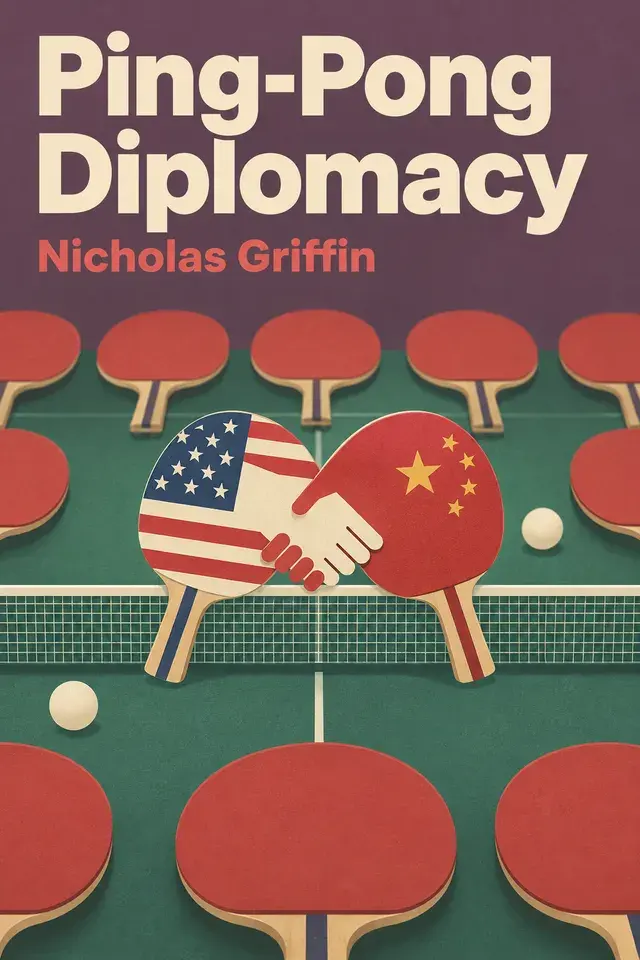
Ping-Pong Diplomacy, by Nicholas Griffin.
The prologue opens at the 1969 World Table Tennis Championships with rumors that the Chinese team had been tortured, shot, or hanged. It says the rumor was rooted in truth, but does not confirm every circulated detail. In April 1971, an American player wandered onto the Chinese team bus. A handshake and gifts led to an invitation, and within forty-eight hours an American delegation made up entirely of table-tennis players was in Beijing. The encounter seemed accidental to the Americans; the book describes it as the managed conclusion of years of Chinese preparation. It was a brief glimpse of what an international sport could make possible. The path to that political reach began decades earlier with Ivor Montagu.
At the turn of the twentieth century, table tennis was a fad played informally after dinner. It went by different names, had no settled rules, and invited disputes over how a game should be played. Its origins were already contested, and the pastime was said to have faded as quickly as it had spread. Montagu’s family was wealthy and titled, but he felt outside his brothers’ sporting world. Table tennis was a game he could play; before he was six, he asked for a table at home. Its modest equipment and informal setting helped make it accessible, but the sport had no lasting structure yet.
Montagu’s politics grew alongside that sense of class. A Fabian pamphlet led him to embrace socialism and pacifism, although he had earlier been fascinated by war and military strategy. During a clash between police and unemployed veterans, he struck a policeman with his cane. He believed his class position would protect him from the consequences. He supported Labour among his father’s tenants and hid Lenin’s State and Revolution beside the ping-pong table. His father eventually ordered him to leave the British Socialist Party and stop using family money for memberships. Privilege gave Montagu money and access, while also leaving his father with leverage over his choices.
At Cambridge, Montagu wanted the fellowship that team sport seemed to offer. After failing at soccer and tennis, he used his allowance to commission two table-tennis tables. A tournament drew 140 players, including a wheelchair user who beat Cambridge’s leading runner. Montagu also played in a Cambridge side that beat Oxford 31–5; all five of Cambridge’s losses were his. The range of players showed him that the game could attract people excluded from more prestigious sports. What began as a personal route into sport was becoming a way to organize others.
A Manchester businessman who was also interested in reviving the game had heard of Montagu’s efforts and approached him, seeking Oxbridge support to draw up rules. Before he was eighteen, Montagu became chairman of the national association. The basic rules he wrote lasted for decades and spread into many languages. When the name Ping-Pong proved to be a trademark, he dissolved the association and immediately formed the Table Tennis Association. Montagu treated the dispute as more than a naming problem. He valued the game because, in his view, it suited lower-paid people and offered little profit or advertising income, leaving little to attract the press. He also believed its small scale made it manageable and could connect Communist countries with the West.
Rules were only one part of making the sport durable. Montagu promoted a national championship through the Daily Mirror, which drew 30,000 entrants, while W. J. Pope organized local clubs. In 1926 they staged a European championship. The crowded venue included Hungarians, Slovaks, French, Germans, and a group of eight Indian students. Montagu quickly recast the event as a world championship. Thousands paid to watch, while newspapers ridiculed the game and mocked its players’ training. Montagu and fellow enthusiasts founded the International Table Tennis Federation at his family home, and he became its president for more than forty years. His grandfather’s bequest paid for tiered seating built inside Memorial Hall; his mother paid for the championship cup. The rules made the sport repeatable; clubs and competitions gave players places to gather, and the federation gave those encounters an international form.
The 1929 Budapest championship showed how far the game could reach beyond its modest image. Three thousand people crowded into the hall, while students gathered outside to support Hungary’s local favorite, Szabados. Montagu smuggled English player Fred Perry in through a coal chute. Perry won, and the crowd cheered for more than ten minutes. Ministers attended, making clear that the event mattered to political elites as well as players. Montagu objected when Hungarian ruler Horthy planned to attend the final, arguing that leaders should not use sport to court popularity. But his position depended on the leader: he accepted some officials and constitutional monarchs while rejecting dictators and controversial political figures. Sport had become a public stage, and Montagu’s own politics shaped who he thought belonged on it.
His cultural work extended beyond sport. Montagu believed culture should serve the people, and he founded the Film Society after visiting Berlin. Free screenings of donated films brought high art and Communist propaganda to British audiences. He arranged a Soviet visit after inviting a trade-union delegation to Cambridge. The official assignment was to collect a Caucasian vole; he also hoped to bring back Soviet films. The zoological expedition failed, and poverty in the Caucasus complicated the revolutionary spectacle that had first impressed him. He remained committed to the cause. On another Moscow trip, more directly tied to the Comintern, he played leading Russian players and gained privileged access to Stalin and Molotov at official events. Moscow also wanted his Film Society to serve as a channel for Soviet productions in London.
Montagu built a professional film career alongside this political work. He worked with Hitchcock, including on story and plot, and later collaborated with Soviet filmmaker Sergei Eisenstein on left-wing scripts in America. Their brief work with Paramount ended amid hostility toward Eisenstein and the project. Film, like table tennis, offered a cultural route into public life. Both could carry ideas across borders, though neither could control how audiences or political leaders would use them.
Montagu’s meeting with Trotsky exposed a personal contradiction without resolving it. He visited Trotsky in Turkey while serving Stalin’s Kremlin, and Trotsky feared assassination by Stalin. Montagu privately admired Trotsky’s frankness and charm. Yet the encounter did not change his allegiance. He later joined the British Communist Party and accepted the Stalinist claim that true Communism was whatever Moscow declared. His admiration for Trotsky faded as his commitment to the Party endured.
In Spain, opposition to fascism connected Communists with wider British public feeling. Montagu produced pro-Soviet documentaries during the Spanish Civil War, including footage meant to show German support for Franco. The films were crude compared with his Hitchcock work, but raw combat footage gave them urgency; a shell nearly injured him while he filmed. The conflict also tested the ideals he served. Spain, fearing defeat, deferred to Stalin; the Soviet Union took Spanish gold and supplied poor arms at inflated prices. When Stalin later signed a non-aggression pact with Hitler, Montagu defended it as a way to avoid a two-front war. His film work and sporting institutions show the same method: build cultural channels that can travel widely, then use them in service of a political commitment.
Chapter 2 of 8 · 7 min · Audio & textIn the app
Espionage Behind the Sporting World
During the war, table tennis belonged to a world where visible pastimes and hidden loyalties ran side by side. Ivor Montagu’s correspondence about the game attracted close attention from British counterintelligence.
Chapter 3 of 8 · 12 min · Audio & textIn the app
Mass Play, National Power
By mid-century, table tennis had acquired two kinds of political value. Its modest equipment and accessibility made it a game for ordinary communities; international contests could turn sporting skill into a public sign of national reach and capability.
Chapter 4 of 8 · 15 min · Audio & textIn the app
Agriculture, Famine, and the Sporting Showcase
By 1961, China had turned table tennis into a national project. The 1959 world title won by Rong Guotuan had shown that Chinese players could defeat the established powers.
Chapter 5 of 8 · 9 min · Audio & textIn the app
When Champions Become Targets
When the Cultural Revolution reached the national table tennis team, its players had reasons to think they might be protected. They belonged to an elite program, and political examination had supposedly been made before they entered it.
Chapter 6 of 8 · 13 min · Audio & textIn the app
Staging the First Opening
The 1969 clashes along the Chinese-Soviet border made the split between the two communist powers impossible to ignore. Beijing feared a Soviet attack; Washington saw that Moscow and Beijing now feared each other more than they feared the United States.
Chapter 7 of 8 · 12 min · Audio & textIn the app
From Public Welcome to Statecraft
The American team’s 1971 visit made a political message out of an exhibition match. At the first stadium event, about eighteen thousand people watched, most reportedly members of the People’s Liberation Army.
Chapter 8 of 8 · 10 min · Audio & textIn the app
The Uneven Costs of Diplomacy
The diplomatic opening made table tennis a public bridge between countries. Its aftermath, however, was measured in individual lives, and those lives followed sharply different paths.
Chapter 1 of 8 · 9 min · Audio & text: Making a Game Political
Wiseley supports reading and listening to summaries in the app.
Continue in WiseleyAbout Nicholas Griffin

Nicholas Griffin is the author of “Ping-Pong Diplomacy”. The book explores how table tennis became a route to diplomatic contact between China and the United States.
Explore more books by Nicholas Griffin