What you'll learn
Key ideas from Phaedo
These ideas compress the book's argument without treating the author's view as settled fact. Use them as an orientation before reading the full work or listening in Wiseley.
Socrates defines death as separation of soul and body, and presents philosophy as practicing that separation by loosening bodily distractions.
Recollection describes learning as recovery of knowledge awakened by sensation, association, and questioning.
Socrates explains misology as blaming reasoning for failed judgments and treats objections as reasons to test arguments more carefully.
Disappointment with Anaxagoras leads Socrates from direct natural inquiry toward hypotheses, Forms, and consequences tested for consistency.
The soul brings life, so it cannot admit death; Socrates calls this deathlessness immortality.
The afterlife story makes education and character enduring possessions of the soul, rather than temporary features erased by death.
The dialogue leaves listeners with care for character and careful reasoning, while keeping hope distinct from knowledge.
Inside Phaedo
Read the first chapter in full here. The other 8 continue in the Wiseley app.
Chapter 1 of 9 · 8 min · Audio & text
Why Philosophy Prepares for Death
Phaedo, by Plato.
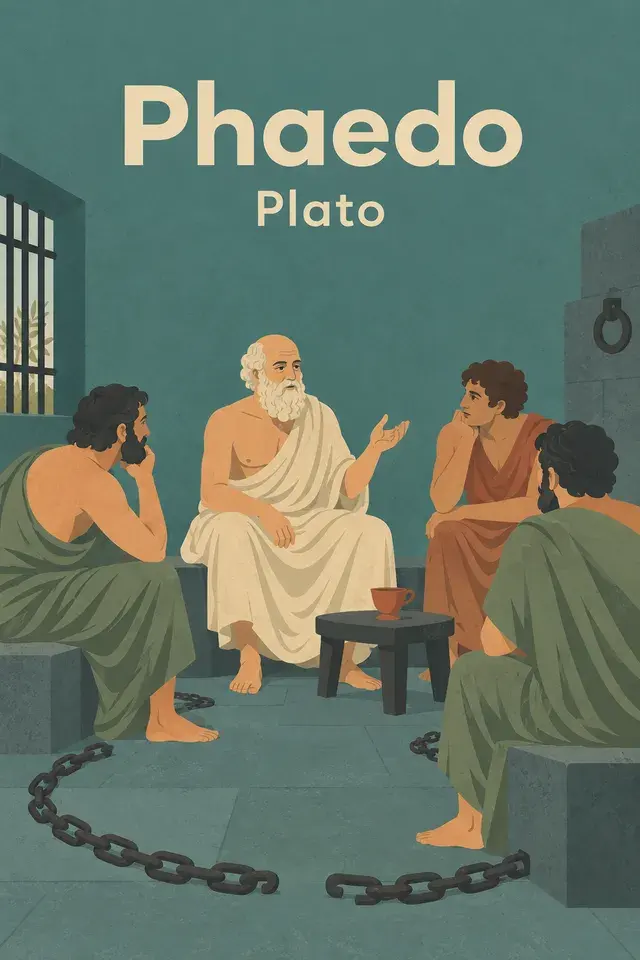
Phaedo opens with Echecrates asking what happened during Socrates’ final hours. Phaedo answers because he was present when Socrates drank the poison, and the report places us in the Athenian prison where the conversation occurred. We enter the dialogue through a witness recalling a conversation, not through an abstract definition. The final day is a lived scene: friends gather, Socrates has been condemned, and everyone knows the sentence will be carried out.
Yet the sentence has been delayed. An annual Athenian ship has sailed to Delos, a voyage associated with Theseus and Apollo. While it is away, the city observes a sacred period during which executions cannot occur. That delay explains why Socrates remains in prison after sentencing and why his friends can spend one last morning with him. When the friends arrive, the jailer tells them that the Eleven are with Socrates, taking off his chains and giving orders that he die that day. He then lets them in, and they find Socrates released. The expected death is therefore close, but the conversation still has room to ask what it means.
The first philosophical clue comes from Socrates’ body. Once the chains are removed, the pain in his legs gives way to pleasure. He treats this succession as a curious relation between opposites. The moment does not yet prove anything about the soul. It simply makes bodily experience impossible to ignore: pain is felt as bad, relief as pleasant, and the mind can notice how one follows the other.
From this immediate experience, Socrates turns to his working definition of death. For him, death is the separation of soul and body. True philosophers have spent their lives practicing this separation in a limited sense. They loosen the soul’s dependence on bodily pleasures and sensations and turn their attention toward the soul’s own activity. This does not mean seeking physical destruction. It means training oneself not to let bodily appetite, discomfort, or fear govern every judgment. Socrates presents this as a philosophical account, not as an established fact about what body and soul really are.
Why should the body be treated as an obstacle? Socrates calls it an unreliable partner in inquiry. Even sight and hearing can mislead, while hunger, illness, desire, fear, fantasy, and material concerns pull attention away from reflection. Bodily interests can generate conflict, money-seeking, and the loss of time needed for philosophy. When the mind is disturbed by sound, sight, pain, pleasure, or desire, it cannot consider things with full steadiness. The clearest thinking, in Socrates’ picture, occurs when the soul gathers itself and considers each thing in itself.
He applies this claim to realities such as justice, beauty, goodness, greatness, health, and strength. These are not grasped, he says, through bodily organs alone. If pure knowledge cannot be attained while the soul is joined to the body, then either knowledge is impossible or it becomes possible after death, when the soul exists apart from the body. Socrates chooses the second possibility as a hope built into his philosophical outlook. The reasoning gives death a positive meaning: it could release the soul from interference and allow a clearer pursuit of truth. It does not by itself establish that such release occurs.
That willingness to die must not be confused with taking one’s own life. Socrates says a philosopher may welcome death while still regarding self-killing as unlawful. He explains this through the image of human beings as possessions or charges of the gods. Just as an animal should not leave its owner without permission, a person should not abandon life before receiving a divine summons. The point is not that life is always pleasant. It is that human beings do not possess complete authority over the time of their departure, according to Socrates’ account of divine guardianship.
Cebes notices a tension. If the gods are the best guardians and rulers, why would a wise person eagerly leave their service? Socrates answers that his willingness rests on confidence that he will go to wise and good gods, together with a more tentative hope that he will join departed men better than those he leaves behind. He also hopes that something remains for the dead, with a better outcome for the good than for the evil. His certainty about divine goodness is stronger than his certainty about the condition of the departed. Thus accepting death is an act of trust and hope within a divine order, not a license for self-authorized escape.
This distinction also clarifies what philosophical virtue means. Ordinary courage may face death because it fears an even worse evil. Ordinary temperance may give up one pleasure only to obtain another. Such conduct can look disciplined, but its motivating currency is still fear or desire. Socrates calls these shadow virtues. Wisdom is the true standard that makes courage, temperance, and justice genuine. A wise person does not merely exchange one impulse for another; understanding determines what deserves fear, what deserves restraint, and what is worth pursuing.
Socrates calls the resulting discipline purification. The soul gathers into itself, withdraws as far as possible from bodily communion, and dwells in its own proper activity. Purification is therefore a practice of attention and judgment. Attention notices when sensation is dominating thought. Judgment refuses to treat every pleasure as good, every pain as evil, or every fear as a command. Present life can only approximate this condition, since the soul remains embodied, but philosophy trains it to remain as pure as possible until God releases it. Socrates also uses the language of the religious mysteries as a metaphor: the unpurified suffer, while the purified and genuinely philosophical are prepared for fellowship with the gods. This imagery expresses the ethical stakes of purification; it is not proof of the afterlife.
Phaedo describes Socrates as calm and gracious, while his friends respond with a mixture of philosophical pleasure, grief, laughter, and tears. That composure gives the discussion its dramatic force, but it does not settle the question being discussed. Socrates has explained why a philosopher might accept death and how philosophy might prepare the soul for it. Cebes now presses the unresolved issue: people fear that the soul may disperse like smoke or air as soon as it leaves the body. He therefore demands substantial argument and proof that the soul of the dead continues to exist with force and intelligence.
Chapter 2 of 9 · 6 min · Audio & textIn the app
Can Life Return from Death
Socrates’ first survival argument begins with a general picture of change. Things do not simply appear from nowhere, he says.
Chapter 3 of 9 · 7 min · Audio & textIn the app
What Equality Reveals About Knowledge
After the earlier argument about life and death moving in a cycle, Socrates turns to a question about knowledge. What does it mean to learn something if the mind can recognize more than the senses seem to provide?
Chapter 4 of 9 · 8 min · Audio & textIn the app
Affinity, Attachment, and the Soul
With the question of the soul’s future still open, Socrates changes the kind of comparison he is making. He is no longer asking only whether the soul existed before the body.
Chapter 5 of 9 · 10 min · Audio & textIn the app
Objections That Strengthen the Inquiry
By now, the discussion has won a limited but important result. Recollection appears to support the soul’s existence before embodiment.
Chapter 6 of 9 · 10 min · Audio & textIn the app
What Counts as an Explanation
Cebes’s challenge now becomes a question about explanation itself. It is not enough to say that the soul has existed before, or that it may outlast one body.
Chapter 7 of 9 · 7 min · Audio & textIn the app
Does Bringing Life Exclude Destruction
The final proof takes up Cebes’s most stubborn objection. Earlier arguments may show that the soul existed before the body or can outlast it, yet Cebes still asks whether a soul might eventually wear out.
Chapter 8 of 9 · 8 min · Audio & textIn the app
The Ethical Work of Myth
Once the dialogue has reached its conclusion about the soul’s immortality, the question becomes practical. What would survival mean for how a person lives now?
Chapter 9 of 9 · 8 min · Audio & textIn the app
Socrates Dies, the Questions Remain
The conversation reaches its decisive moment when the last objections have fallen silent. Cebes has no further challenge.
Chapter 1 of 9 · 8 min · Audio & text: Why Philosophy Prepares for Death
Wiseley supports reading and listening to summaries in the app.
Continue in WiseleyAbout Plato
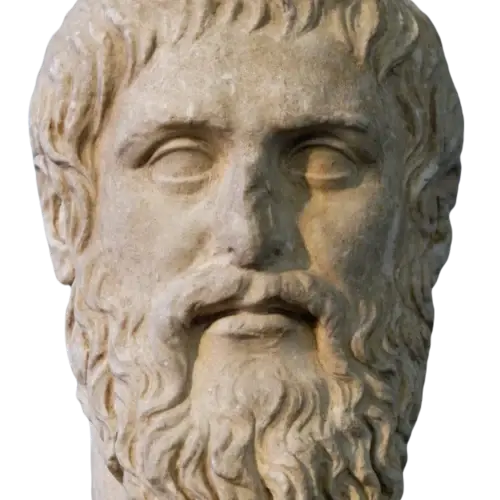
Plato was an ancient Greek philosopher. “The Republic” explores justice, education, and the organization of a good society through philosophical dialogue.
Explore more books by Plato