What you'll learn
Key ideas from Peak
These ideas compress the book's argument without treating the author's view as settled fact. Use them as an orientation before reading the full work or listening in Wiseley.
Purposeful practice uses specific subgoals, focused attention, feedback, and challenges that stretch current ability.
Mental representations organize familiar details into meaningful patterns that support memory, anticipation, and action.
Practice requirements vary by field; ten thousand hours is no universal threshold, and repetition alone is not deliberate practice.
Top Gun made aerial tactics repeatable through simulated encounters, recorded evidence, detailed review, and practice after feedback.
Achievement, belonging, and identity can help motivation shift from outside encouragement toward self-direction.
Selection systems can turn age, prior experience, and talent labels into unequal coaching and practice, making early judgments seem accurate.
Instruction should define success by what students can do and build each skill in ordered, manageable steps.
Inside Peak
Read the first chapter in full here. The other 11 continue in the Wiseley app.
Chapter 1 of 12 · 6 min · Audio & text
The Gift Is Trainable
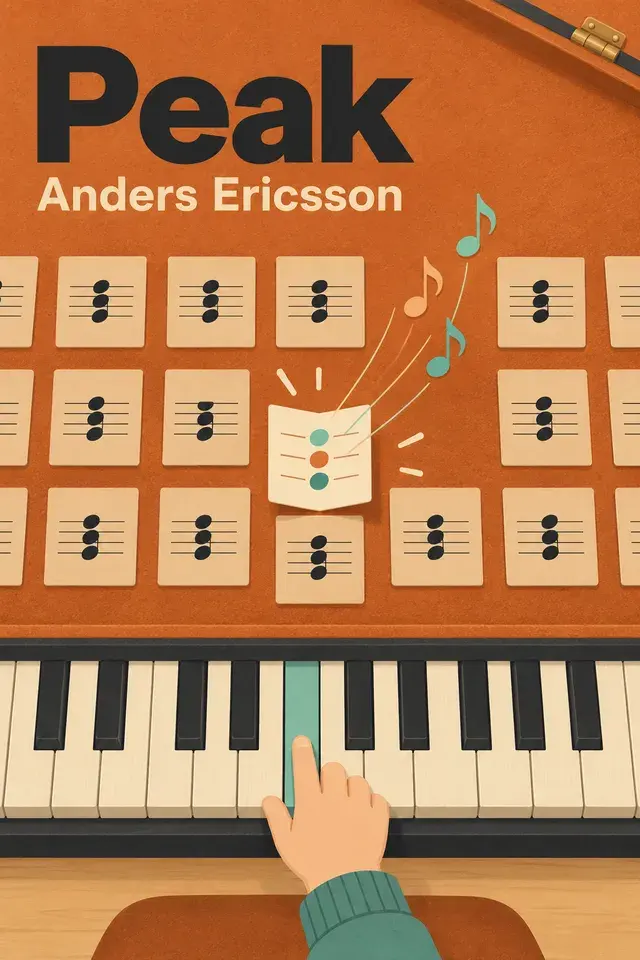
Peak, by Anders Ericsson.
Exceptional ability is often treated as evidence of an inborn gift. When someone performs at a level most people cannot reach, it is tempting to think they were born with a special capacity that practice can polish but never create. Ericsson begins by asking whether that explanation is right. After studying exceptional performers, he proposes that their shared gift is the human capacity to develop skill through training. The claim is not that everyone starts in the same place or can achieve anything. It is that abilities that seem mysterious may be built, rather than simply revealed.
Perfect pitch offers a clear test of this idea. It is the ability to identify a musical note by its exact pitch, and it has often been treated as a rare, innate talent. The book describes it as exceptionally uncommon, appearing in roughly one person in ten thousand. That rarity makes a training result especially striking: if an ability can be taught, it is harder to argue that only a lucky few are born with it.
In Sakakibara’s study, twenty-four young children took part in repeated short training sessions. They learned to identify fourteen chords. Afterward, all of them could identify individual notes as well. The result suggests that these children had developed perfect pitch through exposure and training. It challenges the idea that the skill must be present at birth, waiting only to be uncovered. Instead, training appears to have produced an ability the children had not previously demonstrated.
The authors treat the study as evidence that perfect pitch is not reserved for a tiny group of people with a special musical inheritance. The result supports the broader possibility that suitable experience can develop skills that look innate. It does not, by itself, explain exactly how the brain makes that possible. The precise circuits involved in perfect pitch remain unidentified. The opening argument rests on the change in what the children could do, while a fuller account of brain and body adaptation comes later.
This way of looking at ability also changes how we picture potential. In a fixed-capacity view, each person is born with a limited amount of ability, and learning merely fills that preset allowance. Ericsson and his coauthor suggest a different model: learning can expand what a person is capable of doing. Under this view, talent is not just a stock of ability revealed by the right opportunity. It can also be the result of development. The question shifts from “How much talent did this person receive?” to “What could training help this person become able to do?”
Ray Allen’s shooting offers a sports example. Allen became known for a jump shot that looked effortless, and observers described it as God-given. Allen rejected the idea that he was born with his shooting touch, insisting that people not undermine the work he put in every day. MacMullan reported that Allen’s high-school coach said his jump shot was poor. Over time, with hard work and dedication, Allen transformed it into one so graceful and natural that people assumed he was born with it. His story changes the apparent explanation: what looked like a natural gift at the height of his career had been built over time. It is a reminder that polished performance can hide the work that made it possible.
The examples do not mean that every ability changes equally, or that training erases every biological limit. Perfect pitch appears especially tied to early development. The book says the adaptability needed for perfect pitch disappears by about age six. If the necessary rewiring has not occurred by then, the ability will not develop. The book notes exceptions of a sort. That is a qualification about perfect pitch, not a rule that all learning must happen in childhood. Adults can still develop many abilities, even if children and adults do not always learn in the same way.
Physical traits matter in some fields, too. Height can be a genuine advantage in activities where body size affects performance, and inherited characteristics may influence how readily a person can sustain demanding practice. Recognizing those constraints makes the argument more precise. Training can shape a great deal, but it does not make every starting condition irrelevant or guarantee that every person will reach the same result.
Nor does wanting improvement, or working hard in the abstract, guarantee progress. Allen’s account credits daily effort, but the book’s larger claim is that improvement depends on the right kind of practice over enough time. The opening does not yet spell out the structure of that practice. It establishes why the structure matters: effort by itself cannot explain why some training changes performance and some does not.
The central question, then, is not whether people have limits or whether biology matters. It is how much of what looks like fixed talent can be developed, and under what conditions. Sakakibara’s children and Allen’s shooting make a case for taking training seriously as a source of ability. They invite us to look at exceptional skill and ask what exposure and effort may have built it, before concluding that it must have been present from the beginning.
Chapter 2 of 12 · 6 min · Audio & textIn the app
Improvement Beyond Routine
Many skills begin with a broad goal, instruction, and repetition. With enough practice, the basic performance can become automatic.
Chapter 3 of 12 · 8 min · Audio & textIn the app
Challenge Rewires Capacity
The body tends to keep its internal conditions stable. This tendency, called homeostasis, helps maintain temperature, blood pressure, glucose, and other conditions within a working range.
Chapter 4 of 12 · 7 min · Audio & textIn the app
Mental Representations Make Expertise
Expertise often looks like fast thinking, an unusually good memory, or an instinctive feel for what to do. Ericsson’s explanation is that practice builds mental representations: organized patterns of knowledge that help a person interpret a situation and respond.
Chapter 5 of 12 · 8 min · Audio & textIn the app
What Deliberate Practice Requires
Practice can mean many things, from repeating a familiar task to working carefully on a weakness. The stricter term deliberate practice describes a particular kind of training.
Chapter 6 of 12 · 7 min · Audio & textIn the app
Practice Inside Professional Work
High-stakes work can be hard to learn from as it happens. Results may be delayed or rare, tasks may not repeat in the same way, and mistakes can harm people.
Chapter 7 of 12 · 7 min · Audio & textIn the app
Build Your Own Practice Loop
A goal becomes practice when you stop treating the whole activity as one thing to repeat. Instead, choose a part you can work on, pay close attention to how you do it, and use the result to decide what to change.
Chapter 8 of 12 · 8 min · Audio & textIn the app
Diagnose Plateaus, Sustain Effort
Improvement rarely moves in a straight line. A learner may make quick gains, then reach a stretch where practice produces no visible progress.
Chapter 9 of 12 · 7 min · Audio & textIn the app
From Curiosity to Commitment
Exceptional expertise can begin with a child treating an activity as a toy. At first, chess may attract a child for the shapes of the pieces or the pleasure of moving them.
Chapter 10 of 12 · 8 min · Audio & textIn the app
Adults, Age, and Breakthroughs
Starting early can give a learner real advantages, but age does not close every door. The brain and body are especially adaptable in childhood and adolescence.
Chapter 11 of 12 · 11 min · Audio & textIn the app
What Talent Explains
Stories of extraordinary talent can seem to challenge the idea that skill develops through practice. But a striking performance tells us little by itself about how someone learned it.
Chapter 12 of 12 · 7 min · Audio & textIn the app
Teaching People to Keep Learning
Ericsson closes with a question about what schools should help students become able to do. Education often treats learning as acquiring facts and procedures.
Chapter 1 of 12 · 6 min · Audio & text: The Gift Is Trainable
Wiseley supports reading and listening to summaries in the app.
Continue in WiseleyWhat Peak is about
Peak asks how people develop abilities that seem like natural gifts. Anders Ericsson argues that focused, feedback-rich practice can expand performance by changing capacity and building domain-specific mental representations. The book applies this account to work, learning, and personal goals, while examining how age, biology, coaching, motivation, and social expectations shape results.