What you'll learn
Key ideas from Passive Income, Aggressive Retirement
These ideas compress the book's argument without treating the author's view as settled fact. Use them as an orientation before reading the full work or listening in Wiseley.
Retirement is financial independence: passive income exceeds expenses, leaving work a choice.
Self-publishing offers more creative control and a larger share, while the author carries production costs, sales risk, and promotion.
Music royalties can recur, but ownership of the composition and recording, along with contributor shares, affects who gets paid.
Hoyt’s course shows how intensive setup can support automated sales later, while its creators keep working to grow the business.
Portfolio income needs little ongoing work, but the amount it produces depends on substantial invested capital and carries investment risk.
Coin-operated businesses earn through repeated pay-per-use transactions, while location terms and machine upkeep shape the operator’s share.
Affiliate commissions follow purchases through links, while ad revenue may depend on views, clicks, or sales; audiences and traffic take time to build.
Direct rentals may combine cash flow with equity from mortgage paydown and possible appreciation, while requiring capital and oversight.
Inside Passive Income, Aggressive Retirement
Read the first chapter in full here. The other 13 continue in the Wiseley app.
Chapter 1 of 14 · 8 min · Audio & text
Why the Nest Egg Feels Fragile
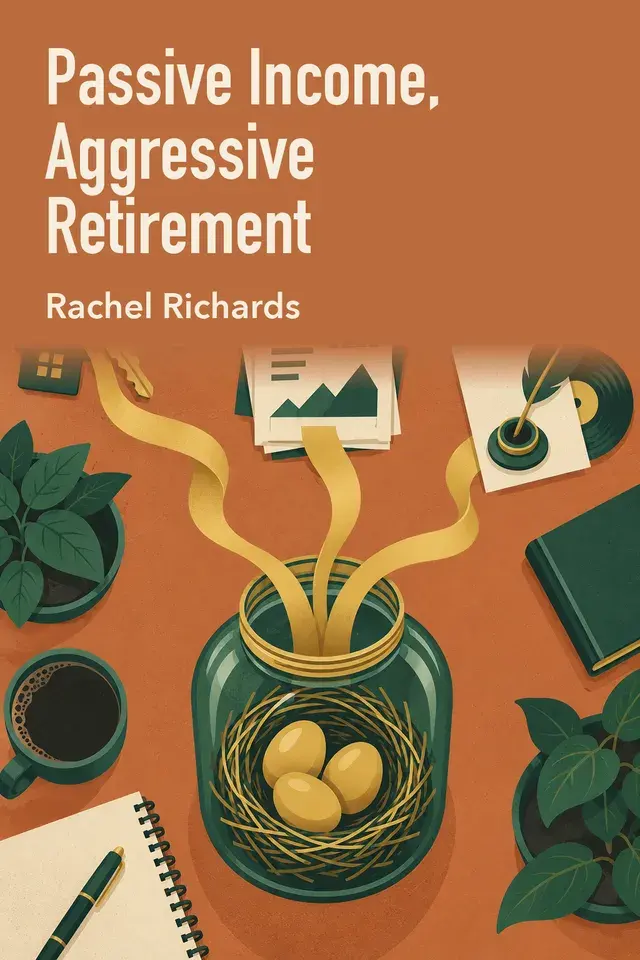
Passive Income, Aggressive Retirement, by Rachel Richards.
Richards begins by asking whether the familiar retirement plan still fits the conditions people face. That plan expects workers to save a large sum, then rely on it after leaving work. She argues that building such a nest egg has become harder as household costs and retirement needs have changed. The challenge is not only accumulating enough. The plan also depends on savings lasting through a long retirement and surviving setbacks along the way.
To make the changes concrete, Richards compares two fictional households. Her 1950s couple lives in a smaller home, has one car and one wage earner, and expects a pension, Social Security, and savings to support retirement. The contemporary couple has a larger home, two cars, two full-time workers, college costs and student loans, and inadequate retirement savings. Richards calls these scenarios simplified; they illustrate a shift in circumstances rather than describe every household.
Her housing figures help explain one part of the comparison. She reports that the average single-family home grew from 983 square feet in 1950 to 2,641 square feet in her contemporary account. Over the same period, average family size fell from 3.8 people to 2.5. By her calculation, space per person rose from 259 square feet to 1,056. She also points to costs associated with more cars, computers and cell phones, and childcare as more mothers of preschool-aged children work outside the home. Social media, she says, can add pressure to keep up with visible lifestyles and attractive homes. Higher expectations can leave less room in a budget for retirement saving.
Retirement itself may last longer, adding to the amount a savings-based plan must cover. Richards reports that life expectancy at retirement rose from 79 in 1950 to 83 in her contemporary account. She also cites average retirement age falling from 70 in 1940 to 62 in 2000, and the average retirement for men lengthening from eight years to nineteen. Under a plan that relies on accumulated savings, a longer retirement means those savings need to support more years.
Social Security is another uncertainty in the book’s account. Richards describes it as a pay-as-you-go system: taxes from current workers fund benefits for current retirees. She notes that the number of workers per beneficiary fell from 159.4 in 1940 to 2.8 in 2013. Citing the trustees’ 2019 report, she says reserves stood at $2.9 trillion at the end of 2018, with full depletion projected for 2035; program costs were also projected to exceed income in 2020. These were projections in that report, not certainties. Richards suggests that younger readers consider the possibility of receiving no benefits as a worst-case planning assumption.
Employer pensions have also become less common in her description. A defined-benefit pension pays a monthly amount in retirement, typically for life. Richards says employers increasingly moved toward 401(k) plans, which place more responsibility on employees to contribute and save. She adds that some workers may not have the means to contribute fully. That shift makes the nest egg more dependent on what individuals can set aside themselves.
College adds another demand on household finances. Richards reports that public four-year college tuition and fees in 1988–89 were $3,360 per year in 2018 dollars, or about $13,000 across four years. In 2018–19, those same four years cost more than $40,000. Student-loan payments can then reduce monthly cash available for years, making it harder to save or invest. Richards allows that some students avoid debt, often with family help or substantial scholarships. Her comparison describes a pressure many households face, not an inevitable outcome for every graduate.
The size of the savings target makes the problem more tangible. Richards uses $2 million as a modest estimate for what a millennial might need at age 65. Under her example’s assumptions, saving $621 each month from age 25 for 40 years at an annual return of 8 percent would reach that sum. But the calculation assumes steady saving and a particular return. She observes that $621 a month may be unaffordable for someone earning $40,000 while paying $400 a month toward student loans. Budgeting and diversified investing can help manage money, but Richards argues that cost-cutting alone is unlikely to produce such a sum for many people. Cutting expenses has limits, especially when further cuts make daily life unsustainable.
Even a person who saves consistently remains exposed to market conditions. An 8 percent return is an assumption, not a promise. A downturn near retirement could sharply reduce a balance and delay retirement for years. Richards also names divorce, disability, lawsuits, and medical problems as events that can drain savings. Following conventional advice cannot guarantee that a lifetime of savings will remain intact.
Extreme saving through Financial Independence, Retire Early, or FIRE, may suit some people. Richards says the approach can work for high earners without children who accept severe frugality. She considers that level of saving impractical for many, including a single parent earning $50,000. She describes her own early attempt: while earning $36,000, she saved half her salary, or $18,000 a year, yet concluded that this would not ensure traditional or early retirement. Her examples qualify the promise of extreme frugality without dismissing it as a possible path for everyone.
Richards illustrates another possibility with her own reported progress. She and her husband bought a duplex in 2017 that produced $500 a month in cash flow. She also describes adding other rental properties, a print-on-demand business, and book royalties. By the end of 2018, she reports more than $10,000 in monthly passive income, after two years of harder work than they had ever done. Richards explicitly says that if she and Andrew could go from $0 to $10,000 a month in passive income in under three years, readers can too. Her broader argument is that a savings-only plan asks people to build a difficult sum while depending on favorable returns, stable circumstances, and retirement support that may be less certain than before.
Chapter 2 of 14 · 5 min · Audio & textIn the app
Time, Work, and Freedom
Richards asks readers to question the assumption that a normal adult life must mean working a fixed schedule for decades and then stopping at a set age. The forty-hour week grew out of factory work, yet it is often treated as a measure of commitment across jobs with different demands.
Chapter 3 of 14 · 6 min · Audio & textIn the app
Choose and Test an Income Stream
Richards uses passive income in a practical sense: a person invests work or capital upfront to create income that can later require less effort. “Passive” describes the maintenance stage, not a work-free beginning.
Chapter 4 of 14 · 7 min · Audio & textIn the app
Making a Book Pay Over Time
A book can keep earning royalties after its first publication, but the work begins well before that. Richards describes income from book sales as dependent on the publisher agreement, while the writing and preparation require an investment of time.
Chapter 5 of 14 · 9 min · Audio & textIn the app
Creative Assets and Uneven Royalties
Creative work can keep earning after its creator has finished a particular piece, but the income works differently across music, photography, digital downloads, and printed products. Some assets can be sold or licensed repeatedly.
Chapter 6 of 14 · 7 min · Audio & textIn the app
Courses and Other Scalable Assets
An online course turns know-how into a product many learners can use without the creator teaching each person individually. That can separate revenue from an hour of instruction, but it shifts much of the work to preparation, production, and selling.
Chapter 7 of 14 · 5 min · Audio & textIn the app
Marketing Before and After Launch
An income-producing product needs a route to buyers. Richards argues that a strong product can go unnoticed without promotion, while a merely decent one may sell well when marketed effectively.
Chapter 8 of 14 · 7 min · Audio & textIn the app
Portfolio Income: Capital and Risk
Portfolio income begins with money already invested. Dividends, bond interest, and bank interest can arrive without the ongoing work of creating a product or operating a business.
Chapter 9 of 14 · 8 min · Audio & textIn the app
Making Coin-Operated Businesses Work
A coin-operated business earns when customers pay to use equipment or buy something from it. The name no longer means that a machine must accept coins; payment can also be electronic.
Chapter 10 of 14 · 6 min · Audio & textIn the app
Online Audiences and E-Commerce
Online income can move work away from storing products or fulfilling every order, but it cannot remove the need to reach buyers. Affiliate links earn a commission when someone purchases through the link, while advertisements may pay based on views, clicks, or sales; dropshipping earns from product sales while a supplier handles fulfillment.
Chapter 11 of 14 · 9 min · Audio & textIn the app
Entering Rental Property
A rental can earn income in two ways at once: rent may leave cash after expenses, and payments on the mortgage can gradually reduce the debt. If the property’s value also rises, that may add equity.
Chapter 12 of 14 · 9 min · Audio & textIn the app
Finding and Evaluating Rental Deals
Once you have a way to finance a rental, the next question is whether a particular property deserves your time and money. Richards treats the search as a sequence: define what fits, build a local team, look for properties, estimate the numbers before visiting, and make an offer only if the deal fits your goals.
Chapter 13 of 14 · 6 min · Audio & textIn the app
Managing Rentals into Durable Income
Buying a rental begins a stream of work that affects whether its income lasts. Tenants need to pay, the property needs attention, and someone must respond when problems arise.
Chapter 14 of 14 · 6 min · Audio & textIn the app
Designing Your First Move
Financial independence begins with a number, but that number belongs to you. Richards defines the goal as having passive income exceed monthly living expenses.
Chapter 1 of 14 · 8 min · Audio & text: Why the Nest Egg Feels Fragile
Wiseley supports reading and listening to summaries in the app.
Continue in WiseleyAbout Rachel Richards

Rachel Richards is the author of “Passive Income, Aggressive Retirement”. The book explores how income streams such as royalties, investments, and rentals can loosen the link between work and money.
Explore more books by Rachel Richards